
Here is something the trading industry does not want to admit: the strategy was almost never the problem.
Go back and look at your worst trading months. Most of the losses did not come from using the wrong indicator or missing a signal. They came from overtrading when nothing was setting up. They came from holding a losing position because you were certain it would turn around. They came from abandoning a strategy after three losing trades — right before it would have delivered its best run of the year.
This is the real conversation about trading strategies. Not which one has the highest win rate in a backtest. Not which one “the pros” use. The real question is: which strategy can you actually execute, consistently, under pressure, over hundreds of trades — and still be in the game two years from now?
This guide answers that question. It covers how trading strategies work at a fundamental level, the most proven approaches active, and — most importantly — a framework to match the right strategy to your specific situation. By the end, you will have everything you need to build a complete trading plan and start validating your edge before risking a single dollar of real capital.
Why Do Most Traders Fail Even With a “Good” Strategy?
When researchers and trading psychologists examine what separates profitable traders from losing ones, the answer is rarely the strategy itself. It is almost always the relationship between the trader and the strategy.
Most traders don’t fail because they use the wrong strategy. They fail because they use a strategy that doesn’t fit how they live, think, or manage risk.
This distinction matters enormously. A trend-following strategy with a 45% win rate and a 1:2.5 risk/reward ratio is mathematically profitable over 300 trades. But if a trader abandons it after 10 consecutive losses — which can and does happen even with positive expected value, they never capture the profit. The math works. The human execution does not.
This is where trading psychology plays a critical role in long-term consistency.
The second structural reason traders fail: they treat a strategy as a magic formula rather than as a probabilistic system. A trading strategy does not tell you what will happen. It describes what tends to happen, under specific conditions, often enough to generate a statistical edge. The moment a trader expects a strategy to be “right” on every trade, they have misunderstood what they are working with.
Understanding this reframes everything. Your job is not to find the perfect strategy. Your job is to find a strategy you can execute with mechanical consistency and then do so long enough for the probabilities to play out.
Is strategy hopping the real reason traders stay unprofitable?
Many traders never commit to one approach long enough to let it work. The tendency to jump from strategy to strategy — especially after a losing streak — is one of the primary reasons retail traders stay unprofitable.
Strategy hopping is psychologically seductive because it feels like problem-solving. You lose with one approach, so you switch to a “better” one. But what you are actually doing is constantly resetting your learning curve, never accumulating enough trade data to know whether your strategy has a real edge, and ensuring you always sell at the bottom of each strategy’s performance cycle.
The antidote is data. Commit to any reasonable, rule-based strategy for a minimum of 100 trades in similar market conditions before drawing conclusions. Track every trade. Look at expectancy (average profit per trade), not just win rate. A 100-trade sample is the beginning of a meaningful dataset — anything less is noise.
What does the research actually say about retail trader failure rates?
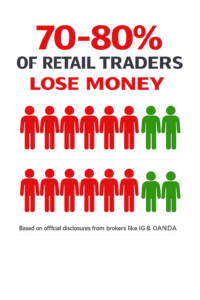
The data from regulated brokers in Europe (required by ESMA to disclose retail trader loss rates under MiFID II) consistently shows 70–80% of CFD accounts lose money. A 2021 study by the Journal of Finance found that day traders who persisted for over two years had a median daily loss that slightly exceeded their gains — but the top decile of persistent traders generated significant positive returns. The differentiator was not IQ or strategy sophistication. It was consistency of execution and position sizing discipline.
The implication: trading skill is real and learnable. The distribution of outcomes is not random. But it requires a longer timeline and more structured approach than most traders give it.
What Is a Trading Strategy and What Makes One Valid?
A trading strategy is a structured, rule-based system that defines: when to enter a trade, when to exit (both for profit and loss), how much capital to risk, and under what market conditions the system is designed to operate. Every word in that definition matters.
If you’re new, this builds on the core concepts covered in trading for beginners.
“Rule-based” is not optional. A strategy that relies on gut feel or discretionary judgment about whether “it looks like a good setup” is not a strategy. It is improvisation. Improvisation does not produce consistent results.
“Under what market conditions” is the most overlooked component. Every trading strategy has conditions under which it performs well and conditions under which it fails. Trend-following strategies underperform in choppy, sideways markets. Mean reversion strategies get destroyed in strong trending environments. Knowing this is not a weakness — it is the most important piece of self-awareness a trader can develop.
Understanding market condition is what determines whether a strategy works or fails.
What are the five non-negotiable components of any real trading strategy?
Every viable trading strategy must specify all five of the following:
- Entry Trigger: The precise condition that must be met to initiate a trade. Example: “Price closes above the 20-period EMA on the daily chart after a pullback to the 50 EMA, with RSI crossing above 50.”
- Exit Rule (Take Profit): Where you close the trade for a win. This must be defined before entry, not adjusted while in the trade.
- Stop Loss Rule: Where you close the trade for a loss. Non-negotiable. Moving a stop loss to avoid being stopped out is one of the most account-destroying habits in trading.
- Position Sizing Rule: How much capital you risk on each trade. Standard practice for retail traders: risk 1–2% of total account equity per trade.
- Market Condition Filter: The type of market environment the strategy is designed for. Trending? Ranging? High volatility? Low volatility? Define this explicitly.
Without all five, you do not have a strategy. You have a hope.
How do you tell if a strategy has a genuine edge or is just noise?
An edge exists when your strategy produces a positive mathematical expectancy over a large sample of trades. Expectancy is calculated as:
Expectancy = (Win Rate × Average Win) − (Loss Rate × Average Loss)
Example: A strategy with a 45% win rate, average winner of $200, and average loss of $100 has an expectancy of: (0.45 × $200) − (0.55 × $100) = $90 − $55 = +$35 per trade. That is a real edge.
The trap is testing this on too few trades. Fifty trades can lie. Two hundred trades begin to tell the truth. Test across different market conditions — bull markets, bear markets, consolidation phases — before concluding anything.
What Are the Core Types of Trading Strategies in 2026?
The trading landscape in 2026 is more algorithmically dominated than ever. High-frequency trading accounts for the majority of volume on major exchanges. This has consequences for which human-executable strategies remain viable — and which ones have been arbitraged away. Below are the strategies that continue to produce edges for disciplined retail traders.
How does trend following work and who is it actually for?
Trend following is one of the most reliable trading strategies in 2026 because it removes the need to predict price movements and instead reacts to where price is already moving. The core logic: identify an established trend, wait for a pullback or consolidation within that trend, enter in the direction of the trend, and ride the move until evidence of trend exhaustion appears.
Tools like VWAP can help identify fair value and improve entry timing within trends.
How it works in practice:
- Use the 50 and 200 period moving averages to define trend direction.
- Wait for price to pull back to the 50 EMA in an uptrend (or rally to it in a downtrend).
- Enter when price shows a reversal signal from that level (candlestick confirmation, RSI turning, volume increase).
- Set stop loss below the most recent swing low (uptrend) or above the most recent swing high (downtrend).
- Trail stop as trade moves in your favour.
In 2026, trend following works especially well on higher timeframes where algorithmic noise matters less. It is slower, calmer, and easier to manage emotionally.
Best for: Traders who can check charts once or twice per day. People with patience. Those who prefer fewer, higher-quality trades. Works across stocks, forex, and commodities.
Not for: Traders who need immediate results, those who cannot tolerate drawdown periods, or those trading highly correlated short-term intraday moves.
What is swing trading and how does it fit a busy lifestyle?
Swing trading sits comfortably between day trading and long-term investing. Instead of watching price every minute, swing traders look for setups that can play out over days or weeks, making it ideal for people with jobs, school, or businesses.
A swing trader’s core workflow: scan for setups in the evening after markets close, place orders (often limit orders at key levels) before the market opens, and check in once or twice during the trading day. No need for live monitoring. No need to stare at tick-by-tick charts.
The most reliable swing trading setups involve:
- Fibonacci retracements: Enter pullbacks to the 38.2%, 50%, or 61.8% retracement levels in established trends.
- RSI divergence: Price makes a new high or low, but RSI does not confirm — signals potential reversal.
- Candlestick patterns at key levels: Pin bars, engulfing candles, and inside bars at major support or resistance.
Swing trading is arguably the most sustainable strategy for retail traders because it operates on a timescale where human judgment can consistently compete with algorithms — a 4-hour or daily chart is not dominated by HFT the way a 1-minute chart is.
Is scalping still profitable in algorithm-dominated markets?
This is the controversial one. Scalping — taking many trades per session for very small profits per trade — was widely practiced before algorithmic market makers became dominant. Today, the reality is more nuanced.
Retail scalping on tight spreads in liquid markets (major forex pairs, large-cap indices) is harder than it was five years ago. Algorithms respond to order flow in microseconds. Human execution latency puts retail scalpers at a structural disadvantage in the most efficient markets.
However, scalping remains viable in specific conditions: less liquid instruments with wider bid-ask spreads where algorithms are less dominant, during high-impact news events when normal market microstructure breaks down, and for traders using direct market access with co-located execution. For the vast majority of retail traders — particularly beginners — scalping is the fastest way to lose money while feeling productive. The transaction costs alone erode edge before psychological pressure even enters the equation.
When does mean reversion work — and when does it destroy accounts?
Mean reversion is based on the statistical observation that prices tend to return to their average after extreme moves. A stock that has fallen 15% in three days might be “oversold” and likely to recover. An RSI reading below 30 signals potential buying exhaustion.
Mean reversion strategies perform well in range-bound, low-volatility markets where prices oscillate around a stable equilibrium. They catastrophically fail in strong trending markets where “oversold” becomes “more oversold” for weeks.
The lethal mistake: applying mean reversion logic during strong trends. Traders who bought “oversold” stocks during the 2022 bear market got destroyed on the first, second, third, and fourth reversal attempt. The setup looked exactly right every time. The context was wrong.
Key filter for mean reversion: Confirm you are in a ranging market (ADX below 25, price oscillating between defined support and resistance levels) before applying mean reversion logic. In trending markets, trade with the trend.
How does breakout trading capture explosive price moves?
Breakout trading involves entering a position when price convincingly moves beyond a defined area of consolidation — a resistance level, a previous high, or a trading range boundary. The logic: the energy that built up during consolidation is released when price breaks, producing a sharp directional move.
Markets spend a lot of time doing nothing — moving sideways, frustrating everyone — then break in seconds. Breakout traders position themselves to capture that burst.
The challenge is false breakouts — price briefly penetrates a level before reversing sharply. The solution is confirmation:
- Wait for a candle close beyond the level, not just an intrabar pierce.
- Require volume confirmation: genuine breakouts typically have above-average volume.
- Enter on the first retest of the broken level, which often provides a lower-risk entry than chasing the initial breakout.
Which Trading Strategy Should You Actually Choose?
This is the question most guides refuse to answer directly. They list ten strategies and say “it depends on your goals.” That is not helpful.
Here is a practical decision framework based on two dimensions that actually determine whether you will stick with a strategy long enough for it to work.
How does your available screen time determine your strategy?
| Daily Screen Time Available | Best Strategy Match |
|---|---|
| Less than 30 minutes | Swing Trading (set orders in evening, check once/day) |
| 30–90 minutes | Swing Trading or Trend Following (daily + 4H timeframes) |
| 2–4 hours | Day Trading on higher intraday timeframes (1H, 4H) |
| Full trading session (6+ hours) | Day Trading or active Scalping (with caveats) |
This matrix is not optional. Trading a scalping strategy when you only have 20 minutes per day is not discipline — it is self-sabotage. The strategy does not fit the container of your life, so it will fail regardless of how technically sound it is.
Why does your personality type matter more than win rate?
High win rates feel psychologically comfortable. A strategy that wins 70% of trades but loses 3x on the losses (negative expectancy) will still attract traders because winning feels good. Meanwhile, a trend-following strategy with a 40% win rate and a 1:3 risk/reward ratio is mathematically superior but requires tolerating 60% of trades being losers.
Ask yourself, with complete honesty: can you take 6 losses in a row and still execute your 7th trade without hesitation? If the answer is no, you need a higher win rate strategy — even if the mathematical expectancy is lower — because a strategy you will not execute has zero edge regardless of its backtest results.
Risk tolerance, patience, comfort with uncertainty, and capacity for routine all matter more to long-term trading success than which indicator combination you use.
How Do You Build a Complete Trading Plan Around Your Strategy?
Knowing a strategy is step one. A trading plan is the operational document that governs how you apply it every single day. Without a trading plan, your strategy is just an idea. With one, it becomes a repeatable business process.
A complete trading plan includes: your strategy rules (entry, exit, stop loss), your universe of instruments to trade, your daily routine (what time you analyse, what time you execute), your maximum daily loss limit (at which point you stop trading for the day), your weekly and monthly review schedule, and your criteria for updating or abandoning the strategy.
What entry and exit rules should every trading plan include?
Entry rules must be specific enough that a stranger could read them and take the same trades you would. “It looks like a good setup” is not an entry rule. “Price has pulled back to the 50 EMA on the 4-hour chart, RSI is between 40 and 50, and the previous candle is a bullish engulfing pattern with above-average volume” — that is an entry rule.
Exit rules are equally critical, and most traders get them wrong in a specific way: they plan their take profit but not their stop loss adjustment logic. Define: under what conditions (if any) do you trail your stop? Under what conditions do you exit early? What does price action need to show to convince you the trade is invalid?
Write all of this down. Print it. Keep it next to your screen. The plan exists specifically for the moments when you are in a losing trade and your emotion is screaming at you to improvise.
How do you size positions to survive losing streaks?
The 1–2% rule is the foundation: risk no more than 1–2% of total account equity on any single trade. This means a 10-trade losing streak — which will happen with any strategy, eventually — costs you 10–20% of your account. That is painful but survivable. You can recover from a 20% drawdown.
Risk 5% per trade with a 10-trade losing streak and you are down 40%. Risk 10% and you are down 65%. At those drawdown levels, the math of recovery becomes brutal — you need a 186% gain just to get back to even from 65% down.
Position sizing is not conservative or aggressive. It is the mechanism that keeps you in the game long enough for your edge to express itself.
How Do You Validate a Trading Strategy Before Risking Real Money?
One of the most common and costly mistakes in trading: finding a strategy online, funding a live account, and losing real money while learning the execution. The alternative — strategy validation — is unglamorous but financially protective.
What is backtesting and how many trades make a sample statistically valid?
Backtesting is the process of applying your strategy rules to historical price data to assess how it would have performed. Done correctly, it gives you your historical win rate, average win/loss ratio, maximum drawdown, and expectancy per trade.
The statistical validity threshold: 200+ trades in similar market conditions. Fewer than 100 trades is noise. One hundred to 200 is indicative but not conclusive. Over 200 trades across different market environments (trending and ranging, bull and bear) begins to represent a genuine edge assessment.
Beware of curve fitting — adjusting your strategy parameters until they work perfectly on historical data. A strategy optimized to work on 2019–2021 data will often fail in live trading because it has been tuned to the specific quirks of that period rather than to a generalizable market principle.
Backtesting tools: TradingView’s Strategy Tester (Pine Script required), TrendSpider (automated), or manual chart-by-chart review in your chosen platform.
Platforms like TradingView provide built-in tools to test and visualize strategies effectively.
Why is paper trading underrated and how do you do it right?
Paper trading (simulated trading with fake money in real-time market conditions) serves a purpose that backtesting cannot: it tests your execution under live market pressure, not just your strategy logic on historical data.
Most traders dismiss paper trading because it does not feel real. That is precisely its value. The goal of paper trading is not to prove you can make money — it is to build the neural pathways of consistent execution before real capital is at stake.
Do paper trading right: use your broker’s demo account or paper trading mode, follow your trading plan exactly as you would with real money, record every trade with entry price, stop, target, and the reasoning behind the entry, and run at least 50 live-market paper trades before transitioning to a small live account.
Process goals consistently outperform outcome goals in trading. Focus relentlessly on following your plan — the profits follow that alignment.
Using a reliable broker with a stable demo environment is essential for accurate testing.
How Does Market Psychology Sabotage Even Proven Strategies?
You can have a mathematically profitable strategy, a detailed trading plan, and a validated edge — and still lose money. This is where the psychological dimension separates traders who perform from those who study trading endlessly but never profit from it.
What is the “strategy abandonment trap” and how do you avoid it?
The strategy abandonment trap works like this: a trader adopts a strategy, experiences a normal losing streak (all strategies have them), concludes the strategy is “broken,” switches to a new strategy — and repeats the cycle indefinitely. Consistency does not come from more tools. It comes from committing to one clear system and executing it the same way every time. TTrades
The antidote is statistical awareness. Before you trade any strategy live, calculate its historical maximum consecutive losing streak from your backtesting data. If a strategy historically produces runs of 8 consecutive losses, you need to know this before you experience them. The 7th loss is devastating if you expected 3. It is manageable if you expected up to 8.
Document your edge statistically. When you feel the urge to abandon a strategy, ask: “Has this losing streak exceeded my historically observed maximum?” If the answer is no, the strategy abandonment impulse is emotional, not evidence-based.
How do you build the discipline to execute a strategy consistently?
Transform discipline from an abstract virtue into a measurable behavioral goal. Not “be more disciplined,” but “only enter trades that score 8 out of 10 or higher on my setup checklist.” Babypips
Practical tools for consistency:
- Pre-trade checklist: A written list of conditions that must all be met before entering a trade. Entry is not a feeling — it is a score.
- Trade journal: Record every trade with the setup rationale, market conditions, entry/exit, and a post-trade review. This is the single most underutilized tool in retail trading.
- Mandatory cooling-off rule: After any losing trade, enforce a minimum 15-minute pause before analysing the next potential entry. This interrupts revenge trading impulses.
- Weekly review ritual: Review your best and worst three trades from the week. Look for patterns in what you did right and what you deviated from.
Which Trading Strategies Work Best for Specific Markets in 2026?
Different asset classes have structural characteristics that make certain strategies more viable than others. This is not a preference — it is a function of volatility profile, liquidity, trading hours, and the composition of market participants.
| Asset Class | Best Strategies | Why |
|---|---|---|
| US & EU Stocks | Swing Trading, Trend Following | Deep liquidity, clear earnings catalysts, daily chart trends are reliable |
| Forex (Major Pairs) | Breakout (news-driven), Trend Following, Carry Trade | 24-hour market, macro-driven trends, high leverage availability |
| Crypto | Trend Following (with wider stops), Breakout | High volatility, 24/7 market, momentum-driven price discovery |
| Futures (ES, NQ, CL) | Intraday trend, Volume profile, AMT-based range trading | Clear contract structure, institutional participation readable via order flow |
| Options | Income strategies (covered calls, cash-secured puts) in ranging markets; directional spreads in trending markets | Asymmetric risk/reward, time decay as strategic tool |
How Has the 2026 Market Environment Changed the Rules?
Trading in 2026 is structurally different from five years ago. Understanding these shifts prevents applying yesterday’s playbook to today’s markets.
Increased algorithmic dominance on short timeframes. Algorithms account for 60–70% of equity market volume in the US and a growing share in European markets. On timeframes below 15 minutes, human-readable patterns are increasingly exploited by machines before retail traders can act on them. The practical implication: retail traders should bias toward higher timeframes (4H, daily, weekly) where algorithmic noise diminishes and human-identifiable structure remains valid.
Volatility regime shift. The financial landscape of 2026 is defined by the return of systemic, persistent volatility across global asset classes, driven by geopolitical developments, tariff policies, and monetary policy uncertainty. WalletInvestor This environment is hostile to passive, low-conviction strategies but highly rewarding for traders who can identify genuine directional momentum and manage position size to withstand wider swings.
AI as a tool, not an oracle. AI-powered analysis tools — pattern recognition, sentiment analysis, backtesting acceleration — are now accessible to retail traders. Used as a supplementary filter (not a decision-maker), they can meaningfully improve setup quality. Used as a replacement for independent analysis and risk management, they create false confidence and dangerous dependency.
The prop firm model. The funded trader model — where traders prove their strategy inside a structured challenge to access firm capital — has changed how serious retail traders approach strategy development. Funding Traders Trading within defined risk parameters (max drawdown rules, daily loss limits) forces discipline that is often absent in self-funded accounts. Even traders who do not pursue prop firm funding benefit from applying prop firm discipline structures to their own accounts.
The market will not wait for you to feel ready. The traders who profit consistently are not smarter or luckier than you. They chose a strategy that matched their life, built a plan around it, validated it without ego, and executed it with the patience of someone who understood they were working with probabilities across hundreds of trades — not gambling on individual outcomes.
Start with one strategy from this guide. Not two. Not “a blend.” One. Paper trade it for 50 trades. Record every trade. Review every week. Then and only then move to a small live account with 1% risk per trade. The compounding of disciplined execution over time is the most powerful force in trading — and the most underestimated.
Pick your strategy. Build your plan. Start today.
This is the foundation behind profitable trading — consistency over hundreds of trades.
FAQ: Trading Strategies — Deep Questions Answered
What is the most profitable trading strategy for beginners?
Swing trading is the most practical starting point for most beginners. It requires no full-day screen monitoring, works on daily and 4-hour charts where patterns are cleaner, and gives you time to think between setups. Trend following is a close second. Avoid scalping and high-frequency day trading until you have at least 12 months of consistent journaled trades across a simpler approach.
Can you make consistent profit with a 40% win rate?
Yes — provided your average winner is at least twice your average loser. A 40% win rate with a 1:2.5 risk/reward ratio produces a positive expectancy of +0.40 × 2.5 − 0.60 × 1 = +0.40 per unit risked. The psychological challenge is tolerating 60% of trades being losers. Build this tolerance through backtesting awareness and strict position sizing — not by changing the strategy.
How long does it take to master a trading strategy?
Realistic timeline: 12–24 months of consistent, journaled trading with one strategy before genuine mastery emerges. The first 6 months involve mechanical execution. Months 6–12 involve understanding how the strategy behaves in different market conditions. Beyond 12 months, pattern recognition deepens and execution quality improves significantly. There are no shortcuts — but the learning curve is dramatically shortened by daily journaling and weekly review.
What is the difference between a trading strategy and a trading system?
A trading strategy defines what to trade and when — the rules for entry, exit, and risk. A trading system is the complete operational framework: strategy + position sizing rules + platform setup + daily routine + review process + capital management rules. Think of a strategy as the engine and a trading system as the full vehicle. You need both to drive anywhere.
Do trading strategies stop working over time?
Some do. Market microstructure evolves, and strategies that depended on specific structural inefficiencies can degrade as those inefficiencies are arbitraged away (usually by algorithms). However, strategies grounded in fundamental market psychology — the tendency of trends to persist, the tendency of price to revert after extremes, the power of supply and demand zones — remain durable across decades. The key is regular strategy review (quarterly at minimum) and willingness to adapt parameters as market conditions shift, without abandoning the underlying principle.