
Most traders think stochastic tells them when to buy or sell.
They see:
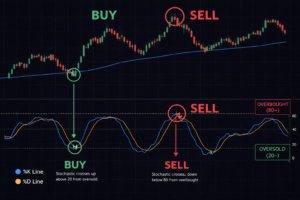
- Above 80 → sell
- Below 20 → buy
Sounds simple.
But then…
👉 Price keeps going up while stochastic says “overbought.”
👉 Price keeps dropping while stochastic says “oversold.”
And they get trapped.
The problem is not the stochastic indicator.
The problem is how traders understand it.
If you’re new to trading, it’s important to first understand the basics of trading for beginners before relying on indicators like stochastic.
What is stochastic and how it works?
Stochastic is a momentum indicator.
It measures where the current price is relative to its recent range.
Formula idea:
👉 Is price closing near the high or low of a range?
- Near high → strong momentum
- Near low → weak momentum
It moves between 0 and 100.
👉 Important insight:
Stochastic does NOT measure trend.
It measures momentum inside a range.
This is why understanding the overall market condition is critical before using any momentum indicator.
What do %K and %D mean?
Stochastic has two lines:
- %K → raw momentum
- %D → smoothed signal
%K reacts fast.
%D reacts slower.
👉 Signal traders use:
- Cross up → buy
- Cross down → sell
But here’s the truth:
👉 Cross ≠ entry signal.
Without context, it’s noise.
This is where most traders fail — they use indicators without a clear trading strategy that defines when and how to act.
What is overbought and oversold?
- Above 80 → overbought
- Below 20 → oversold
But this is where most traders fail.
👉 Overbought does NOT mean price will drop.
👉 Oversold does NOT mean price will rise.
It only means:
👉 Momentum is strong.
Why stochastic gives false signals?
Because traders use it blindly.
Stochastic fails when:
- Market is trending strongly
- Price keeps making new highs/lows
👉 In trend:
Overbought = continuation
Oversold = continuation
Not reversal.
When does stochastic work best?
Stochastic works best in:
👉 Ranging markets
When price moves sideways:
- High → sell
- Low → buy
Because market respects boundaries.
When does stochastic fail?
It fails in:
- Strong trend
- Breakout
- News events
👉 Because momentum stays extreme.
How to use stochastic correctly?
Steps:
- Identify range
- Wait stochastic extreme
- Confirm with price
👉 Combine with support/resistance.
How to combine stochastic with trend?
Better approach:
- Use trend first
- Use stochastic for timing
Example:
- Uptrend → wait stochastic oversold → buy
👉 This filters bad trades.
Stochastic vs RSI: which is better?
Both measure momentum.
But:
- RSI → smoother
- Stochastic → faster
👉 Stochastic gives more signals
👉 RSI gives more reliable signals
What are common mistakes traders make?
- Using stochastic alone
- Trading against trend
- Ignoring structure
- Overtrading signals
- Not understanding context
FAQ about stochastic
What is stochastic indicator?
A momentum indicator measuring price position in a range.
Is stochastic accurate?
Only when used in the right context.
Best settings?
Default (14,3,3) works for most cases.
Is stochastic better than RSI?
Depends on strategy.
Can beginners use stochastic?
Yes, but must understand context.
f you rely on stochastic alone…
You will keep getting trapped.
But if you understand:
👉 Context
👉 Structure
👉 Liquidity
Then stochastic becomes powerful.
Not as a signal.
But as a tool.
To apply stochastic effectively, many traders use platforms like TradingView to visualize momentum, structure, and key levels in real time.