
Most traders lose money not because they pick the wrong direction…
But because they enter at the wrong time.
👉 This is exactly why most traders struggle — they don’t understand how to trade for consistent profit
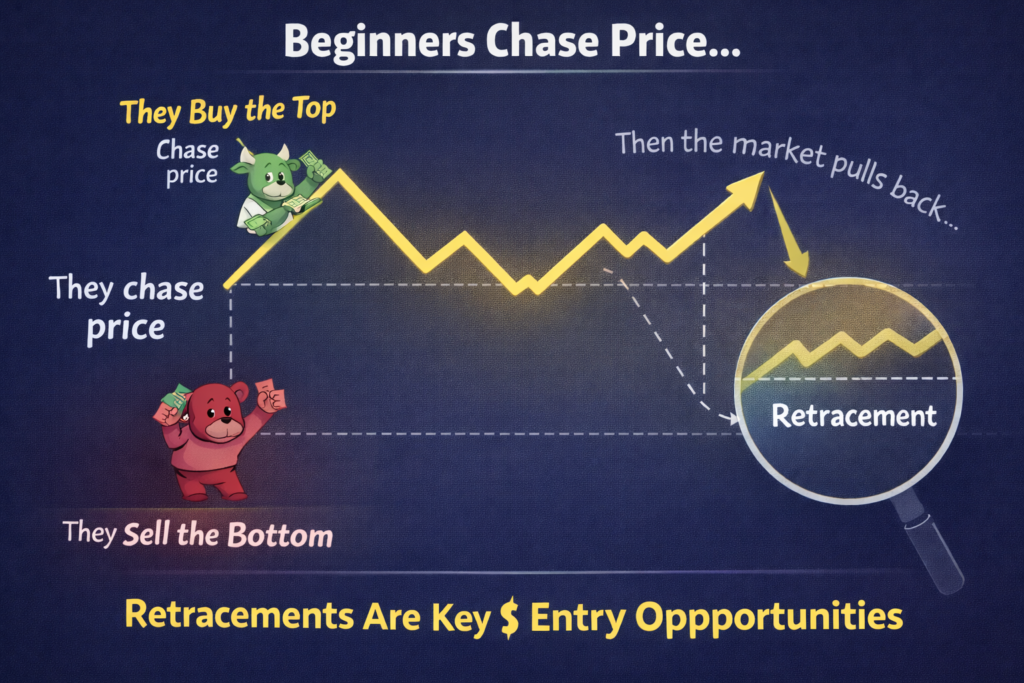
They chase price.
They buy the top.
They sell the bottom.
And then the market pulls back.
That pullback?
👉 That’s called a retracement.
And if you understand it properly,
it becomes one of the most powerful tools in trading.
What is a retracement in trading?
A retracement is:
👉 A temporary move against the main trend
It happens when price pauses and “pulls back” before continuing.
How is retracement different from reversal?
This is where most traders get trapped.
| Retracement | Reversal |
|---|---|
| Temporary | Permanent |
| Trend continues | Trend changes |
| Entry opportunity | Trend shift |
👉 Misreading this is one of the biggest trading mistakes.
Why do retracements happen in the market?
Markets don’t move in straight lines.
Retracements happen because:
- Traders take profit
- New traders enter at better prices
- Liquidity gets filled
👉 In reality:
Retracements are not weakness.
They are fuel for continuation.
This is why retracement is so powerful.
It allows you to enter the market at a better price — with lower risk and higher potential reward.
Instead of buying when everyone is excited, you buy when the market is temporarily pulling back.
👉 That’s where the real edge comes from.
How deep is a normal retracement?
There is no fixed number.
But common zones include:
- 38.2%
- 50%
- 61.8%
What are common Fibonacci retracement levels?
Fibonacci retracement is widely used to:
- Identify pullback zones
- Predict continuation
👉 But here’s the truth:
Fibonacci doesn’t work alone.
It works when aligned with:
- Market structure
- Liquidity
- Volume
How to trade retracement effectively?
Retracement is not a signal.
It’s a setup.
How to enter using pullbacks?
Basic logic:
- Identify trend
- Wait for pullback
- Enter at key level
👉 But real edge comes from confirmation.
Let’s look at a simple example:
Price is in an uptrend — making higher highs and higher lows.
Instead of entering at the top, smart traders wait.
When price pulls back to a previous support level, that’s where they enter.
This is what separates beginners from experienced traders.
Beginners chase the move.
Professionals wait for value.
How to confirm retracement continuation?
Look for:
- Weak pullback momentum
- Structure holding
- Volume decreasing
👉 This shows trend is still strong.
When does retracement become reversal?
Retracement turns into reversal when:
- Structure breaks
- Momentum shifts
- Liquidity flips
👉 This is where most traders lose money.
What are common retracement traps?
- Entering too early
- Ignoring structure
- Trusting Fibonacci blindly
- Trading against trend
Most beginners don’t lose because they don’t understand retracement —
they lose because they don’t wait for it.
They feel like they are missing out.
They rush into trades.
And by the time they enter, the move is already exhausted.
👉 This is one of the most common trading mistakes beginners make.
How do professional traders use retracement?
They don’t chase price.
They wait.
They let the market come to them.
👉 Retracement = opportunity
👉 Not hesitation
FAQ about retracement
Is retracement bullish or bearish?
Depends on the trend.
Is retracement a good entry strategy?
Yes — but only when combined with trend direction and confirmation.
Retracement alone is not enough.
Best timeframe?
All timeframes.
Does Fibonacci always work?
No.
Final Thoughts
Retracement is not just a concept.
It’s a mindset shift.
In simple terms:
👉 Trend gives direction
👉 Retracement gives entry
If you combine both, your timing improves significantly.
👉 Stop chasing price
👉 Start waiting for value
Because in trading:
The best entries don’t feel exciting.
They feel patient.
👉 If you master retracement,
you stop guessing…
And start timing the market.