
FTMO Review 2026: Is It Still the Best Prop Firm for Forex Traders?
You’ve probably seen the same split everywhere you’ve looked. One trader on Reddit says FTMO is “awesome, always pays out, no issues.” Another says FTMO denied their payout, calling their winning strategy “gambling” with no real explanation. Both of these are real reviews, from real traders, about the same firm — and that contradiction is exactly why you’re still reading reviews instead of just buying a Challenge.
This FTMO review is built to resolve that contradiction, not repeat it. We’ll look at what FTMO has actually paid out, what changed when it acquired the broker OANDA at the end of 2025, what specific trading behavior gets flagged under its more controversial rules, and whether the Challenge cost is genuinely worth it for your trading style in 2026. No vague reassurances — just what the data, the rules, and the trader community actually show.
Is FTMO Legit, or Just Another Prop Firm Scam?
Let’s settle the core fear first, because the prop trading industry has earned its reputation for caution. Multiple firms in this space have collapsed or had their payout practices seriously questioned, so asking “is this one different?” is a reasonable starting point, not paranoia.
FTMO was founded in 2014–2015 in Prague, making it one of the oldest firms still operating in the modern prop-challenge model it helped popularize. It has processed payouts continuously through multiple periods of industry turmoil that took down newer competitors — a track record that’s harder to fake than a polished homepage.
How Much Has FTMO Actually Paid Out to Traders?
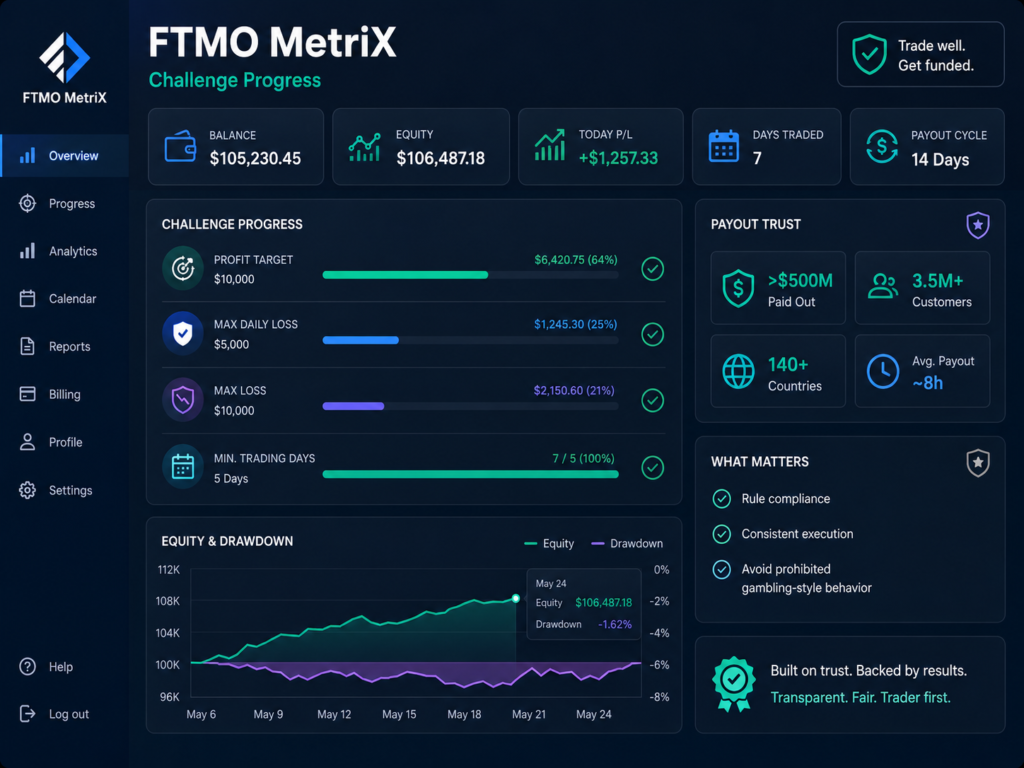
As of 2026, FTMO has paid out more than $500 million cumulatively to traders across more than 3.5 million customers in over 140 countries. That figure matters less as a marketing number and more as an operational reality check: a firm in genuine financial trouble simply cannot sustain that volume of real cash payouts at the cadence FTMO publishes — averaging around 8 hours from request to processing on a bi-weekly cycle. Thematic sentiment across independent trader communities is dominantly positive specifically on the payout question, with most negative experiences centered on timing frustrations or rule disputes rather than outright denial of legitimate, rule-compliant withdrawals.
Why Does FTMO’s Acquisition of OANDA Change the Trust Picture?
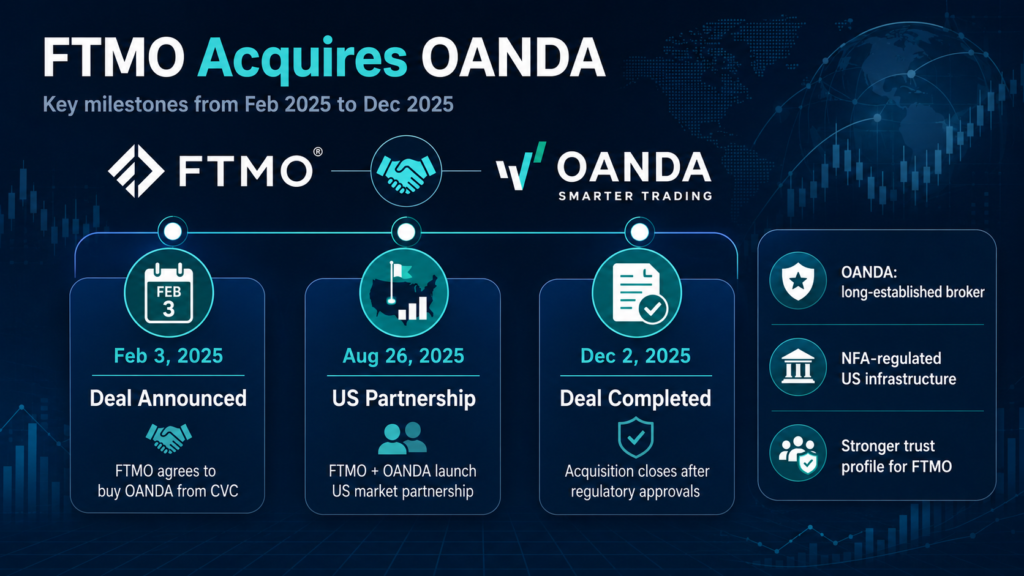
Here’s the detail most reviews still haven’t fully absorbed: FTMO completed its acquisition of OANDA in December 2025, with a co-CEO appointment finalized in March 2026. This is a meaningfully different trust signal than anything FTMO could claim before. OANDA is a long-established broker regulated by the NFA in the United States, among other jurisdictions — meaning FTMO is no longer just a privately held Czech evaluation company asking you to trust its internal dashboard numbers. It now owns regulated brokerage infrastructure directly. For US-based traders specifically, this also matters practically: FTMO’s US-facing route increasingly runs through this FTMO-owned, NFA-regulated infrastructure rather than a third-party partnership, which is a structurally stronger position than most competing prop firms currently offer.
What Do Traders Say on Reddit and Trustpilot About FTMO?
Aggregating sentiment across both platforms reveals a consistent, specific split — not random noise, but two clearly identifiable patterns.
What Are the Most Common Positive Reports?
The dominant positive theme is operational reliability: traders repeatedly describe fast, responsive customer service, consistent payouts “every time, no issues,” and a Challenge structure that feels realistic rather than designed to fail everyone. Specific support staff get named and praised multiple times across review threads — a small but telling detail, since it suggests traders are having enough real, resolved interactions to remember individual names. Several long-tenured traders report receiving recurring payouts across multiple accounts over several years, which independently corroborates the aggregate payout figures FTMO publishes.
What Are the Most Common Complaints?
The recurring negative pattern centers on discretionary account terminations — traders report having profitable accounts shut down under “one-sided betting” or “non-genuine trading” labels, often without being shown the specific trade-level evidence that triggered the flag. A smaller number of complaints describe retroactively applied restrictions, such as a 1% risk-per-trade limit appearing on an account after the fact, not stated in the original terms at signup. Execution-related complaints — gold spreads widening during volatile periods, occasional slippage past stop-loss levels — also appear, though less frequently and less severely than the discretionary-termination concern. The honest summary: FTMO’s payout mechanics work for the large majority of traders, but the subjective enforcement of certain rules is the legitimate, well-documented weak point worth understanding before you fund a Challenge.
What Are FTMO’s “One-Sided Betting” and “Non-Genuine Trading” Rules?
This is the part nearly every other review mentions as a risk without actually explaining — and it’s exactly what you need to understand to protect yourself.
What Specific Trading Behavior Triggers These Flags?
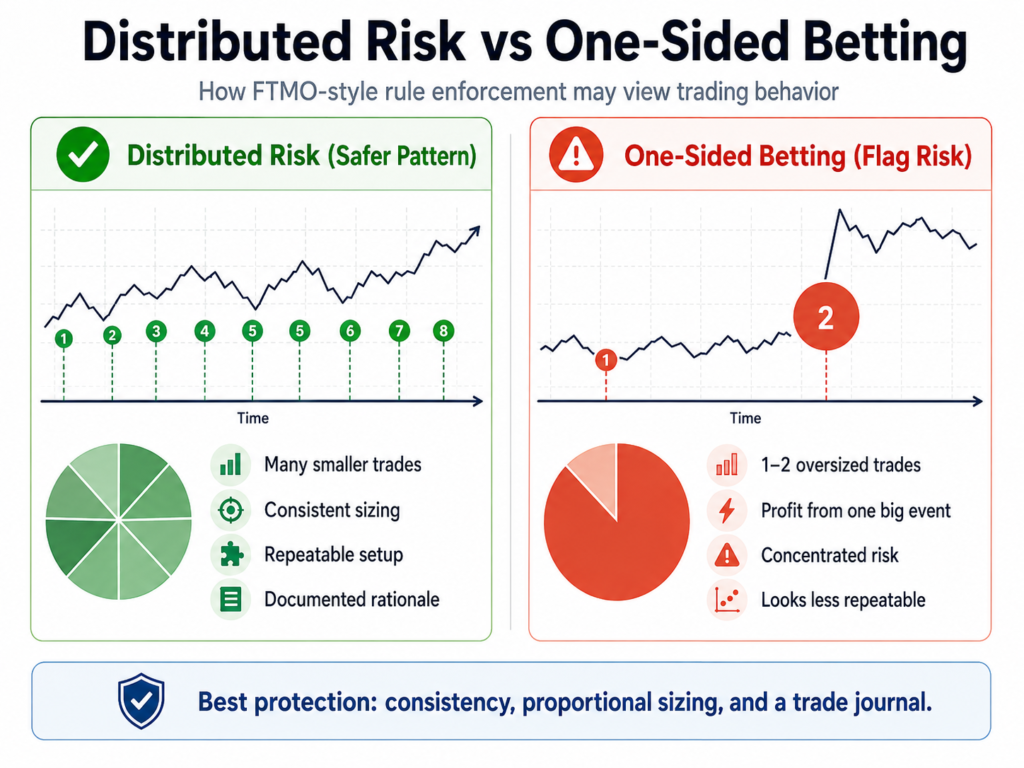
“One-sided betting” generally refers to placing one or very few oversized trades that account for the bulk of an account’s risk and profit, rather than trading with a distributed, repeatable strategy across many positions — the kind of pattern that looks more like a single lucky bet than a tradeable edge. “Non-genuine trading” is a broader catch-all that can include things like copying trades from an external signal source without independent analysis, exploiting latency or pricing errors rather than genuine market moves, or patterns that otherwise don’t resemble organic, skill-based trading. FTMO uses proprietary detection software to flag these patterns, and the core tension traders report is that the practical line between “aggressive but legitimate” and “one-sided betting” isn’t always obvious from FTMO’s published documentation alone.
How Can You Avoid Getting Flagged?
The most reliable protection is consistency: trade a strategy you apply repeatedly across many positions, sized proportionally to your account rather than concentrated in one or two outsized bets, and keep your own trade journal documenting your reasoning for each entry. If your profit on the Challenge or funded account comes overwhelmingly from a single trade or a single news event rather than a distributed series of decisions, that’s specifically the pattern most likely to draw scrutiny, even if every individual trade technically complied with the stated drawdown rules. Documenting your strategy and rationale as you go also gives you something concrete to reference if you ever need to dispute a flag — a materially stronger position than trying to reconstruct your reasoning after the fact.
How Does the FTMO Challenge Actually Work?
FTMO’s evaluation runs through either a 1-Step or 2-Step model, but the underlying logic is the same: prove you can hit a profit target while staying inside defined risk limits, without a time deadline forcing you into bad decisions.
What Are the Profit Targets and Drawdown Limits?
On the 2-Step Challenge, the first phase requires a 10% profit target with a maximum daily loss of 5% and a maximum overall loss of 10%, with no minimum time limit — you can take as long as you need, as long as you don’t breach the limits on any single day. The Verification phase that follows typically asks for a smaller 5% profit target under the same risk rules. The 1-Step path compresses this into a single phase with a tighter 3% daily loss limit, measured against the higher of your equity or balance at end of day, alongside a 10% trailing maximum loss — stricter day-to-day discipline in exchange for skipping the second evaluation stage entirely.
What Is the Best Day Rule, With a Real Example?
This consistency rule states that your single best trading day’s profit cannot represent more than 50% of your total profit across all positive days. Here’s a concrete example: if you’ve had four profitable days generating $1,000, $800, $600, and $400 — a total of $2,800 across positive days — your best day ($1,000) represents about 36% of that total, which is compliant. If instead one single day generated $2,000 while your other three positive days totaled only $800, your best day would represent 71% of total positive-day profit, breaching the rule. Importantly, breaching this rule isn’t an instant failure the way a drawdown breach is — it’s a flag that requires you to keep trading and rebalance the ratio with more distributed profitable days before requesting a payout.
Should You Choose the 1-Step or 2-Step Challenge?
If your strategy involves frequent scalping or short-term trades where you can tolerate tighter daily discipline in exchange for speed, the 1-Step Challenge’s single-phase structure and 90% profit split from day one can get you to a funded, higher-paying account faster. If you’re a swing trader who holds positions overnight or through weekends, or your strategy occasionally needs a wider daily cushion to avoid getting stopped out by short-term volatility, the 2-Step Challenge’s 5% daily loss allowance — plus the optional Swing account variant exempting overnight and weekend restrictions — is the structurally safer fit, even though it starts at an 80% split before scaling to 90%. Neither path is objectively superior; the right one depends on how your actual trading behavior maps onto each rule set’s tolerances.
[link-best-prop-firms]
What Does FTMO Cost, and Is the Fee Refundable?
Challenge pricing scales with account size and is priced in euros, which can shift slightly in your local currency depending on exchange rates at checkout. A $100,000 account Challenge has been cited around $449–$540 depending on the specific program and current pricing, while smaller account sizes starting around $10,000 carry a proportionally lower fee. The critical detail that makes this cost structure more forgiving than it first appears: the Challenge fee is fully refunded alongside your first payout once you pass both evaluation stages and successfully withdraw profit from a funded account. For a trader who passes and trades profitably, the effective entry cost becomes zero — you’re not out any money beyond the time and discipline the evaluation demanded.
How Does FTMO’s Payout and Scaling Plan Work?
Once funded, profit splits start at 80% on the 2-Step path or 90% from day one on the 1-Step path, with both capable of reaching a 90% split through the Scaling Plan over time.
How Fast Are FTMO Payouts in Practice?
Payouts follow a bi-weekly cycle, with FTMO publishing an average processing time of around 8 hours once a request is submitted and verified — a figure that multiple independent, named-trader reports corroborate, with payouts commonly clearing within 1 to 4 days total depending on the withdrawal method. You become eligible to request your first payout after a minimum of 14 calendar days from your first trade on the funded account, provided the account is in profit with no open or pending orders at the time of the request.
How Does the Scaling Plan Grow Your Account?
If you hit at least 10% net profit over a four-month evaluation window, post profit in at least two of those four calendar months, and avoid any rule violations, FTMO increases your funded account balance by 25% at each scale-up event. This compounds meaningfully over time — a trader who starts at $50,000 and qualifies for repeated scale-ups can grow toward the program’s $2,000,000 maximum account size without paying any additional Challenge fees along the way, since scaling is based purely on demonstrated consistency rather than a new purchase.
What Trading Platforms and Assets Does FTMO Support?
FTMO supports MetaTrader 4, MetaTrader 5, cTrader, and DXtrade, alongside its own proprietary Metrix dashboard for tracking Challenge progress, drawdown limits, and trading statistics in real time. Asset coverage spans forex pairs, indices, commodities, cryptocurrencies, and stocks, giving traders flexibility to apply a single strategy across multiple markets without needing a separate funded account for each asset class. Expert Advisors and algorithmic strategies are generally supported, though the same “non-genuine trading” scrutiny covered earlier still applies to automated strategies that produce patterns inconsistent with organic, skill-based trading.
Is FTMO Worth It in 2026? Final Verdict
FTMO earns its position as the most recognized name in prop trading through a combination that’s genuinely difficult for newer competitors to replicate: a decade of continuous operation, more than $500 million in verified payouts, and now, direct ownership of a regulated broker through the OANDA acquisition — a trust signal no other major prop firm currently matches at the same scale.
That said, “most trusted in the industry” doesn’t mean “risk-free.” The discretionary enforcement of rules like “one-sided betting” remains the legitimate, documented weak point in the FTMO experience, and it’s a real factor — not a hypothetical one — for traders planning to scale toward larger funded accounts. My honest read: if you trade with a distributed, repeatable strategy, document your reasoning as you go, and treat the rules as genuine risk parameters rather than suggestions, FTMO’s combination of refundable fees, fast payouts, and now broker-backed credibility makes it the strongest default choice in the category. If your edge depends on occasional outsized, concentrated bets, go in aware that this specific style is exactly what draws the most scrutiny — and plan your risk management accordingly before you spend a dollar on a Challenge.
Ready to see how FTMO stacks up against the alternatives before you commit? Check our best prop firms for forex trading to weigh rules, fees, and payout speed side by side.
Frequently Asked Questions About FTMO
Is FTMO Available for US Traders?
Availability has historically been restricted for US nationals and residents, though FTMO’s 2025 acquisition of the NFA-regulated broker OANDA has opened a new, firm-owned route for US-based access. Always verify current eligibility directly on FTMO’s official site before paying any Challenge fee, since regional rules can change.
Can You Use Expert Advisors (EAs) on FTMO?
Yes, EAs and algorithmic strategies are generally permitted across FTMO’s supported platforms. However, automated strategies are still subject to the same “non-genuine trading” review as manual trading, so an EA producing patterns inconsistent with organic trading behavior can still be flagged.
What Happens If You Fail the FTMO Challenge?
Breaching the maximum daily or overall drawdown limit results in automatic failure of that evaluation stage. You can purchase a new Challenge to restart the process, though the original fee for the failed attempt is not refunded unless you separately qualify for a specific free retry promotion.
Does FTMO Allow Weekend Holding and News Trading?
It depends on the account type. Standard accounts restrict trading within a short window around high-impact news and may limit overnight or weekend holding. The Swing account variant, available on the 2-Step Challenge, removes both of these restrictions for traders who need that flexibility.
How Does FTMO Compare to FundedNext or FXIFY?
FTMO generally sits at the premium end of pricing compared to firms like FundedNext or FXIFY, but offsets this with a longer track record, larger cumulative payout volume, and now the added credibility of owning a regulated broker. Budget-focused traders may find competitors cheaper; trust-focused traders typically still default to FTMO.
Risk Disclosure: Prop trading challenges involve simulated capital and significant risk of losing your evaluation fee. Most traders do not pass evaluations. This article is for informational purposes only and does not constitute financial advice. Always read the current rules directly on FTMO’s official website before purchasing a Challenge, as terms can change.
Methodology: This review is based on FTMO’s publicly published rules, fee schedules, and payout policies current as of 2026, the verified OANDA acquisition timeline, and aggregated trader sentiment from Reddit, Trustpilot, and independent prop-firm review platforms cited throughout.