
You knew you should have cut the loss at your stop.
You watched the price hit the level. You felt the tightness in your chest. And then — for reasons you still cannot fully explain — you moved the stop lower. “Just give it a little more room.” The trade went against you. You held. It went further. You told yourself it would recover. It did not.
This is not a story about strategy. Your strategy was correct. Your analysis was sound. Your entry was valid. What failed was something deeper — the neural infrastructure between your eyes and your mouse click.
Most traders don’t lose because they lack a strategy — they lose because they can’t execute consistently.
👉 If you want to fix that, you need to understand how to trade for consistent profit
Trading psychology is not a motivational concept. It is a scientific reality. Neuroscience research from institutions including Caltech demonstrates that financial decision-making activates the same reward pathways as addictive substances. The market is essentially a mechanism designed to exploit psychological weaknesses: impatience, overconfidence, loss aversion, and the desperate need to be right. Understanding why your brain behaves this way in trading — not just that it does — is the first step toward rewiring it.
This guide gives you that understanding. Then it gives you the tools to measure, track, and systematically correct the psychological patterns that are costing you real money. No motivational platitudes. No vague advice to “control your emotions.” A practitioner-level breakdown of the mental architecture of consistent trading — and how to build it.
Why Does Your Brain Actively Sabotage Your Trading Performance?
Most traders frame their psychological problems as personal weakness. “I lack discipline.” “I am too emotional.” “I need more willpower.” This framing is not only inaccurate — it is counterproductive. The psychological errors traders make are not signs of personal failure. They are the predictable outputs of a brain running hardware that was not designed for financial markets.
The human brain evolved over hundreds of thousands of years to optimize for survival in a physical world. It is exquisitely tuned for pattern recognition, threat detection, and social belonging. These capabilities are liabilities in trading. Pattern recognition creates signals in market noise. Threat detection fires during normal drawdowns. Social belonging drives herd behavior at exactly the wrong moments.
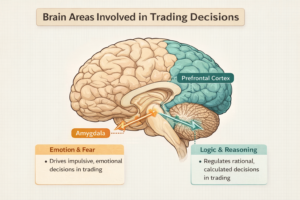
Neuroscientific research demonstrates that financial decisions activate the same neural reward pathways as cocaine — the nucleus accumbens releases dopamine surges during winning trades that literally impair the prefrontal cortex’s ability to calculate risk. Trading-setup This is not metaphor. It is measurable neurochemistry. When you are on a winning streak, your brain is, in a clinically meaningful sense, compromised.
What happens in your brain during a losing trade?
When a trade moves against you, your amygdala — the brain’s threat-detection center — triggers a stress response. Cortisol floods your system. Heart rate rises. Breathing shallows. The prefrontal cortex, responsible for rational analysis and rule-following, becomes functionally suppressed in favour of the faster, more instinctive limbic system.
This is an amygdala hijack. In a survival context, it is life-saving — it bypasses slow rational processing when you need to react immediately to a predator. In a trading context, it produces exactly the wrong response: holding a losing position because the emotional pain of realizing the loss feels more threatening than the financial reality of letting it run.
The stop loss you do not take is not a rational decision. It is the biological reflex of an organism trying to avoid pain. Understanding this does not excuse the behavior — but it does tell you that willpower alone is an ineffective remedy. You cannot simply decide to override a neurological threat response. You need structural systems that remove the decision from the amygdala entirely.
Why does winning feel less powerful than losing hurts?
Research by Kahneman and Tversky (1979) established that losses feel approximately twice as painful as equivalent gains feel pleasurable. A $500 loss is psychologically experienced as roughly twice as painful as the pleasure of a $500 gain. This asymmetry — loss aversion — is hardwired and universal across cultures and demographics.
In trading, loss aversion manifests with devastating precision: traders hold losing positions far longer than winning ones, desperately trying to avoid the psychological pain of a realised loss. Meanwhile, they take profits too early on winning trades, capturing the pleasurable feeling of “locking in” a gain before the market can take it away. The net effect: losers run, winners cut. The exact opposite of what profitable trading requires.
This is not irrational behavior — it is the perfectly rational output of a brain optimizing for psychological comfort rather than expected value. The market does not reward psychological comfort. It rewards expected value.
What Is Trading Psychology and What Does It Outweigh Strategy?
Trading psychology is the study and management of the mental and emotional processes that influence trading decisions. It encompasses cognitive biases, emotional states, behavioral patterns, and the habitual responses that shape how a trader executes — or fails to execute — their strategy.
Trading success depends approximately 85% on psychology and emotional control, outweighing technical analysis and strategy in importance.This figure, consistently cited by professional traders and trading researchers, surprises many beginners who spend the vast majority of their learning time on chart patterns and indicators. The distribution of attention among most retail traders is almost perfectly inverted from what actually determines outcomes.
Think of it this way: a perfect trading strategy, executed by a psychologically compromised trader, will underperform. A mediocre strategy, executed with mechanical precision and emotional discipline, will outperform. The difference is not the strategy. It is the human running it.
If you’re completely new, start with a solid foundation in trading for beginners guide before diving deeper into psychological concepts.
What does the research say about psychology vs. technical skill?
Research by Barber and Odean (2000) found that overconfident traders who trade excessively underperform by 6.5% annually. Odean’s earlier work (1998) showed traders are 1.5× more likely to sell a winning position than a losing one — the disposition effect in action across thousands of real brokerage accounts.
These are not anecdotal observations. They are derived from analysis of tens of thousands of actual trading accounts over multi-year periods. The behavioral patterns are systematic, measurable, and consistent across demographics. The implication is precise: fixing your psychology produces a measurable, quantifiable improvement in returns — not a vague “mindset upgrade.”
The question shifts from whether psychology matters to which specific psychological patterns are costing you the most money — and how to fix them in priority order.
How do you measure the actual financial cost of your psychology?
The key insight from behavioral finance is that awareness alone does not change behavior. A feeling by itself is not useful until you know its P&L impact. When you can say “trades I take when frustrated have a 30% lower win rate than trades I take when calm,” you have something you can act on.
This is the “psychology cost” framework — and it is the most underutilised tool in retail trading improvement.
The method:
- Tag every trade in your journal with your emotional state at entry (calm, frustrated, FOMO, revenge, overconfident, fearful, uncertain).
- After 50+ trades, calculate your win rate, average win, and average loss separately for each emotional tag.
- Calculate the dollar difference between your “calm” trades and your “frustrated” or “FOMO” trades over the same period.
- That dollar difference is your psychology cost — the exact financial toll of your emotional trading.
Most traders who run this analysis for the first time are shocked. Psychology costs are rarely small. They are often the single largest line item separating a trader’s theoretical edge from their actual P&L.
What Are the Most Destructive Cognitive Biases in Trading?
Cognitive biases are systematic errors in thinking that arise from the brain’s heuristic shortcuts. In everyday life, these shortcuts are efficient. In financial markets, they are expensive. Here are the four biases with the highest measurable cost for retail traders.
How does loss aversion cause traders to hold losers too long?
Loss aversion’s trading manifestation is the refusal to take a stop loss. The trade has moved against you. Your plan says exit. But the psychological pain of converting a paper loss into a realised loss — making it real — is so acute that the brain constructs elaborate justifications for staying in. “It will recover.” “The market is being irrational.” “My analysis is still valid.”
Each of these statements may occasionally be true. That is what makes them dangerous. They are sometimes correct and always emotionally convenient, which means they survive in the trader’s mental toolkit regardless of their statistical accuracy.
The structural fix is non-negotiable: stop losses must be placed at entry, before the emotional pressure of a moving trade begins. Once the order is in the market, the decision to exit has already been made. This is not a trick — it is the removal of the decision from the amygdala’s jurisdiction. The stop fires. The trade closes. No hijack possible.
What is the disposition effect and how much money is it costing you?
The disposition effect is the documented tendency to sell winning trades too early and hold losing trades too long — the exact inverse of optimal trading behavior. Review your Maximum Favorable Excursion (MFE) data: how much money did you leave on the table by exiting winners early? This directly measures the disposition effect in your own trading.
MFE analysis is transformative. For each closed trade, calculate how far price moved in your favour after you exited. If your average winner was $200 but the average MFE (maximum profit available during the trade before reversal) was $450, you left $250 per trade on the table. Multiply that by your annual trade frequency and you have the annual cost of the disposition effect in your specific trading.
The fix: use trailing stops rather than manual exits. Automate the exit criteria wherever possible. The less your conscious, emotion-laden brain is involved in the decision to close a winning trade, the longer the winning trades will run.
MFE analysis is transformative — and it becomes significantly easier when you use the best charting platform for traders to track price movement and analyze trade performance visually.
How does confirmation bias turn analysis into self-deception?
Confirmation bias means that once you have a position, you unconsciously seek information that supports it and discount information that contradicts it. This makes it harder to recognize when a trade is going wrong.
A trader who is long EURUSD will notice every bullish signal and dismiss every bearish one. This is not deliberate dishonesty. It is the brain’s automatic filtering system protecting an existing belief — and, by extension, protecting the trader’s ego identity as someone who made a correct analysis.
The most dangerous form of confirmation bias in trading is the “thesis update” — when a trade has moved against you and you reanalyse the chart to find new reasons why it will recover. This is not analysis. It is rationalisation. The position came first. The analysis followed. The causality is backwards.
Protocol to counter it: before entering any trade, write down the specific conditions that would make your analysis wrong. These are your invalidation criteria. When those conditions appear, close the trade — not because you “feel” it is not working, but because you defined in advance that this outcome means the thesis is incorrect.
What is recency bias and how does it distort your next trade?
Recency bias is the tendency to weight recent events more heavily than the full historical sample. After three losing trades in a row, the trader’s brain perceives the market as “hostile” and becomes risk-averse — missing the next valid setup. After three winning trades in a row, the brain perceives the market as “easy” and increases risk — just before a normal losing trade arrives.
The Gambler’s Fallacy is a close cousin: believing that a string of losses makes a win more likely (or vice versa). Each trade is independent. Markets do not owe you a correction.
The counter is statistical: know your strategy’s historical streaks. If your system historically produces maximum consecutive losing runs of 7, a current 4-trade losing streak is not a signal that something is wrong. It is a data point well within normal distribution. This knowledge does not eliminate the emotional discomfort — but it provides a rational anchor to prevent the discomfort from altering your behavior.
What Are the Most Common Emotional Trading Mistakes?
Cognitive biases operate quietly in the background, shaping decisions without the trader’s conscious awareness. Emotional trading mistakes are louder — they often feel wrong even as they happen, yet the impulse is powerful enough to override the trader’s own rules.
What is revenge trading and how do you interrupt the cycle?
Revenge trading is the compulsive act of immediately re-entering the market after a loss, driven by the ego’s need to “get the money back” rather than by a valid setup. It is one of the most account-destructive patterns in retail trading — not because any single revenge trade is catastrophic, but because it typically chains: the revenge trade loses, which triggers another revenge trade, which loses, compounding the original loss into a major drawdown in a single session.
Most traders do not fail because of a bad strategy — they fail because of one small rule they overlook. For revenge traders, that rule is: no trade without a setup that meets your full entry criteria. A loss does not create a setup. Market noise does not create a setup. Only your pre-defined conditions create a setup.
The circuit breaker: after any losing trade, enforce a mandatory 15–30 minute pause before reviewing another chart. During this pause, do not look at the markets. Step away from the screen. The neurological purpose is to allow cortisol levels to drop and prefrontal cortex function to restore. When you return after 30 minutes, you will analyse the market as a strategist — not as someone trying to recover a loss.
How does FOMO lead traders to buy tops and sell bottoms?
Fear of Missing Out is the anxiety produced when a trade moves without you. You identified the setup. You hesitated. The trade launched. Now it is 2% in the direction you anticipated, and every passing minute of price movement feels like money being taken directly from your account.
FOMO produces a specific and predictable error: chasing entry — buying into strength rather than at the planned entry price. The irony is mechanical: by the time FOMO is strong enough to override your hesitation, the setup is typically exhausted. The early-movers who entered at the correct price are already thinking about where to take profit. The FOMO entrant is providing their exit liquidity.
The rule that fixes FOMO is simple but demanding: if you missed the entry, the trade does not exist for you. Your job is not to capture every move — it is to execute your plan on setups where your criteria are met. Markets that move without you are not missed opportunities. They are tests of discipline that you pass by doing nothing.
The rule that fixes FOMO is simple but demanding — and it is part of trading discipline strategies that actually work
Why does overconfidence after a winning streak destroy accounts?
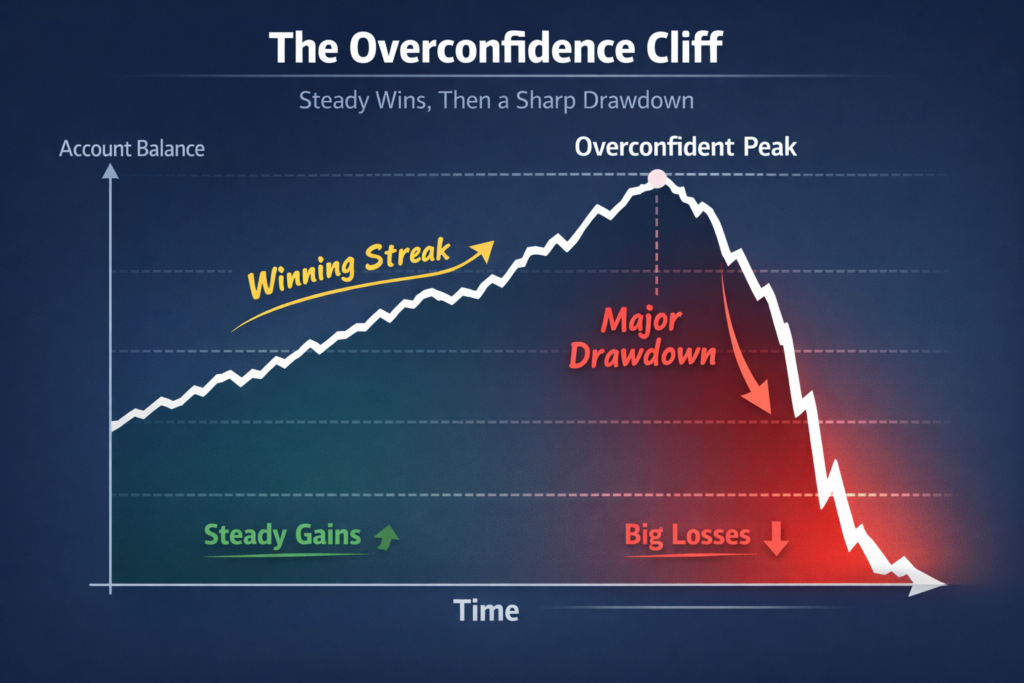
A winning streak is neurologically identical to a drug high. Dopamine releases with each profitable trade. The prefrontal cortex — the seat of rational risk assessment — becomes progressively impaired. Position sizes creep upward. Stop losses get set wider. Setups that would not have met entry criteria two weeks ago suddenly look “good enough.”
Overconfident traders who trade most actively underperform by 6.5% annually— and the pattern is consistent: a profitable period of disciplined trading is followed by a period of inflated confidence, which is followed by oversized positions and ignored rules, which produces a rapid drawdown that erases the gains.
The structural counter: position sizing must be fixed by rule, not by feel. If you risk 1% per trade when you are at breakeven, you risk 1% per trade when you are up 15% on the month. The account balance changes. The percentage does not. This mechanical constraint prevents the dopamine-driven escalation that destroys winning streaks.
This is what we call the “overconfidence cliff” — a phase where traders increase their position size after a winning streak, only to give everything back in a single drawdown.
The only way to avoid this is by applying strict risk management strategies for traders
What Type of Trading Psychology Problem Do You Actually Have?
Most guides list cognitive biases without helping you identify which ones apply to your specific trading. Use this self-diagnostic to prioritise your improvement work.
| Symptom | Primary Problem | Protocol Priority |
|---|---|---|
| Cannot cut losses at stop | Loss Aversion | Place stops before entry; use hard stops via broker |
| Exit winning trades too early | Disposition Effect | Use trailing stops; review MFE data |
| Enter after missing the move | FOMO | “If I missed it, it does not exist” rule |
| Immediately re-enter after loss | Revenge Trading | Mandatory 30-min post-loss cooldown |
| Increase size during winning streaks | Overconfidence | Fixed % position sizing — non-negotiable |
| Find new reasons to stay in bad trades | Confirmation Bias | Write invalidation criteria before entry |
| Performance worsens after recent losses | Recency Bias | Know your strategy’s historical loss streaks |
| Analyse endlessly, rarely execute | Analysis Paralysis | Predefined entry checklist with scoring |
Run this diagnostic honestly. Most traders have one or two dominant patterns that account for 80% of their psychology cost. Identify yours. Fix those first. The compounding improvement in P&L from addressing your top psychological weakness will exceed the improvement from any new indicator or strategy.
How Do You Build the Discipline to Execute Your Plan Consistently?
Discipline is not a character trait you either have or do not have. It is a system — a set of environmental designs, behavioral rules, and review rituals that make consistent execution more likely than deviation.
The three pillars: structure, tracking, and review. Structure eliminates discretionary decisions. Tracking converts emotional patterns into data. Review creates learning loops that gradually recalibrate behavior. Together, they replace willpower — which depletes — with habit and system — which compound.
What does a daily pre-market mental preparation routine look like?
Many professional traders establish pre-market routines that include mental preparation, market analysis, and setting intentions for the trading day. These practices create psychological boundaries between personal life and trading activity.
A minimal effective pre-market protocol (15–30 minutes):
- Physical activation (5 min): Brief exercise, cold water, or breathing exercises. Physiological arousal primes attention without triggering threat response.
- Previous session review (5 min): Review yesterday’s trades. Did you follow your plan? If not, note the deviation specifically — not as self-criticism, but as data.
- Today’s market context (10 min): Identify key levels. Define the conditions under which you will trade today and the conditions under which you will not.
- Session intention statement (2 min): Write down one behavioral goal for the session. Not a P&L target — a process goal. “Today I will only enter trades that score 8/10 or higher on my checklist.” “Today I will not move my stop loss under any circumstances.”
This routine does not guarantee profitable trades. It creates the psychological state — calm, focused, rule-oriented — in which profitable execution is most likely.
How do you use a trading journal to track psychological patterns?
Tag every trade with the emotion present at entry. Track stats by emotional state. The goal is not to feel calm — it is to act consistent, even when you do not feel calm.
A psychology-integrated trading journal records:
- Emotional state at entry: Use a simple tag system (calm, FOMO, revenge, uncertain, overconfident).
- Setup quality score: Rate the setup against your criteria on a scale of 1–10 before entry.
- Rule adherence: Binary yes/no — did you follow every rule of your plan on this trade?
- Outcome: P&L, maximum adverse excursion, maximum favorable excursion.
After 50 trades, run the analysis: filter by emotional tag, calculate win rate and average P&L for each tag. This transforms vague self-awareness into actionable data. When you can put a dollar sign on your emotional trading, your psychology cost becomes concrete and motivating to address.
How Do Professional Traders Manage Emotions Under Pressure?
Professional and funded traders face the same neurological architecture as retail traders. The difference is not that they feel no fear or greed. It is that they have built systems that prevent those feelings from determining behavior.
What mental rules do funded and professional traders use daily?
The most consistent patterns observed across consistently profitable traders:
- Rules are non-negotiable by design, not by effort: Every rule that requires active willpower to maintain will eventually break under sufficient emotional pressure. Professional traders design their systems so that the correct behavior is the path of least resistance — stops are pre-placed, position sizes are calculated before entry, daily loss limits are enforced by platform settings.
- Performance is evaluated over series, not individual trades: A professional trader who takes a valid setup and loses on it considers the trade a success. The trade met the criteria. The outcome was within the distribution of normal results. Evaluating individual trades by outcome rather than process is a retail trader behavior.
- Emotional states are acknowledged, not acted on: Professional traders recognize the feeling of FOMO, frustration, or overconfidence — and treat it as a signal to review their next potential action more carefully, not as a prompt to act.
How do loss limits and circuit breakers remove emotional decisions?
A common approach among professional traders involves stopping trading for the day after losing 3–5% of the account, and ceasing trading for the week after losing 10%. These limits prevent the common pattern of attempting to recover losses through increasingly aggressive trading.
Loss limits serve two functions: financial (capping daily drawdown) and psychological (removing the trader from the market before the amygdala hijack compounds losses). When you are triggered by a losing session, your analytical capacity is impaired. The correct intervention is removal from the market — not increased activity.
Screenshot the chart the moment you enter, mark the specific pattern you saw, then review at end of day when emotions have faded. Was the setup perfect or did you force it? This end-of-day review, conducted in a calm state, is where learning happens. Not in the heat of a losing trade.
How Do You Rewire Your Trading Brain Over Time?
Cognitive rewiring is not a metaphor. The brain physically restructures — a process called neuroplasticity — in response to repeated behavior. Consistently following trading rules, especially when the emotional pressure to deviate is high, literally builds new neural pathways that make rule-following easier over time.
This is the most important structural reality in trading psychology improvement: the first 100 times you follow your rule instead of your emotion, it is effortful. The next 100 times, it is habitual. The 100 times after that, it is automatic.
Why is awareness alone not enough to change trading behavior?
Every retail trader reading this guide is already “aware” that they should not revenge trade. They are already “aware” that they should take their stop loss. Awareness did not stop them before today. It will not stop them tomorrow.
The key insight from behavioral finance is that awareness alone does not change behavior. Data turns gut feeling into strategy. The shift from awareness to behavioral change requires: a tracking system that makes the cost of the behavior visible, a structural constraint that makes the problematic behavior harder to perform, and a review ritual that creates accountability and learning.
Willpower is finite and depletes throughout the trading session. Systems do not. Build the system. Trust the system. Let the system do what willpower cannot sustain.
What habits compound into consistent trading psychology over months?
The habits that produce the largest long-term psychological improvement, in priority order:
- Daily trade journaling with emotional tags — the foundation of self-knowledge and measurable improvement.
- Pre-market routine — creates the mental state required for disciplined execution before the session begins.
- Post-loss cooling-off protocol — eliminates revenge trading structurally.
- Fixed position sizing — removes overconfidence escalation from the decision space.
- Weekly performance review — converts individual sessions into learning data, prevents recency bias from dominating.
- Reading performance data, not feeling it — evaluate your trading by statistics over 30+ trades, not by your emotional memory of recent sessions.
You cannot predict your profit. But you can control your behavior every single trading day. Focus relentlessly on process. Track what you control. Build habits that compound. The profits take care of themselves.
Which Resources Actually Help Improve Trading Psychology?
Not all trading psychology resources are equal. Here is a curated shortlist based on practical impact:
Books (highest impact):
- Trading in the Zone by Mark Douglas — the foundational text on probabilistic thinking and discipline.
- The Mental Game of Trading by Jared Tendler — the most systematic approach to identifying and fixing specific psychological problems.
- Thinking, Fast and Slow by Daniel Kahneman — the scientific foundation for understanding cognitive bias.
Journaling platforms:
- TradesViz — psychology tagging, P&L impact by emotional state, MFE/MAE analysis.
- Edgewonk — strong for pattern analysis across large trade samples.
- Manual spreadsheet — less automated but forces deeper engagement with each trade’s data.
Practices with evidence base:
- Mindfulness meditation — reduces amygdala reactivity over time (confirmed by fMRI research). Even 10 minutes daily produces measurable reduction in emotional reactivity within 8 weeks.
- Physical exercise before trading — reduces cortisol baseline, improves prefrontal cortex function.
- Breathwork during trading — box breathing (4-4-4-4 counts) activates the parasympathetic nervous system within 90 seconds, counteracting acute stress response.
You already know the rules. You have known them for months, possibly years. The gap is not knowledge. The gap is the neurobiology between knowing and doing — and that gap closes not through more learning about trading strategies, but through systematic, data-driven work on the psychological layer underneath them.
Start today: open a trade journal, tag your next 20 trades with your emotional state at entry, and calculate the win rate difference between your calm trades and your emotional ones. That number — your psychology cost — is the most important figure in your trading. And it is entirely within your power to reduce.
Start tracking. Start changing. The market rewards the patient and the systematic — and becoming both is a skill, not a personality trait.
FAQ: Trading Psychology — Your Deepest Questions Answered
Can trading psychology be learned or is it innate?
Trading psychology is entirely learnable — it is not a fixed personality trait. The neuroplasticity of the brain means that with consistent practice, journaling, and structured behavioral protocols, traders measurably improve their emotional discipline over months. Personality influences your starting point — naturally patient people have an easier early journey — but does not determine your ceiling.
How long does it take to fix emotional trading habits?
Realistic timeline: noticeable improvement in 30–60 days of consistent journaling and protocol application; meaningful habit formation in 3–6 months; deep behavioral rewiring over 12–18 months. The speed depends entirely on the consistency of your journaling, review rituals, and adherence to structural protocols — not on motivation or intention.
Is trading psychology the same as general emotional intelligence?
Related but distinct. General emotional intelligence — recognizing and managing emotions in social contexts — helps, but trading psychology requires market-specific conditioning. A highly emotionally intelligent person can still have severe loss aversion or disposition effect in trading because these are domain-specific cognitive patterns activated by financial risk. Trading psychology training addresses the specific triggers and specific biases of financial decision-making, not general emotion management.
What is the best book on trading psychology for beginners?
Trading in the Zone by Mark Douglas is the near-universal first recommendation. It explains probabilistic thinking — understanding that trading results are distributions, not individual outcomes — in a way that fundamentally reframes how traders relate to losses and uncertainty. Read it once for the concepts, then again 6 months into live trading when the concepts will resonate at a much deeper level.
Does meditation actually help traders perform better?
Yes — with important caveats. The benefit of meditation is not immediate calm during a bad trade. It is a gradual reduction in baseline amygdala reactivity over weeks of consistent practice, confirmed by fMRI research. This means fewer amygdala hijacks, less impulsive response to market movements, and improved access to prefrontal cortex function during high-stress trading moments. 10–15 minutes of focused breathing meditation daily produces measurable results within 6–8 weeks. Apps such as Headspace or Waking Up provide structured starting points.