
If you’ve ever felt like your entries are always “just a bit too late” or your exits happen right before price reverses… you’re not alone.
Most traders rely on indicators like EMA or RSI. But there’s one tool quietly used by professional traders and institutions every single day
The VWAP indicator.
Not because it predicts the future —
but because it reveals something far more powerful:
👉 Where the real “fair price” is.
What is the VWAP indicator in trading?
VWAP stands for Volume Weighted Average Price.
In simple terms:
👉 It shows the average price of an asset, weighted by volume.
Unlike a normal moving average, VWAP doesn’t treat all price points equally.
It gives more importance to price levels where more volume was traded.
How is VWAP calculated?
VWAP uses this logic:
- Multiply price × volume for each trade
- Sum all values
- Divide by total volume
This creates a line that reflects where most money was actually traded — not just where price moved.
Why does VWAP represent fair price?
Because markets are driven by volume.
If a large amount of volume traded at a certain price,
that price becomes a consensus value.
👉 VWAP = where buyers and sellers agreed the most.
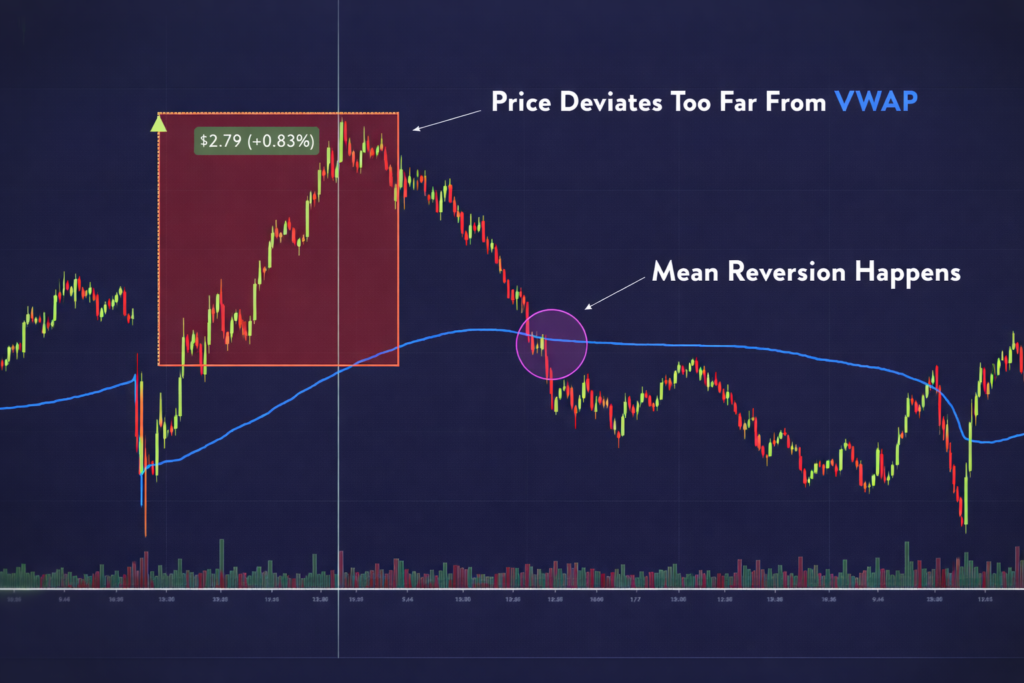
That’s why price often:
Returns to VWAP (mean reversion)
Reacts strongly around it
Why do institutional traders rely on VWAP?
Big players don’t care about random indicators.
They care about:
- Execution efficiency
- Liquidity
- Market impact
VWAP helps them:
- Enter positions without moving the market
- Measure trade performance
👉 If they buy below VWAP → good execution
👉 If above → bad execution
How does VWAP reflect liquidity and volume?
VWAP naturally adapts to:
- High-volume zones
- Active trading periods
This makes it:
- More reliable than static indicators
- Context-aware
How does VWAP differ from moving averages?
Here’s the key difference:
| Indicator | Based on | Meaning |
|---|---|---|
| EMA/SMA | Price only | Trend smoothing |
| VWAP | Price + volume | Fair value |
👉 VWAP = where money is
👉 EMA = where price is
VWAP vs EMA: which is better?
Neither is “better”.
They serve different purposes:
- EMA → trend direction
- VWAP → value reference
Best traders use both.
How to use VWAP in real trading?
VWAP is not a standalone signal. It works best when combined with solid trading strategies and proper risk management.
How to trade mean reversion with VWAP?
One of the most common strategies:
- Price moves far away from VWAP
- Momentum slows
- Price returns toward VWAP
👉 This is called mean reversion
But here’s the truth most guides don’t tell you:
⚠️ It only works in balanced markets
If you’re new, it’s important to first understand the basics of trading for beginners before using indicators like VWAP.
How to use VWAP as dynamic support resistance?
VWAP often acts like:
- Support in uptrends
- Resistance in downtrends
But not always.
👉 The key is context:
- Volume
- Trend strength
- Time of day
You can easily observe how VWAP behaves as dynamic support and resistance by analyzing live charts on platforms like TradingView, where volume and price interaction become much clearer.
When does VWAP fail in the market?
This is where most traders lose money.
Why VWAP breaks during strong trends?
In strong trends:
- Price doesn’t return to VWAP
- It rides above or below it
👉 VWAP becomes irrelevant
This is why blindly buying VWAP is dangerous.
What is anchored VWAP and when to use it?
Anchored VWAP allows you to:
- Start VWAP from a specific point
Example:
- Swing high
- News event
- Breakout
👉 This gives more precise context than daily VWAP.
What are common VWAP mistakes traders make?
- Using VWAP without volume context
- Trading mean reversion in trending markets
- Ignoring time of day
- Treating VWAP as signal, not context
FAQ about VWAP indicator
Is VWAP good for forex?
Yes, but less reliable due to lack of centralized volume.
Is VWAP lagging?
Yes. It’s based on past data.
Best timeframe for VWAP?
Intraday (M1–M15).
Final Thoughts
VWAP is not magic.
It won’t predict the market.
But it gives you something most traders never truly understand:
👉 Where value is.
And in trading,
understanding value is far more powerful than chasing signals.
👉 If you want to trade like professionals:
Stop asking “Where will price go?”
Start asking:
“Where is fair value?”
Once you understand where fair value is, execution becomes the next challenge. Using a reliable broker with fast order execution and stable pricing can make a significant difference when trading around VWAP levels.