
What is an ETF?
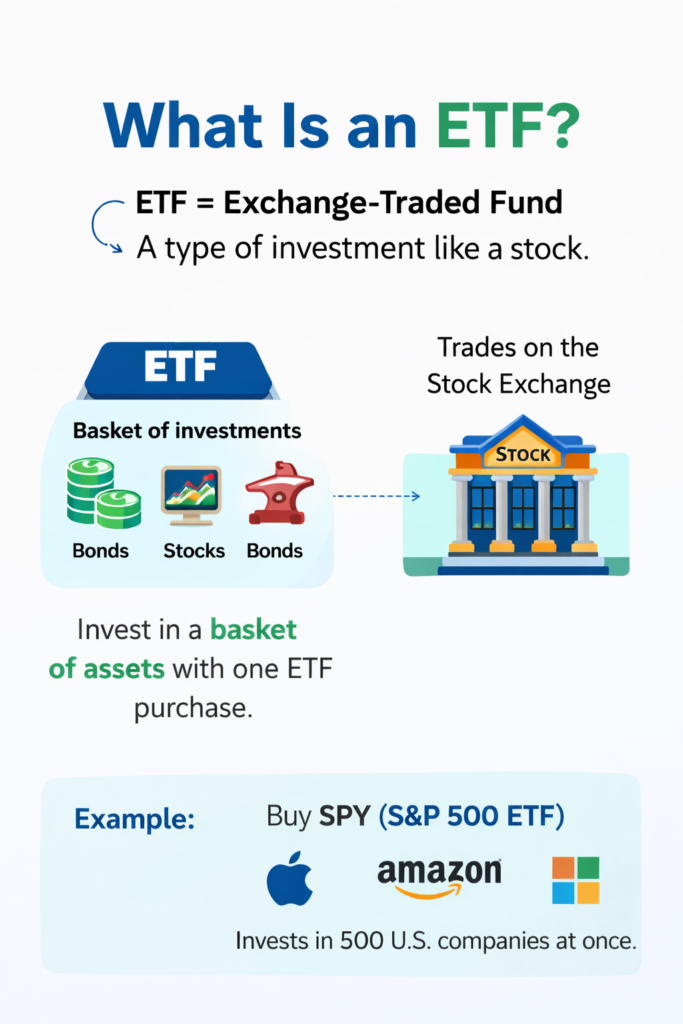
An ETF (Exchange-Traded Fund) is a type of investment that you can buy and sell on a stock exchange, just like a stock.
In simple terms, an ETF is a basket of assets—such as stocks, bonds, or commodities—that allows you to invest in many assets at once with a single purchase.
For example, when you buy SPDR S&P 500 ETF Trust, you are investing in hundreds of major companies like Apple, Microsoft, and Amazon in one trade.
What does ETF stand for?
ETF stands for Exchange-Traded Fund.
- “Exchange-traded” means it is bought and sold on stock exchanges
- “Fund” means it holds a collection of investments
This is why many people search for terms like what does ETF mean or what does ETF stand for in stocks.
What are exchange traded funds?
Exchange traded funds (ETFs) are investment funds that track a specific index, sector, or asset class.
Some common examples include:
- S&P 500 ETFs (such as SPY or VOO)
- Nasdaq ETFs (such as QQQ)
- Gold ETFs
Instead of picking individual stocks, investors can buy one ETF and gain exposure to an entire market.
How does an ETF work?
An ETF works by pooling money from investors and using it to buy a portfolio of assets.
Here is how it works step by step:
- The ETF provider builds a portfolio (for example, tracking the S&P 500)
- Shares of the ETF are listed on a stock exchange
- Investors buy and sell ETF shares throughout the day
The price of the ETF changes based on the value of the assets it holds.
For example, an ETF like QQQ tracks the Nasdaq 100, which includes major technology companies.
What is an ETF investment?
An ETF investment is a way to invest in a diversified portfolio without needing to buy each asset individually.
This makes ETFs especially popular among beginners.
Key benefits include:
- Diversification across many assets
- Lower costs compared to many mutual funds
- Easy access through any brokerage account
According to industry data from firms like Vanguard and Morningstar, ETF expense ratios are often as low as 0.03% to 0.20% per year, making them one of the most cost-efficient investment options.
ETF vs Mutual Fund
Many beginners compare ETFs with mutual funds.
The main differences are:
- ETFs trade throughout the day, while mutual funds are priced once per day
- ETFs usually have lower fees
- ETFs offer more flexibility for buying and selling
Because of these advantages, ETFs have become increasingly popular in recent years.
Types of ETFs
There are several types of ETFs available in the market.
Index ETFs
These track major indexes like the S&P 500.
They are the most common type of ETF.
Sector ETFs
These focus on specific industries such as technology, healthcare, or energy.
Dividend ETFs
These are designed to generate income by investing in dividend-paying stocks.
Leveraged ETFs
These aim to amplify returns (for example, 2x or 3x the market movement).
They are high-risk and generally not suitable for beginners.
Inverse ETFs
These are designed to profit when the market declines.
Popular ETF examples
Some of the most widely known ETFs include:
- SPY: Tracks the S&P 500
- QQQ: Tracks the Nasdaq 100
- VOO: Another S&P 500 ETF with low fees
These ETFs are commonly used by both beginners and professional investors.
Are ETFs good for beginners?
ETFs are widely considered one of the best investment options for beginners.
They are simple to understand, easy to access, and provide instant diversification.
Instead of trying to pick individual winning stocks, investors can use ETFs to follow the overall market.
Warren Buffett has often recommended index-based investing, stating:
“For most people, the best thing to do is own the S&P 500 index fund.”
What ETF should I invest in?
The best ETF depends on your goals.
- For long-term growth: S&P 500 ETFs or total market ETFs
- For technology exposure: Nasdaq-based ETFs
- For income: dividend-focused ETFs
Beginners often start with broad market ETFs because they offer a balanced and lower-risk approach.
How to Buy an ETF (Step-by-Step Guide)
Buying an ETF is simple and similar to buying a stock. Here is a step-by-step guide:
1. Open a brokerage account
To buy ETFs, you need an account with a broker such as Fidelity Investments, Charles Schwab, or Robinhood.You can watch how to buy an ETF step by step here
Most platforms today allow you to open an account online within minutes.
2. Fund your account
Deposit money into your account using a bank transfer or other supported payment methods.
3. Choose an ETF
Search for an ETF based on your goals:
- Broad market → S&P 500 ETFs (like VOO or SPY)
- Tech exposure → Nasdaq ETFs (like QQQ)
- Income → Dividend ETFs
Make sure to check:
- Expense ratio (fees)
- Holdings (what assets are inside)
- Historical performance
4. Place your order
Enter the ETF ticker (for example, SPY or QQQ), choose how many shares you want to buy, and place your order.
You can use:
- Market order (buy instantly at current price)
- Limit order (buy at a specific price)
5. Monitor and hold
Most beginners use a long-term strategy:
- Buy regularly
- Hold for years
- Avoid frequent trading
Simple Example
Let’s say you invest $100 into an S&P 500 ETF.
Instead of picking one company, your money is spread across hundreds of companies, reducing risk while still following overall market growth.
Pros and cons of ETFs
Advantages:
- Diversification
- Low cost
- Easy to trade
Disadvantages:
- Limited ability to outperform the market
- Some ETFs (like leveraged ETFs) carry high risk
- Still affected by market downturns
If you’re interested in ETFs, it likely means you’re starting to explore investing more seriously.
While ETFs are one of the easiest ways to begin, many people also want to understand how the market actually works and how to trade it.
If that’s you, you can check out our trading for beginners guide, where we break down the basics step by step in a simple and practical way.