Most traders start with indicators.
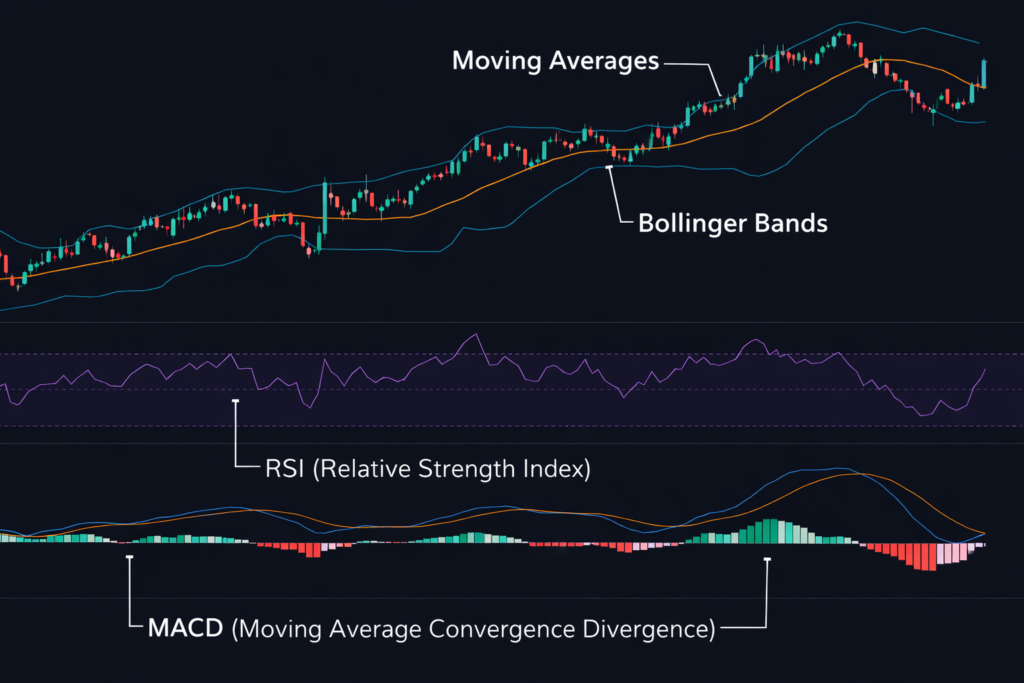
RSI. MACD. Moving averages.
They believe indicators will tell them when to buy or sell.
But here’s the truth:
👉 Indicators don’t predict the market.
👉 They react to it.
And that misunderstanding is why most traders lose.
Most traders start with indicators.
If you’re new, it’s important to first understand the basics of how markets actually work before relying on tools.
👉 Learn the fundamentals here: trading for beginners
What is an indicator and how it works?
An indicator is a mathematical calculation based on price data.
It transforms raw price into something easier to read.
For example:
- Moving Average → smooths price
- RSI → shows momentum
- MACD → shows trend strength
👉 Important:
Indicators don’t create information.
They only repackage existing price data.
What types of indicators exist?
What are trend indicators?
Trend indicators help identify direction.
Examples:
- Moving Average
- MACD
They answer:
👉 Is the market trending or not?
What are momentum indicators?
Momentum indicators measure strength.
Examples:
- RSI
- Stochastic
They answer:
👉 Is price accelerating or slowing?
What are volatility indicators?
Volatility indicators measure movement.
Examples:
- Bollinger Bands
- ATR
They answer:
👉 How strong is price movement?
Why do most traders fail using indicators?
Because they expect indicators to predict.
But indicators are lagging.
They react after price moves.
👉 Common mistakes:
- Using too many indicators
- Entering too late
- Ignoring market context
👉 Reality:
Indicators don’t fail.
Misuse does.
If you want to understand what actually makes traders profitable (beyond indicators), read this: how to actually make money from trading
Are indicators lagging or leading?
Most indicators are lagging.
Why?
Because they use past data.
Even “leading indicators” like RSI:
👉 Still based on previous price.
There is no true predictive indicator.
What is the best indicator?
There is no best indicator.
Only:
👉 The right tool for the right context.
Example:
- Trend market → moving average works
- Range market → RSI works
👉 The problem:
Traders use the same indicator everywhere.
Should you use indicators or price action?
This is controversial.
👉 Most pros rely on price action.
Why?
Because price is the source.
Indicators are derived.
👉 Better approach:
- Use price action as base
- Use indicator as confirmation
How to use indicators the right way?
How to combine indicators correctly?
Bad way:
- RSI + MACD + Stochastic (same function)
Good way:
- Trend + momentum + volatility
Example:
- EMA + RSI + ATR
To use indicators effectively, you also need a clean and flexible charting platform.
👉 See our full review here: tradingview review
How to avoid indicator overload?
Rule:
👉 If you need many indicators → you don’t understand the market.
Keep it simple.
When should you not use indicators?
Avoid indicators when:
- Market is choppy
- News events
- Low liquidity
👉 Indicators fail in unstable conditions.
FAQ about indicators
What is an indicator in trading?
A tool that analyzes price data to help decision-making.
Are indicators reliable?
Only when used correctly with context.
What is the best indicator?
There is no best indicator.
Should beginners use indicators?
Yes, but not depend on them.
Do professional traders use indicators?
Some do, but most prioritize price action.
If you are stuck in trading…
It’s not because you don’t have enough indicators.
It’s because you rely on them too much.
Learn to read price first.
Then use indicators as tools — not crutches.