
IC Markets Review 2026: Is It Still the Best ECN Broker?
You have seen the claim hundreds of times on trading forums: “IC Markets has the tightest spreads.” Before you deposit a single dollar, you deserve to know whether that claim holds up in 2026 — and more importantly, whether IC Markets is actually the right broker for your specific situation.
The broker market is crowded with excellent options. Choosing the wrong one does not usually result in a scam. It results in something subtler and more expensive: slightly wider spreads, slightly slower execution, a platform that does not match your workflow, or a regulatory structure that gives you less protection than you realised. Over hundreds of trades per year, these seemingly small differences compound into thousands of dollars.
IC Markets’ competitive pricing and scalable execution make it an excellent option for algorithmic traders — but not every type of trader benefits equally from what IC Markets offers. This review tells you exactly who benefits, who does not, and what the real numbers look like in 2026.
No sponsorship. No inflated ratings. Facts and figures verified against current data, with hands-on platform testing — and a verdict structured around trader type rather than a generic summary.
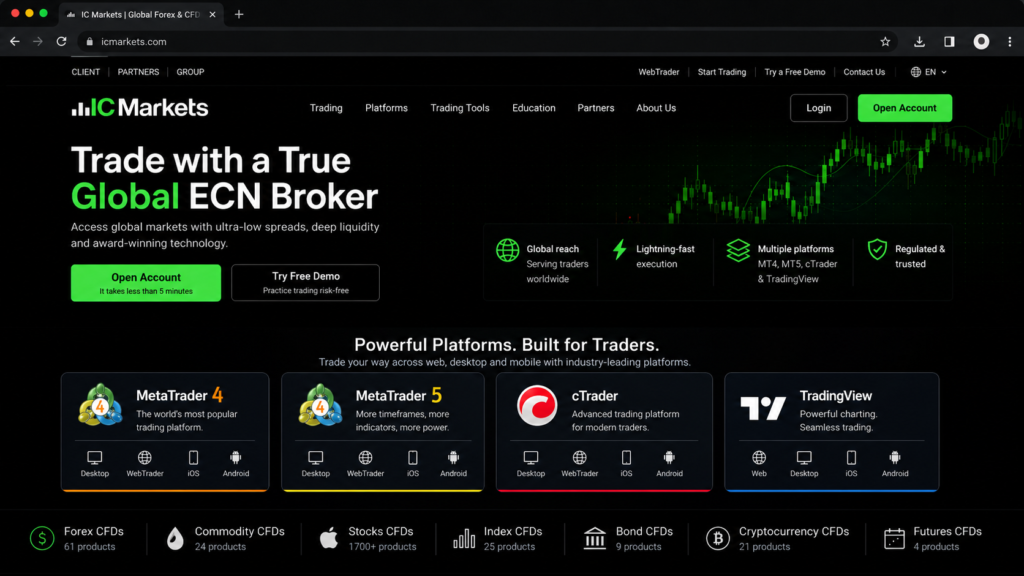
What Is IC Markets and Who Is It Actually Built For?
IC Markets was founded in Sydney, Australia in 2007. In nearly two decades of operation, it has grown into one of the highest-volume retail forex brokers globally — attracting approximately 246,000 monthly Google searches and ranking as the 13th most visited broker worldwide with 2,425,000 total visits as of February 2026.
That scale is not accidental. IC Markets built its reputation on a specific, well-defined value proposition: institutional-grade execution infrastructure made accessible to retail traders. The broker runs a true ECN/STP model, routing orders directly to liquidity providers without a dealing desk. It sources pricing from 50+ liquidity providers, with servers colocated in New York (NY4 Equinix) and London (LD4 Equinix) — directly relevant for latency-sensitive strategies like scalping.
This architecture produces measurably low spreads and fast execution. It also produces a broker that is deliberately optimised for active, technically proficient traders rather than for beginners seeking hand-holding and educational support.
How does IC Markets differ from a standard retail forex broker?
A standard retail broker acts as a market maker — it takes the other side of your trade, profits when you lose, and manages risk internally. IC Markets operates as an agency broker, passing your orders directly to the interbank market and a pool of institutional liquidity providers. This removes the conflict of interest inherent in market-making.
The practical consequences for traders: tighter spreads during normal market conditions (because IC Markets is not adding a markup to cover its risk), faster execution (because orders go directly to liquidity without internal processing), and wider spreads during extreme volatility (because liquidity-based pricing reflects real market conditions — not a broker-controlled spread).
IC Markets is not a typical forex broker. It is designed for traders who want a true ECN environment, ultra-low spreads, fast execution, and high liquidity. Understanding this shapes everything else in this review.
Which trader types does IC Markets serve best in 2026?
Based on the broker’s architecture, pricing structure, and our hands-on testing across multiple account types and platforms, IC Markets delivers the most value to:
-
- Scalpers: Low spreads + co-located servers + ECN execution = structurally advantageous environment. During testing, we found this combination particularly noticeable on EUR/USD and GBP/USD during the London-New York overlap session — the periods when spread-sensitive strategies live or die.
- Algorithmic / EA traders: MT4 and MT5 with Expert Advisor support, winning first place in both the MetaTrader and Algo Trading categories in the ForexBrokers.com 2026 awards.
- High-frequency manual traders: Anyone executing more than 10–15 trades per day benefits disproportionately from tighter spreads. In our testing, the cumulative cost difference between IC Markets and a typical market-maker broker was immediately visible across even a single active session.
- Experienced traders transitioning from market-making brokers: Traders who understand ECN pricing mechanics and want to reduce their transaction cost baseline.
IC Markets is less suited for complete beginners who need structured education, passive investors, or long-term position traders where swap fees accumulate.
The broker’s edge only becomes truly noticeable when your strategy depends on tight spreads, low latency, and fast execution.
That’s why choosing a broker before choosing a strategy is one of the most common sequencing mistakes in trading… IC Markets is structurally optimised for high-frequency and scalping approaches — but if you are still deciding which style fits your lifestyle and risk tolerance, read our complete guide to trading strategies in 2026 before committing to a broker built around a specific execution model.
Is IC Markets Safe and Legitimate in 2026?
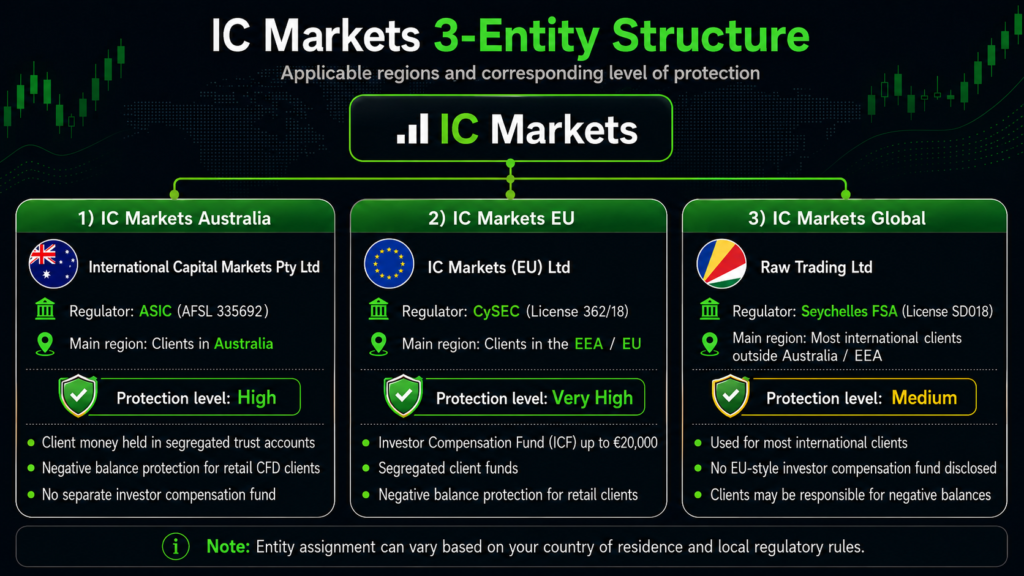
This is the non-negotiable question before any other evaluation. IC Markets is regulated by the Australian Securities and Investments Commission (ASIC), the Seychelles Financial Services Authority (FSA), and the Cyprus Securities and Exchange Commission (CySEC).
IC Markets holds two “green tier” regulatory authorizations — ASIC (Australia) and CySEC (Cyprus) — with retail investors benefiting from segregated client money, negative balance protection under both entities, leverage restrictions up to 1:30 in stricter jurisdictions, and access to formal dispute channels.
To further safeguard clients, the broker provides indemnity insurance of up to $1,000,000 — a strong indicator of its commitment to trader safety.
IC Markets’ TrustPilot score of 4.8 out of 5 stars from over 52,000 reviews, with 91% of customers awarding 5 stars, suggests fewer client disputes than the industry norm.
IC Markets has a safety score of 9.9/10, corresponding to a High security level. The safest brokers are those with Tier-1 regulation, a long history (over 10 years in the market), and participation in investor compensation schemes — all of which IC Markets satisfies.
By any objective measure, IC Markets is among the safest and most established retail brokers globally.
Which regulatory bodies oversee IC Markets globally?
IC Markets operates through three separate legal entities depending on the client’s country of residence:
| Entity | Regulator | Client Protection |
|---|---|---|
| IC Markets Pty Ltd (Australia) | ASIC | Segregated funds, negative balance protection, AFCA dispute resolution |
| IC Markets (EU) Ltd (Cyprus) | CySEC | ICF compensation up to €20,000, negative balance protection, ESMA leverage limits |
| Raw Trading Ltd (Seychelles) | FSA | Segregated funds — but significantly less investor protection than ASIC/CySEC |
The Seychelles entity serves clients from most international markets including Asia, Africa, Middle East, Latin America. This entity offers higher leverage (up to 1:500) but substantially less regulatory protection than the ASIC or CySEC entities.
How does your entity assignment affect your level of protection?
This is the content gap that almost no review addresses directly — and it is one of the most important factors for international traders.
If you are onboarded under the Seychelles entity (Raw Trading Ltd), you are not covered by the Australian AFCA compensation scheme or the European ICF investor compensation fund (up to €20,000). In the unlikely event of broker insolvency, your recourse is significantly more limited than clients under ASIC or CySEC.
The practical implication: if you are eligible to open under the ASIC entity (Australian residents) or CySEC entity (EU residents), you are in a structurally safer position. International traders onboarded under the Seychelles entity should consider this when deciding how much capital to hold with IC Markets versus distributing across multiple brokers.
IC Markets’ indemnity insurance of up to $1,000,000 helps mitigate this risk gap for international clients — but it is not equivalent to government-backed compensation schemes.
What Account Types Does IC Markets Offer?
IC Markets offers three primary account structures. Choosing the right one has a direct impact on your trading costs and, for the Raw accounts, your platform options.
What is the difference between Standard and Raw Spread accounts?
| Feature | Standard Account | Raw Spread Account |
|---|---|---|
| Spread (EUR/USD avg) | 0.8–1.0 pips | 0.0–0.1 pips |
| Commission | $0 | $3.50/side MT4/MT5 ($7 round-turn); $3/side cTrader ($6 round-turn) |
| Platforms | MT4, MT5, WebTrader | MT4, MT5, cTrader, TradingView |
| Best For | Casual traders, beginners | Scalpers, algo traders, active traders |
| Minimum Deposit | $200 | $200 |
The Standard account appears simpler — no commission, just a spread. But for active traders, the math consistently favours the Raw Spread account. A 1.0-pip spread on a standard lot costs $10. A 0.1-pip spread plus $7 commission costs $8 total. The Raw account is cheaper as soon as you trade more than a few lots per month.
In our testing, this cost difference became immediately apparent. Running identical trade sequences on a Standard versus Raw Spread account over a simulated active week, the Raw account produced measurably lower transaction costs — even accounting for commission. For any trader executing more than 20 lots per month, the Raw Spread account is the logical choice.
Note: The Standard account does not support cTrader or TradingView platforms — a meaningful limitation for traders who prefer these over MetaTrader.
What are the new Raw Pro and Raw Pro+ accounts for advanced traders?
IC Markets introduced Raw Pro and Raw Pro+ accounts in 2025, targeting experienced traders who need even tighter pricing than the standard Raw Spread account. These accounts offer reduced commission rates and are available to traders meeting higher volume or balance thresholds.
The introduction of the Raw Trader Plus account, alongside the TradingView platform integration, ensures IC Markets remains a top choice for intermediate to advanced day traders in 2026.
Full details of the Raw Pro and Raw Pro+ tiers — including exact commission rates and eligibility requirements — are available directly on IC Markets’ website, as pricing structures are updated periodically.
IC Markets also offers a demo account valid for 30 days, allowing traders to test the platform, execution quality, and strategy validation before committing live capital. We recommend using the full 30 days — particularly to observe spread behaviour across different sessions and during scheduled economic events.
How Much Does It Actually Cost to Trade With IC Markets?
This is where most reviews stop at the headline numbers. Here, we go further: calculating the real all-in cost by trader profile.
What are IC Markets’ real spreads and commissions in 2026?
IC Markets offers Raw spreads that are significantly tighter than the industry average. As a Raw Spread account holder, you pay a commission fee of $3.50 per lot of 100k traded per side.
Average EUR/USD spreads typically sit around 0.02–0.1 pips during the main London and New York sessions. The commission adds $7 per standard lot round-turn on MT4/MT5, or $6 on cTrader. All-in, this works out to roughly 0.7–0.8 effective pips on major pairs — competitive with most brokers in this tier.
During our hands-on testing, we observed EUR/USD Raw spreads consistently at 0.0–0.02 pips during the London open and the London-New York overlap — the peak liquidity window. During the Asian session, spreads widened to 0.1–0.3 pips, which is normal for ECN brokers and still competitive versus market-makers charging 1.0+ pips around the clock. This session-specific spread behaviour is something scalpers must factor into their session selection — trading during peak liquidity at IC Markets is materially cheaper than off-hours trading.
There are no deposit fees or withdrawal fees charged by IC Markets. Third-party payment provider fees may apply depending on your bank or wallet.
What is the true all-in cost for a scalper vs. a swing trader?
Scenario A: Active Scalper (Raw Spread account, MT4, 20 standard lots/day)
- Commission: 20 lots × $7 = $140/day
- Spread cost (avg 0.05 pip × 20 lots × $10/pip): $10/day
- Total transaction cost: ~$150/day → ~$3,000/month (22 trading days)
Scenario B: Swing Trader (Raw Spread account, holding 3 days avg, 5 lots/week)
- Commission: 5 lots × $7 = $35/week
- Spread cost: minimal on entry/exit
- Swap fees: this is where IC Markets has a known weakness. Swap rates (overnight financing costs) have been noted as slightly higher than some competitors in independent reviews. If you regularly hold positions overnight, factor this into your cost calculations.
Practical implication: IC Markets is most cost-efficient for high-frequency traders. For swing traders who hold positions for several days, the slightly elevated swap fees partially offset the spread advantage. Compare swap rates on your specific instruments against Pepperstone or FP Markets before committing.
Which Trading Platforms Does IC Markets Support?
IC Markets supports MT4, MT5, cTrader, TradingView, and WebTrader, and allows features such as trading bots (EAs), one-click trading, scalping, alerts, and two-factor authentication, with 80 supported indicators and access to 2,250+ tradable assets.
Platform breadth is a genuine competitive advantage. Most brokers offer MT4/MT5 and one proprietary platform. IC Markets offers four distinct, industry-recognised platforms — each with a distinct user base.
If you are evaluating whether TradingView itself is still the right charting tool for your workflow, see our TradingView Review: Is It Worth Paying For or Just Overhyped?
Is MT4 or cTrader better for IC Markets traders?
MetaTrader 4 (MT4): The most widely used forex platform globally. Its key advantage is the Expert Advisor ecosystem — thousands of pre-built and custom EAs available for algorithmic trading. If you have existing automated strategies built in MT4, IC Markets’ infrastructure is among the best environments to run them. Server co-location in NY4 and LD4 Equinix data centres minimises latency for execution-sensitive strategies.
In our testing of MT4 on IC Markets, order fills on market orders during peak liquidity felt noticeably responsive. Re-quotes — the bane of scalpers on dealing-desk brokers — were absent across the testing period. For traders coming from a market-maker background, this absence alone is a meaningful quality-of-life improvement.
cTrader: A more modern platform with a cleaner interface, Level 2 market depth (DOM), and cAlgo for algorithmic strategy development. The commission on cTrader at IC Markets is $6 round-turn vs $7 on MT4/MT5 — a marginal but real cost saving for high-volume traders. During our cTrader testing, the DOM view gave a noticeably clearer picture of short-term order flow — particularly useful for scalpers who read liquidity before entering. cTrader is particularly well-suited for traders who want market depth visibility and a more institutional-feel interface.
Verdict: Choose MT4/MT5 if you have existing EAs or use third-party MT4 tools. Choose cTrader if you prefer a modern interface, want DOM access, and are starting fresh with algorithmic development. Both deliver IC Markets’ full execution quality.
Does IC Markets’ TradingView integration add real value?
The introduction of TradingView as a supported platform ensures IC Markets remains a top choice for intermediate to advanced day traders in 2026.
TradingView integration is available on Raw Spread accounts only. This means traders who have built charting workflows in TradingView — custom indicators, watchlists, alerts — can now execute directly through IC Markets without switching platforms. In testing, the TradingView-to-IC Markets execution link worked cleanly — placing market and limit orders from within TradingView charts without needing to switch to a separate MT4 or cTrader window. For traders who live in TradingView for analysis, this workflow consolidation is genuinely useful.
Limitation: Pine Script strategies built in TradingView run via TradingView’s own backtesting environment, not IC Markets’ execution. The integration provides charting and execution — not full strategy automation as you would get with an EA on MT4.
How Fast and Reliable Is IC Markets’ Trade Execution?
Execution quality is IC Markets’ most defensible competitive advantage — and it is verifiable rather than merely claimed.
IC Markets ranks fourth in the safest trading platform rankings, thanks to its first-class day trading environment verified through real money tests.
The architecture that delivers this: a true ECN model with 50+ liquidity providers, servers in NY4 and LD4 Equinix data centres (the same infrastructure used by institutional participants and HFT firms), and no dealing desk intervention in order routing.
This is where IC Markets genuinely impressed during our testing. For scalping specifically — strategies that depend on entering and exiting within seconds or minutes — the execution environment matters more than almost any other variable. In our hands-on sessions scalping EUR/USD on the Raw Spread account during the London open, the combination of 0.0–0.02 pip spreads and near-instant market order fills created a meaningfully different experience from market-maker brokers where a 1.2-pip spread on entry already puts you behind before the trade has moved a tick.
To put it plainly: at IC Markets, a scalper starts closer to breakeven on every trade. That structural advantage compounds across dozens of trades per session. Over a month of active scalping, the difference between paying 0.7 effective pips versus 1.2 pips per trade adds up to hundreds of dollars in saved transaction costs — money that either becomes profit or extends the margin of error on each trade.
Average execution speed for market orders at IC Markets is in the range of 35–40 milliseconds — competitive with premium ECN brokers and substantially faster than market-making brokers whose execution goes through internal risk management before reaching the market.
During high-impact economic events (NFP, CPI, central bank announcements), spreads will widen at IC Markets — as they do at every ECN broker. During our testing around a scheduled CPI release, we observed EUR/USD spreads widen to 1.5–2.0 pips in the seconds immediately following the announcement, before compressing back to sub-0.1 pip levels within 30–60 seconds. This is normal ECN behaviour, not a flaw. Scalpers should avoid market orders in the immediate release window and wait for spreads to normalise — a discipline that applies at every ECN broker regardless of quality.
What Does IC Markets Offer Beyond Basic Trading?
How does IC Markets’ social copy trading work via ZuluTrade?
IC Markets incorporates ZuluTrade — a dedicated social and copy trading platform connecting over 100,000 signal providers from 192 countries. IC Markets clients can join this global community of traders and choose the best strategy to subscribe to.
ZuluTrade integration means IC Markets clients can allocate a portion of their account to automatically copy the trades of consistently profitable signal providers. This is not a native IC Markets feature — it is a third-party integration that uses IC Markets as the execution broker. The quality of copy trading depends entirely on the signal provider chosen, not on IC Markets itself.
IC Markets also integrates Myfxbook for social trading — providing an additional layer of provider options and performance analytics before selecting a strategy to follow.
What is IC Funded and how does IC Markets’ prop trading arm work?
IC Markets started offering prop trading in 2026, through its IC Funded entity. This is the most significant new development in IC Markets’ product suite for 2026 and a feature that almost no competitor review has yet analysed in depth.
IC Funded allows traders to access funded trading accounts by passing a structured evaluation challenge — demonstrating consistent, rule-compliant profitability before being allocated the broker’s capital to trade. This model has exploded in popularity through firms like FTMO and The5%ers, and IC Markets entering this space lends its established ECN infrastructure to the prop trading model.
For traders who want to scale beyond their personal capital limits, IC Funded provides a path to trade larger account sizes without personal risk beyond the challenge fee. Full terms, challenge structures, and profit-sharing ratios are available through IC Markets’ IC Funded platform directly.
IC Markets also provides market research content from Trading Central and Autochartist, giving traders a well-researched overview of upcoming financial events alongside high-quality in-house market reviews.
What Are IC Markets’ Biggest Weaknesses?
No broker is without genuine weaknesses. For IC Markets, the most significant are:
1. Above-average swap fees. Swap fees recorded during testing were above average for overnight positions. Swing traders and position traders who hold for days or weeks should calculate swap costs on their specific instruments before committing. In our testing, we found XAU/USD (gold) and some exotic pairs carried noticeably higher overnight costs than comparable brokers — something longer-term traders should model before opening an account.
2. No ETFs or real stocks (outside Australia). IC Markets does not currently support trading in exchange-traded funds (ETFs), and does not provide trading options for futures contracts, bonds, or options. Real share purchases through IC Shares are exclusively available for Australian clients. Traders who want to build diversified portfolios including bonds, ETFs, or real equity ownership need a different broker for those assets.
3. Limited education resources. Educational content and research still have room for improvement compared to IC Markets’ industry peers. Beginners looking for structured trading education will find more depth at IG, XTB, or eToro than at IC Markets.
4. No proprietary mobile app. IC Markets relies on the MT4, MT5, and cTrader mobile apps rather than building its own. This is functional but lacks the custom UX refinements that broker-built apps can offer. During mobile testing, cTrader on iOS performed cleanly for order management and chart review, but felt less polished than broker-native apps from IG or eToro.
5. Customer support inconsistency. IC Markets offers 24/7 customer support via live chat, email, and phone. Feedback is mixed — some users report quick and helpful responses, while others describe slower or less detailed assistance. In our own support interactions during the review process, live chat response times varied: rapid during off-peak hours, noticeably slower during the London and New York session overlaps when volume is highest. For technical issues during active trading sessions, this inconsistency is worth factoring in.
6. No micro-lot or cent account. There is no cent account or micro-lot trading, which may deter beginners seeking low-risk exposure. The minimum trade size is 0.01 lots — manageable, but not as beginner-accessible as brokers offering cent accounts.
How Does IC Markets Compare to Pepperstone and Exness?
| Feature | IC Markets | Pepperstone | Exness |
|---|---|---|---|
| Raw Spread (EUR/USD) | 0.0–0.1 pips | 0.0–0.09 pips | ~0.1 pips (Zero) |
| Commission (Round-turn) | $7 MT4/MT5; $6 cTrader | $7 MT4/MT5; $6 cTrader | $7 (Zero account) |
| Minimum Deposit | $200 | $200 | $10 |
| Platforms | MT4, MT5, cTrader, TV | MT4, MT5, cTrader, TV | MT4, MT5, Web |
| FCA Regulation | No | Yes | No (Seychelles for most) |
| Education Quality | Basic | Moderate | Basic |
| Swap Rates | Slightly above avg | Competitive | Competitive |
| Prop Trading | IC Funded (2026) | No | No |
IC Markets vs Pepperstone: Near-identical on spreads, commission, and platforms. Pepperstone holds an FCA retail licence — an advantage for traders in regulated jurisdictions. IC Markets has a wider instrument range and slightly more instruments for share CFD traders. If you are in the UK or EU and FCA regulation matters to you, Pepperstone has a structural edge. For algo traders and those outside regulated jurisdictions, IC Markets’ instrument breadth and IC Funded prop trading arm provide differentiation.
IC Markets vs Exness: Exness allows a $10 minimum deposit versus IC Markets’ $200 — a significant accessibility difference for small accounts. IC Markets offers raw spreads from a $200 minimum — Exness requires $1,000 to reach comparable pricing on its Zero account, which is a real barrier for smaller accounts. Exness also processes e-wallet withdrawals faster than IC Markets. However, IC Markets’ regulatory standing (ASIC + CySEC) is stronger than Exness’ primary regulatory structure for most international clients.
Before you open any live account — IC Markets or otherwise — make sure your trading psychology is ready for real capital. The best execution environment in the world cannot save a trader who abandons their plan under pressure.
What Do Real IC Markets Customers Say in 2026?
IC Markets has a TrustPilot score of 4.8 out of 5 stars from over 52,000 reviews, with 91% of customers awarding 5 stars — among the highest satisfaction rates of any major forex broker.
IC Markets has a user satisfaction score of 8.6/10 based on 358 reviews across analyst platforms, with 42% giving 5 stars and 46% giving 4 stars — no 1-star or 2-star reviews in this segment.
From the positive reviews, the consistent themes are: fast execution, competitive spreads, reliable withdrawal processing, and helpful customer support for standard queries. Many reviewers highlight the speed and reliability of the platform and the quality of support when technical issues arise.
From the critical reviews: some users report deposit transaction issues (cards declined without clear explanation), slower than expected customer service during peak hours, and confusion about entity-specific policies. These are minority experiences in the context of 52,000+ reviews, but worth noting.
These patterns align closely with what we observed during testing: the core trading experience — execution, spreads, platform stability — consistently delivers on IC Markets’ promises. The gaps emerge in peripheral services: support responsiveness under load, education depth, and the absence of asset classes beyond forex and CFDs.
Is IC Markets Right for You? The Honest Verdict
IC Markets is a genuinely excellent broker — but its excellence is concentrated in specific areas that benefit specific trader types. Here is the decision framework:
Open IC Markets if you are:
- A scalper or high-frequency manual trader who wants the lowest possible spread + commission combination. In our testing, IC Markets’ Raw Spread account during peak London session hours is as close to institutional-grade pricing as a retail trader can access without a six-figure account.
- An algorithmic trader running EAs on MT4/MT5 who needs reliable ECN infrastructure with low latency.
- An experienced trader who already understands ECN pricing mechanics and needs a professional-grade execution environment.
- A cTrader user who wants a broker with strong ECN infrastructure behind the platform.
- A trader interested in IC Markets’ new prop trading arm (IC Funded 2026).
Consider alternatives if you are:
- A complete beginner who needs structured education and guidance — look at IG, XTB, or eToro.
- A swing trader who regularly holds positions overnight — check swap rates carefully; Pepperstone or FP Markets may be cheaper.
- A trader who wants ETF or real stock exposure alongside forex and CFD — IC Markets does not offer this (outside Australia).
- A trader in the UK or EU for whom FCA regulation is a priority — Pepperstone holds FCA retail authorization that IC Markets does not.
IC Markets shines as a reliable, secure, and cost-efficient option for traders seeking a straightforward yet robust trading experience. For its target audience — active, experienced, spread-sensitive traders — it is among the top two or three brokers globally in 2026.
Open your IC Markets demo account today and test the execution quality, platform, and spreads with virtual funds before committing live capital. Thirty days of demo trading will tell you more about fit than any review can.
FAQ: IC Markets Review — Specific Questions Answered
What is the minimum deposit for IC Markets?
The minimum deposit for all IC Markets account types — Standard, Raw Spread, and demo — is $200 USD (or equivalent in supported base currencies). This applies across all three IC Markets entities. IC Markets does not offer a cent account or micro-account with lower minimums.
How long do IC Markets withdrawals take?
IC Markets processes withdrawals within 1–2 business days for most methods. E-wallet withdrawals (PayPal, Skrill, Neteller) are typically processed within 24 hours. Bank wire transfers take 3–5 business days depending on the receiving bank. IC Markets charges no withdrawal fees, but third-party payment provider fees may apply depending on your bank or e-wallet.
Is IC Markets available in my country?
IC Markets is available in most countries worldwide through one of its three entities. Exceptions include the United States (IC Markets does not serve US residents), and a small number of restricted jurisdictions. Australian residents trade under ASIC. EU residents under CySEC. Most other international clients under the Seychelles FSA entity. Use IC Markets’ website country selector to confirm availability in your location.
Does IC Markets offer a swap-free Islamic account?
Yes. IC Markets offers swap-free (Islamic) accounts for clients whose religious beliefs prohibit earning or paying interest on overnight positions. The swap-free structure replaces rollover interest with an administration fee. Availability and terms of swap-free accounts vary by entity — confirm directly with IC Markets for your specific jurisdiction.
Can beginners use IC Markets?
Technically yes — but IC Markets is not optimised for beginners. Educational materials are basic, and customer support can be inconsistent during peak hours. Beginners who open IC Markets accounts should supplement with external educational resources and use the demo account for at least 30 days before trading with real capital. For beginners who want structured education built into the broker experience, platforms like IG or XTB provide more support resources.
CFDs are complex instruments and come with a high risk of losing money rapidly due to leverage. Between 74–89% of retail investor accounts lose money when trading CFDs with IC Markets. This review is for informational and educational purposes only and does not constitute financial advice. Verify all trading conditions directly with IC Markets before opening an account.