
Finding the lowest spread forex brokers is one of the most important decisions an active trader can make. Every pip you save on spread goes directly to your bottom line — compounded across hundreds of trades per year, the difference is significant.
Every broker says they have the “lowest spread.” Every single one.
Some advertise 0.0 pips. Others show a table with EUR/USD at 0.6 pips. One claims tighter spreads than interbank pricing. And you’re sitting there, trying to figure out which one is actually telling the truth — and which is just running the best marketing campaign.
Here’s the uncomfortable reality: most “lowest spread” comparisons are comparing apples to oranges. Raw spreads, standard spreads, all-in costs, and commission-adjusted costs are four completely different numbers — and 90% of traders don’t know the difference.
This guide cuts through the noise. We present verified 2026 spread data, explain the actual all-in cost formula, and give you a clear ranked comparison of the brokers that genuinely deliver the lowest trading costs — not just the lowest headlines.
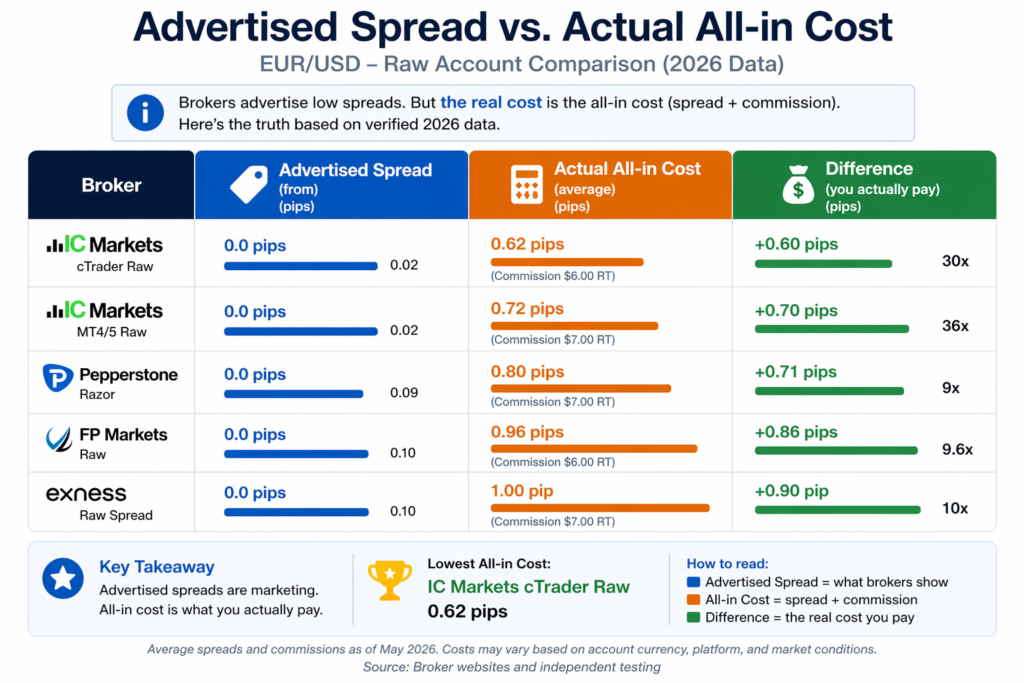
Does Spread Actually Matter in Practice? My Experience
I trade forex majors — EUR/USD, GBP/USD, USD/JPY — primarily as a swing trader holding positions overnight.
Honest answer: for swing trading, spread is less critical than most people think. If you’re holding a trade for 2–5 days, a 0.2 pip difference in entry cost is noise compared to your target.
But here’s where it does matter:
**1. Entries on lower timeframes**
I use M5 and M15 for entry timing even on swing trades.At that level, tighter spread means your entry cost is lower and your stop placement is more precise. On IC Markets, entries on EUR/USD during active sessions feel cleaner — less gap between where I want to enter and where I actually fill.
**2. If you also scalp occasionally**
I don’t scalp as my main strategy, but when I do take shorter trades, the spread difference between a retail broker and an ECN broker is immediately obvious. On a retail broker you’re paying 1.5–2 pips before the trade starts. On IC Markets cTrader Raw, that drops to near zero plus a flat commission.
**3. Volume compounds the cost**
At 20–30 trades per month on standard lots, even 0.5 pip difference per trade adds up to real money over a year.
**Bottom line from actual trading:**
Spread matters more than beginners think and less than some advanced traders obsess over. For active traders doing 20+ trades a month on major pairs, ECN execution with raw spread is worth the switch.
👉 Full broker comparison by actual cost → IC Markets vs Pepperstone
What does “lowest spread” actually mean in forex trading?
Before ranking any broker, you need to understand what you’re actually measuring. “Spread” is deceptively simple-sounding. In practice, it’s the most misrepresented number in retail forex marketing.
The spread is the gap between the buy (ask) price and sell (bid) price of a currency pair. If EUR/USD is quoted at 1.08503/1.08511, the spread is 0.8 pips. That 0.8 pips is your immediate cost the moment you enter the trade — before the market moves a single tick in your favor.
The spread is the difference between the bid and ask prices in the market — the compensation to the broker for providing the trader with access to the forex market. Spreads are a function of how much a broker is willing to sell an asset to traders, as well as how liquid the asset is. Liquid currency pairs such as EUR/USD and GBP/USD typically attract lower spreads than illiquid pairings. Spreads can also widen considerably when markets are very volatile — a phenomenon known as slippage.
Every time you open a position, you pay the spread. Close 100 trades per month on 1 standard lot each — and 1 pip of spread costs you $1,000. That’s $12,000 per year just in spread friction. This is why finding the genuinely cheapest broker isn’t a nice-to-have. It’s a performance variable.
Is “0.0 pip spread” real or just a marketing headline?
It’s real — and it’s misleading at the same time. Here’s how: a raw spread of 0.0 pips means there is literally no markup between the interbank buy and sell price. For a millisecond during peak London-New York overlap, EUR/USD can genuinely show 0.0 pips on a raw account.
But you’re not paying 0.0 pips. You’re paying 0.0 pips plus commission.
Raw spread accounts offer spreads as low as 0.0 pips but charge a per-lot commission — usually $3–7 per standard lot round trip. Standard accounts have wider spreads, typically 1–2 pips, but no commission. For high-volume traders and scalpers, raw spread accounts are usually cheaper overall. Total cost equals spread in pips times $10 per pip for one lot, plus commission.
A 0.0 pip spread with $7 commission is identical in cost to a 0.7 pip spread with zero commission. Different packaging, same price. The brokers advertising “0.0 pips” aren’t lying — they’re just showing you half the equation.
What is the difference between raw spread and all-in cost?
Raw spread: the spread offered before adding commission. This is what brokers advertise in their marketing.
All-in cost: raw spread converted to pip-equivalent, plus commission converted to pip-equivalent. This is what you actually pay.
Formula:
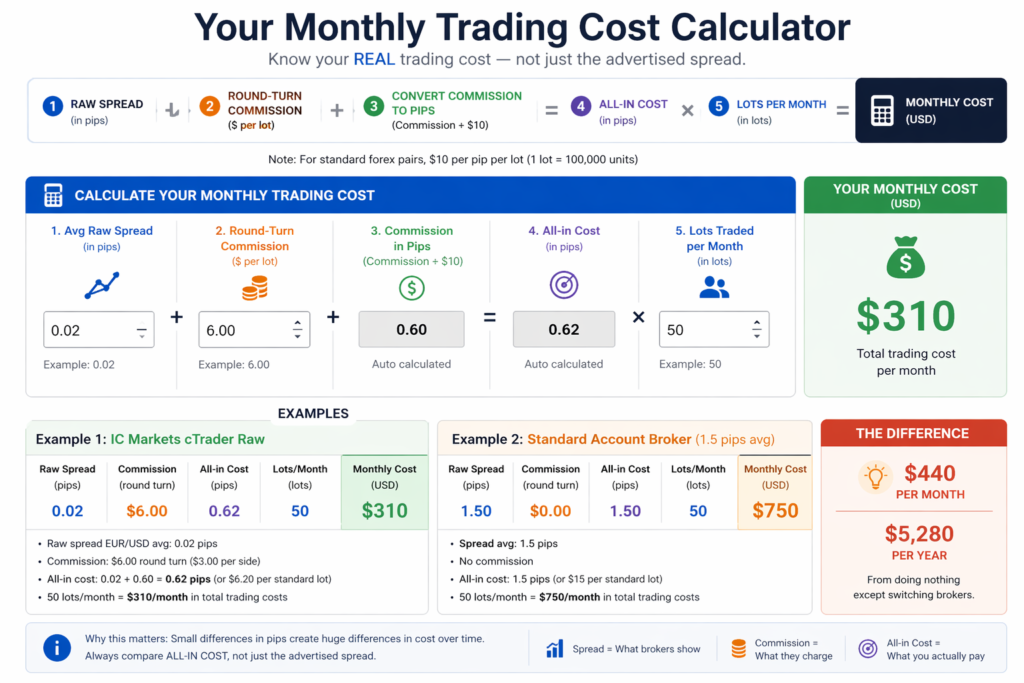
All-in cost (pips) = Raw spread + (Commission per lot ÷ $10)
Example: IC Markets cTrader Raw — 0.02 pip spread + ($6 ÷ $10) = 0.02 + 0.60 = 0.62 pips all-in
This single formula changes everything about how you evaluate brokers. Always use it. Never compare raw spreads in isolation.
How do you calculate the real cost of a forex trade?
Let’s make this concrete with numbers, because abstract comparisons don’t reveal what you actually lose or save.
What is the all-in cost formula every trader must know?
Here’s the complete cost breakdown you need every time you evaluate a new broker:
Step 1: Find the average raw spread (not the “from” figure — the average). Step 2: Find the round-turn commission per standard lot (1 lot = 100,000 units). Step 3: Apply: All-in cost = Raw spread + (Commission ÷ $10) Step 4: Multiply by number of lots/month to get monthly cost.
Example for IC Markets cTrader Raw:
- Raw spread EUR/USD avg: 0.02 pips
- Commission: $6.00 round turn
- All-in cost: 0.02 + 0.60 = 0.62 pips (or $6.20 per standard lot)
- 50 lots/month = $310/month in total trading costs
Example for a standard account broker at 1.5 pips avg:
- No commission
- All-in cost: 1.5 pips (or $15 per standard lot)
- 50 lots/month = $750/month in trading costs
The difference: $440 per month. $5,280 per year. From doing nothing except switching brokers. 👉 Switch to IC Markets here and reduce your trading costs
*Note: Availability depends on your country (US traders may need alternative brokers).*
How much does 0.1 pip difference cost you over 100 trades?
If you are a scalper who takes approximately 300 trades a month on the EUR/USD using a standard lot each time, a reduction in spreads by 1 pip is a savings of $10 per pip, and $3,000 a month. That is massive.
Even a 0.1 pip difference — which sounds trivial — means $1 per lot. At 100 trades per month on 1 lot each: $100 saved monthly, $1,200 per year. At 300 trades/month at 2 lots each: $600 saved monthly, $7,200 per year. Now you understand why professional traders fight over fractions of a pip.
Spread Comparison on Minor Pairs
Beyond EUR/USD, here’s how IC Markets and Pepperstone compare on pairs swing traders commonly ask about:
| Pair | IC Markets Raw | Pepperstone Razor | All-in Cost Diff |
|---|---|---|---|
| NZD/JPY | ~1.2 pips + $3.5 | ~1.3 pips + $3.5 | Similar |
| EUR/GBP | ~0.8 pips + $3.5 | ~0.9 pips + $3.5 | Similar |
| AUD/USD | ~0.1 pips + $3.5 | ~0.1 pips + $3.5 | Equal |
For swing traders holding NZD/JPY or other cross pairs overnight, swap rates matter more than spread at entry. Always check current swap rates directly on each broker’s platform before trading cross pairs.
Which brokers have the lowest spread on EUR/USD in 2026?
Here is the verified, all-in cost ranking for EUR/USD based on published and tested data updated to 2026:
Master Comparison Table — All-in Cost, EUR/USD:
| Broker | Account | Raw Spread (avg) | Commission (RT) | All-in Cost |
|---|---|---|---|---|
| IC Markets | cTrader Raw | 0.02 pips | $6.00 | ~0.62 pips |
| IC Markets | MT4/MT5 Raw | 0.02 pips | $7.00 | ~0.72 pips |
| Tickmill | Raw | 0.11 pips | $6.00 | ~0.71 pips |
| FP Markets | Raw ECN | 0.10 pips | $6.00 | ~0.70 pips |
| Fusion Markets | RAW | 0.09 pips | $4.50 | ~0.54 pips* |
| Pepperstone | Razor | 0.09–0.10 pips | $7.00 | ~0.80 pips |
| Tradu | Standard | — | $0 | Lowest avg 2026† |
| IC Markets | Standard | 0.62 pips avg | $0 | 0.62 pips |
*Fusion Markets wins on commission cost ($4.50 vs $6–7) but has slightly wider raw spreads than IC Markets. Combined all-in, Fusion is the cheapest on pure commission math. †Tradu won the ForexBrokers.com 2026 Annual Award for #1 Trading Fees for lowest average EUR/USD spreads among all tested brokers.
What are IC Markets’ actual raw spreads and commissions?
IC Markets’ cTrader Raw account charges $3.00 per side ($6.00 round turn), while the MetaTrader Raw Spread account is $3.50 per side ($7.00 round turn). IC Markets lists an average EUR/USD spread as low as 0.02 pips; all-in costs are around 0.62 pips on cTrader Raw and 0.72 on MetaTrader Raw.
IC Markets achieves these near-interbank spreads through direct access to over 50 liquidity providers and a high-volume matching engine at the Equinix NY4 data center. The Raw Pro and Raw Pro+ accounts slash commissions to just $3.00 and $2.00 per lot per side respectively — some of the lowest available for qualifying high-volume traders.
For most traders, the cTrader Raw account is the optimal entry point. The $1 per lot savings over the MT4/MT5 Raw account is modest on small volumes but meaningful at scale. If you’re doing 100+ lots/month, the difference is $100/month — worth the minor learning curve of switching from MT4 to cTrader.
How does Fusion Markets achieve the lowest commission rate?
Fusion Markets offers the lowest commission rate of any forex broker at $2.25 per side ($4.50 round turn). With RAW spreads from 0.14 pips on EUR/USD across 84 currency pairs, Fusion Markets provides ECN execution with no minimum deposit.
The trade-off is spread width. IC Markets maintains lower raw spreads with better consistency — 0.02 pips on EUR/USD and 0.03 on AUD/USD. Even cross pairs like EUR/JPY and AUD/JPY have noticeably tighter spreads than Fusion. Fusion charges just $2.25 per side, one of the lowest rates in the industry — but IC Markets more than compensates with consistently tighter spreads across both standard and raw accounts.
The mathematical reality: Fusion’s lower commission + wider spread vs IC Markets’ higher commission + tighter spread comes out roughly equivalent for EUR/USD — both in the $5.40–$6.20 per lot range. For major pairs: it’s a near draw. For cross pairs and exotics: IC Markets wins on total cost.
Where do Tickmill, FP Markets, and Pepperstone rank on costs?
Tickmill: Tickmill’s Raw account charges $3.00 per side ($6 round turn) and lists a typical EUR/USD spread of 0.11 pips, for an estimated 0.71 pips all-in. Tickmill’s VIP account is the most compelling offer for high-volume traders: at $1/side, it cuts commission costs dramatically. Minimum VIP qualification is typically $50,000+ balance.
FP Markets: FP Markets’ Raw ECN account averaged about 0.1 pips on EUR/USD, coming to roughly 0.8 pips all-in after its flat $6 per round turn per standard lot. FP Markets excels on cross pairs and exotic pairs, where it often beats IC Markets.
Pepperstone: Pepperstone’s Razor account averages about 0.09–0.10 pips raw spread with $7 round turn commission, giving an all-in cost of ~0.80 pips. Pepperstone trails IC Markets on pure cost but leads on platform diversity (TradingView, Smarttrader Tools) and regulatory breadth.
Which low spread broker is best for scalping and day trading?
Scalping and day trading are where spread costs matter most — because you’re opening and closing positions dozens of times per session. Every fraction of a pip compounds directly into your P&L.
IC Markets has built its reputation as the go-to broker for serious scalpers. The combination of raw spreads, institutional-grade infrastructure, and explicit scalping support makes it the benchmark against which other brokers are measured. Raw spreads from 0.0 pips, EUR/USD averages 0.1 pips during liquid sessions. Commission: $7 per round turn (MT4/MT5) or $6 per round turn (cTrader). Execution speed: under 40ms average, sub-millisecond on cTrader.
For EA traders and algorithmic scalpers specifically, IC Markets is the technical gold standard:
- Zero requote policy
- No minimum order distance restrictions
- $29B+ daily FX volume through its matching engine
- No restriction on scalping or hedging strategies
For discretionary scalpers who chart on TradingView: Pepperstone is the better fit, because it integrates TradingView natively while IC Markets does not.
For the absolute lowest cost scalping (pure commission math): Fusion Markets with its $4.50 round turn commission. Just accept slightly wider raw spreads.
Scalping Cost Per 300 trades/month (1 lot each, EUR/USD):
| Broker | All-in cost/lot | Monthly cost (300 trades) |
|---|---|---|
| IC Markets cTrader Raw | $6.20 | $1,860 |
| Fusion Markets RAW | ~$5.50 | $1,650 |
| Tickmill Raw | ~$7.10 | $2,130 |
| Pepperstone Razor | ~$8.00 | $2,400 |
| Industry Avg Standard | ~$12.00 | $3,600 |
The gap between Fusion Markets and an industry-average standard account: $1,950 per month on 300 lots. $23,400 per year. This is not a rounding error. This is a car payment — or a family vacation — saved by simply choosing the right broker.
What is the hidden danger of “zero spread” accounts?
Here is the piece every low spread article conveniently skips. The number printed on a broker’s website is the average spread during normal trading hours. It is not the spread you’ll actually get every time you trade.
How much do forex spreads widen during news events?
Spreads can widen considerably when the markets are very volatile — a phenomenon known as slippage. It is essential to operate with a broker that not only gives you low spreads under normal market conditions, but also under conditions of excessive volatility.
During major news events — NFP, FOMC, CPI — EUR/USD spreads on “0.0 pip” accounts can spike to 5, 10, even 30+ pips for seconds. If your trade executes during that spike, your “0.62 pip all-in cost” becomes a “15-pip cost.” Your stop-loss may be triggered immediately. Your scalp trade is killed before it starts.
This is not a niche problem. It happens every news release. For scalpers who trade news, this is an existential risk.
How to protect yourself:
- Always check a broker’s spread during news events, not just average spreads.
- Use limit orders rather than market orders during high-volatility periods.
- Consider avoiding positions 5 minutes before and after major releases.
Which brokers handle spread spikes the best?
IC Markets and Pepperstone — both with deep multi-LP liquidity pools — generally show tighter spreads during volatility than smaller ECN brokers. Their liquidity depth (IC Markets processes $29B+ daily) provides more cushioning when individual LPs widen.
Smaller brokers like Fusion Markets, with fewer LPs, may show wider spikes during news. This is the trade-off for lower commissions.
Rule of thumb: For news-sensitive strategies, prioritize liquidity depth (IC Markets, Pepperstone). For quiet-session strategies or commission-sensitive overnight trading, Fusion Markets delivers superior cost efficiency.
Standard account vs raw spread account: which is cheaper for you?
This is the most practically important decision new traders face. The answer is not always “raw account.”
The fees are the only difference with the standard account having spreads marked up 0.6 pips compared to the raw account that has a commission added. Beginner traders often prefer the standard account based on fee simplicity while advanced traders should choose the raw spread account, which is the most popular account type.
Standard account wins when:
- You trade fewer than 5–10 lots per month (commission overhead outweighs spread savings)
- You make frequent micro-lot trades (commission minimums make it proportionally expensive)
- You prefer simple, predictable per-trade costs
- You’re learning and want to minimize administrative complexity
Raw spread account wins when:
- You trade 10+ standard lots per month
- You scalp or day trade frequently
- You run EAs or high-frequency strategies
- You want the tightest possible pricing during peak liquidity hours
Break-even calculation (IC Markets example):
- Standard account: 0.62 pip spread avg = $6.20 per standard lot
- Raw Spread (cTrader): 0.02 pip spread + $6 commission = $6.20 per standard lot
IC Markets’ Standard account is uniquely competitive — it matches the cost of many brokers’ raw accounts. For traders with smaller accounts or inconsistent volume, it removes commission complexity without sacrificing much pricing.
Which low spread broker is best for your trading style?
Stop looking for the universally “best” low spread broker. It doesn’t exist. The best broker is the one whose cost structure aligns with your trading frequency, style, and platform preference.
| Trading Profile | Best Broker | Why |
|---|---|---|
| Pure scalper (max volume, max speed) | IC Markets (cTrader Raw) | Lowest all-in, deepest liquidity, zero requotes |
| Cost-obsessed EA trader | Fusion Markets RAW | $4.50 RT commission beats everyone on raw commission math |
| TradingView discretionary scalper | Pepperstone Razor | Native TradingView + competitive Razor account |
| High-volume institutional-level trader | Tickmill VIP ($1/side) | Lowest commission in the industry at VIP tier |
| Beginner / low volume trader | IC Markets Standard | Near-raw pricing, zero commission complexity |
| Exotics & cross-pairs specialist | FP Markets Raw ECN | Tighter exotics than most ECN competitors |
| Multi-asset (forex + equities) | IC Markets | 730+ equity CFDs alongside competitive forex pricing |
| US-based trader | OANDA / FOREX.com | Regulated options under CFTC/NFA |
Already using a high-spread broker? Open a demo account with IC Markets or Fusion Markets and run your last month’s trades through both platforms. Calculate your actual savings. Most traders are shocked by the number.
Are low spread brokers safe and regulated?
A critical question — because low-cost doesn’t always mean low-risk. Fortunately, the best low spread brokers are also among the best regulated.
- IC Markets: Regulated by ASIC (Australia) and CySEC (Cyprus) — both Tier-1 regulators with strict capital requirements and segregated client fund rules.
- Fusion Markets: Regulated by ASIC. Smaller but compliant with Australia’s strict financial services framework.
- Tickmill: Regulated by FCA (UK), CySEC (Cyprus), FSA (Seychelles). FCA regulation provides the highest protection for UK/European traders.
- FP Markets: Regulated by ASIC and CySEC.
- Pepperstone: Regulated by ASIC, FCA, CySEC, BaFin — the broadest regulatory portfolio of the group.
All five maintain segregated client funds. None mingle client capital with operational funds. Such forex companies keep more money in your pocket at the end of the day — not just through low spreads but through operational transparency and regulatory compliance that protects your capital.
The safety hierarchy: For maximum regulatory protection, Pepperstone’s FCA license and €100,000 investor compensation offer the highest institutional backstop. For pure price execution safety (no conflict of interest), all five use ECN/STP models — your broker is not trading against you.
How do you open a raw spread account and start trading?
Opening a raw spread account at any of these brokers takes under 15 minutes online. Here’s the streamlined process:
Step 1: Choose your broker based on the trading style matrix above.
Step 2: Visit the broker’s website and select “Open Account” or “Get Started.”
Step 3: During account type selection — choose Raw (IC Markets), RAW (Fusion Markets), Raw ECN (FP Markets), Raw (Tickmill), or Razor (Pepperstone). Don’t accidentally default to the standard account.
Step 4: Complete identity verification — passport/national ID + proof of address. Most brokers approve within 1–24 hours.
Step 5: Fund your account. Minimum deposits:
- Fusion Markets: $0
- Pepperstone: $0
- Tickmill: $100
- FP Markets: $100
- IC Markets: $200
Step 6: Download your preferred platform (MT4, MT5, or cTrader) and start with a demo account to verify execution quality matches advertised conditions.
Pro tip: Test your chosen broker with a small live deposit before committing full capital. Verify that the average spread you see in live trading matches the published averages. The best brokers are consistent; the worst show narrow spreads only during demo testing.
Frequently Asked Questions About Lowest Spread Forex Brokers
Does a lower spread always mean a cheaper broker?
No. A “lower spread” on a raw account still includes commission. Always calculate all-in cost: raw spread + commission equivalent in pips. IC Markets’ 0.02 pip raw spread + $6 commission = 0.62 pips all-in. A standard account at 0.7 pips with no commission is cheaper for low-volume traders. Use the formula: all-in cost = raw spread + (commission ÷ $10 per pip per lot).
Which broker has the lowest spread for gold (XAUUSD)?
IC Markets consistently delivers some of the tightest gold spreads in the industry, averaging 0.10–0.20 pips on XAUUSD during peak hours. FP Markets is also highly competitive on gold. Both offer it on raw accounts with the same commission structure as forex. Always verify live spread data — gold spreads widen significantly during US session opens and NFP releases.
Are zero spread accounts good for beginners?
Generally no. Zero spread (raw) accounts charge a flat commission per trade, which adds complexity and can be disproportionately expensive for micro-lot or small-volume trading. Beginners are often better served by a competitive standard account (like IC Markets Standard at 0.62 pip avg) where costs are bundled into the spread — simpler to understand and monitor. Switch to raw/razor when your monthly volume consistently exceeds 10–15 standard lots.
Can I get volume discounts at low spread brokers?
Yes — at IC Markets and Tickmill specifically. IC Markets offers volume discounts above 100 lots per month, reducing commission rates. Tickmill’s VIP account at $1/side is available for qualifying high-balance traders and delivers the lowest commission structure in the industry. Pepperstone also operates a volume rebate program for active traders — contact their desk directly once you exceed 50+ lots per month.
Final Verdict: The Lowest Spread Broker Rankings for 2026
After stripping away the marketing and measuring actual all-in cost per standard lot:
- IC Markets cTrader Raw — ~$6.20/lot. Best combination of tight raw spreads + competitive commission. Industry benchmark for ECN execution.
- Fusion Markets RAW — ~$5.40–$5.50/lot on commission math alone. Best for pure commission minimization on major pairs.
- Tickmill Raw — ~$7.10/lot standard; VIP at ~$2.10/lot. The VIP account is the industry’s cheapest for qualifying traders.
- FP Markets Raw ECN — ~$7.00/lot. Excellent on cross pairs and exotics. Great ASIC regulation.
- Pepperstone Razor — ~$8.00/lot. Highest cost of the group but best platform ecosystem (TradingView + FCA regulation).
Every pip you pay in unnecessary spread is profit that belongs to you — permanently transferred to your broker. Switching to a genuinely low-spread ECN broker is the single highest-ROI decision most active traders can make.
No strategy change. No new skills required. Just a better broker.
Take action now: Open a free demo account with IC Markets or Fusion Markets. Run your strategy for two weeks. Then compare your simulated cost against your current broker’s actual cost. The math will make your decision for you.
Risk Warning: Forex and CFD trading involves a high risk of capital loss due to leverage. Between 51% and 89% of retail investor accounts lose money when trading CFDs. All spread data presented reflects published broker averages and may vary during off-peak hours, high-volatility events, or for non-standard account sizes. Always verify live spread conditions before committing capital.