
Most traders don’t lose because of strategy.
They lose because they don’t understand what the market is doing.
They see price moving… but they don’t understand the structure behind it.
And that’s where everything falls apart.
Market structure is the foundation of trading. Without it, every entry is just a guess.
If you’re new, this concept builds directly on the core ideas covered in trading for beginners.
What is market structure and why it matters?
Market structure is simply how price moves over time.
It answers one question:
👉 Is the market going up, down, or sideways?
This is essentially how traders define market condition before applying any strategy.
Instead of relying on indicators, market structure uses pure price action:
- Higher High (HH)
- Higher Low (HL)
- Lower High (LH)
- Lower Low (LL)
This is not just theory.
This is how institutions read the market.
Why it matters:
- Helps you identify trend early
- Prevents trading against momentum
- Improves entry timing
- Filters bad trades
👉 Without structure, you are reacting.
👉 With structure, you are predicting.
How do HH HL LH LL define trend?
What is an uptrend structure?
An uptrend is defined by:
- Higher Highs (HH)
- Higher Lows (HL)
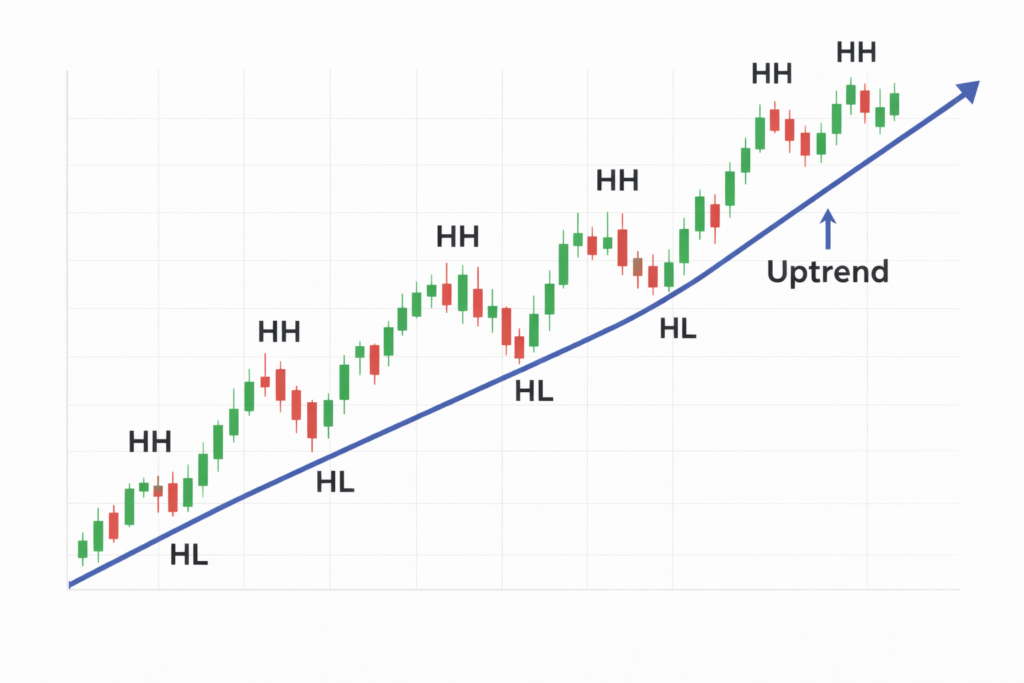
Meaning:
- Buyers are in control
- Price keeps pushing higher
- Pullbacks are temporary
👉 Key insight:
Pullbacks are not reversals.
They are opportunities.
These pullbacks are known as retracement moves and often provide the best entry opportunities within a trend.
What is a downtrend structure?
A downtrend is defined by:
- Lower Highs (LH)
- Lower Lows (LL)
Meaning:
- Sellers dominate
- Price keeps making new lows
- Rallies are weak
👉 Most beginners fail here:
They buy in a downtrend.
How to identify market structure step by step?
How to mark swing highs and lows?
Step 1: Look for turning points
Step 2: Identify clear highs/lows
Step 3: Ignore noise (small candles)
👉 Rule:
If you need to zoom in too much → it’s not important.
How to confirm a trend?
Use structure logic:
- Uptrend → HH + HL
- Downtrend → LH + LL
Wait for confirmation, not assumption.
👉 One swing does not define a trend.
What is break of structure (BOS)?
Break of Structure (BOS) happens when price breaks a previous key level.
Example:
- In uptrend → break previous high → continuation
👉 BOS confirms trend strength.
Not reversal.
Many trading strategies rely on break of structure as a confirmation signal before entering a trade.
What is change of character (CHoCH)?
CHoCH signals potential reversal.
Example:
- Uptrend → suddenly breaks previous low
👉 That’s not a pullback anymore.
That’s a shift in control.
This is where trading psychology becomes critical, as most traders hesitate or react emotionally during these transitions.
Why traders lose without market structure?
Because they:
- Enter randomly
- Trade against trend
- Confuse pullback with reversal
- Chase breakouts
👉 Biggest mistake:
Thinking indicators = edge.
Reality:
Structure = edge.
How to trade using market structure?
How to enter after pullback?
Best setup:
- Identify trend
- Wait for pullback
- Enter at structure zone
👉 This gives:
- Better risk/reward
- Higher win rate
How to avoid fake breakouts?
Fake breakout happens when:
- Price breaks level
- Then reverses immediately
Why?
👉 Liquidity grab.
Smart money traps retail traders.
Solution:
- Wait for confirmation
- Don’t enter on first break
Indicators like the stochastic indicator often give misleading signals during these fake breakouts.
How does market structure connect with liquidity?
This is where most content online is weak.
Market structure exists because of liquidity.
- Highs = stop loss zones
- Lows = liquidity pools
Smart money:
- Push price into liquidity
- Then reverse
👉 Structure is not random.
It’s engineered.
What are common mistakes traders make?
- Using too many indicators
- Ignoring higher timeframe
- Trading every structure
- Not waiting for confirmation
- Overtrading
👉 Simplicity wins.
This aligns with the core principles of profitable trading — focusing on clarity over complexity.
FAQ about market structure
What is market structure in trading?
It is the pattern of price movement that defines trend direction.
Is market structure better than indicators?
Yes, because it is based on raw price, not lagging data.
Can beginners learn market structure?
Yes, it’s actually the best starting point.
What timeframe is best?
All timeframes work, but higher timeframe is more reliable.
Is market structure part of Smart Money Concept?
Yes, it is the foundation of SMC.
If you are serious about trading…
Stop chasing indicators.
Start understanding structure.
Because once you see how the market moves…
You will never trade the same way again.
To apply market structure effectively, many traders use platforms like TradingView to visualize price action and structure in real time.
Once you understand structure, using a reliable broker ensures your execution matches your analysis.