
Trading basics can feel confusing when you are new to online trading, especially when you see terms like spread, leverage, margin, stop loss, and liquidity for the first time.
The first time I looked at a trading chart, I didn’t just not understand the chart. I didn’t understand half the words people used to talk about the chart.
Pip. Lot. Leverage. Margin call. Spread. Buy stop. Sell limit. Each one sounded like it should be simple. None of them were — at least not until someone explained them without assuming you already knew the other terms.
This glossary is the one I wish existed when I started. Every term is explained the way I would explain it to a friend who has never traded before — with real examples, honest context, and where relevant, the mistakes I made so you don’t have to.
Use this page as a reference. Bookmark it. When you encounter a term you don’t recognise while learning to trade, come back here first.
How to Use This Glossary
Terms are grouped by topic, not alphabetically — because understanding one concept often requires knowing the one before it. Read through in order the first time. After that, jump to whichever section you need.
- Charts & Candlesticks
- Market Structure — Trends, Support & Resistance
- Timeframes
- Order Types
- Lot Size, Pip & Position Sizing
- Leverage & Margin
- Trading Costs — Spread, Commission & Swap
- Risk Management Terms
- Indicators & Analysis
- Trading Psychology Terms
- Market & Asset Terms
Charts & Candlesticks
What is a candlestick chart?
A candlestick chart is the most common way traders visualise price movement. Each “candle” on the chart represents a specific period of time — one minute, one hour, one day — and shows you four pieces of information about that period:
- Open: The price at the start of the period
- Close: The price at the end of the period
- High: The highest price reached during the period
- Low: The lowest price reached during the period
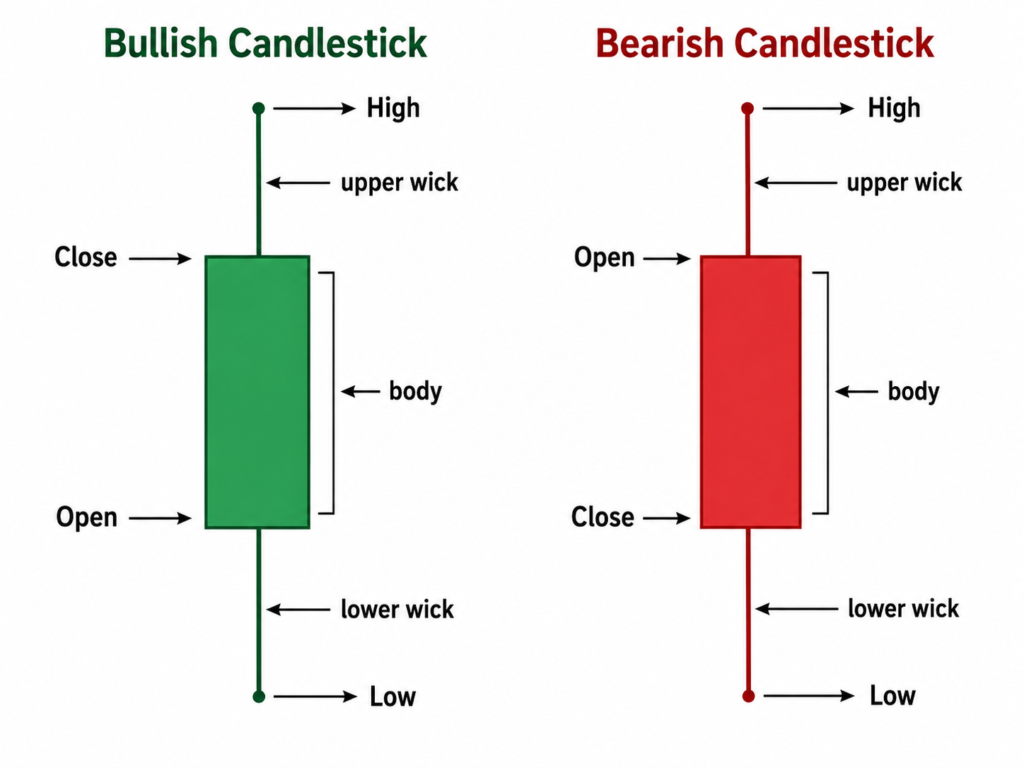
The body is the thick rectangle — the distance between open and close. A green candle means price closed higher than it opened (buyers were in control). A red candle means price closed lower than it opened (sellers were in control).
The thin lines above and below the body are called wicks (or shadows). They show where price tried to go but failed to hold. A long upper wick means buyers pushed price up — but sellers pushed it back down before the candle closed. A long lower wick means the opposite.
Here’s a simple way to think about it: imagine a tug of war between buyers and sellers during that time period. The body shows who won. The wicks show how far each side managed to push before losing ground.
When I first looked at a candlestick chart, it looked like pure chaos — red and green bars everywhere, lines sticking out randomly. The moment it clicked was when I stopped looking at individual candles and started seeing them as a story: each candle is one chapter, and together they tell you what buyers and sellers have been doing.
What are the most important candlestick patterns?
You don’t need to memorise 50 candlestick patterns. As a beginner, focus on these five — they appear frequently and have clear, logical meaning:
| Pattern | What It Looks Like | What It Means |
|---|---|---|
| Bullish Engulfing | Large green candle completely covers the previous red candle | Buyers overwhelmed sellers — potential upward move |
| Bearish Engulfing | Large red candle completely covers the previous green candle | Sellers overwhelmed buyers — potential downward move |
| Pin Bar (Hammer/Shooting Star) | Small body, very long wick on one side | Price rejected a level strongly — potential reversal |
| Doji | Almost no body — open and close nearly equal | Indecision — neither buyers nor sellers in control |
| Inside Bar | Candle completely contained within the previous candle’s range | Consolidation — market pausing before next move |
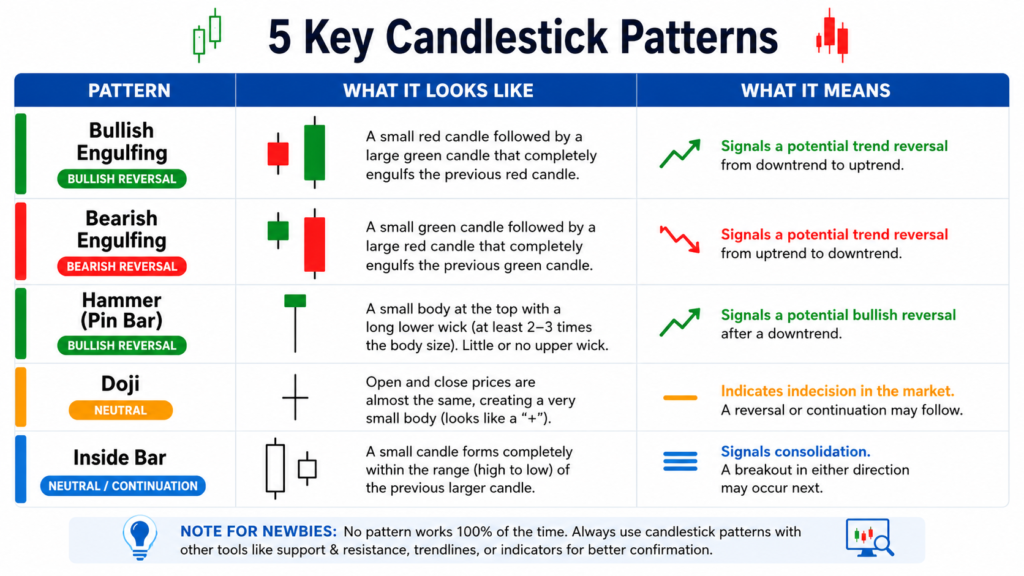
Remember: no single candlestick pattern is a trading signal on its own. A pin bar at a key support level after a downtrend is meaningful. A pin bar in the middle of a range with no context is noise. Patterns gain meaning from where they appear — which brings us to the next section.
Market Structure — Trends, Support & Resistance
What is a trend?
A trend is the general direction price is moving over time. There are three states:
- Uptrend: Price is making higher highs and higher lows — each peak is higher than the last, each pullback ends higher than the last pullback
- Downtrend: Price is making lower highs and lower lows — each peak is lower than the last, each bounce ends lower than the last
- Ranging (Sideways): Price is moving between two horizontal levels without clear direction
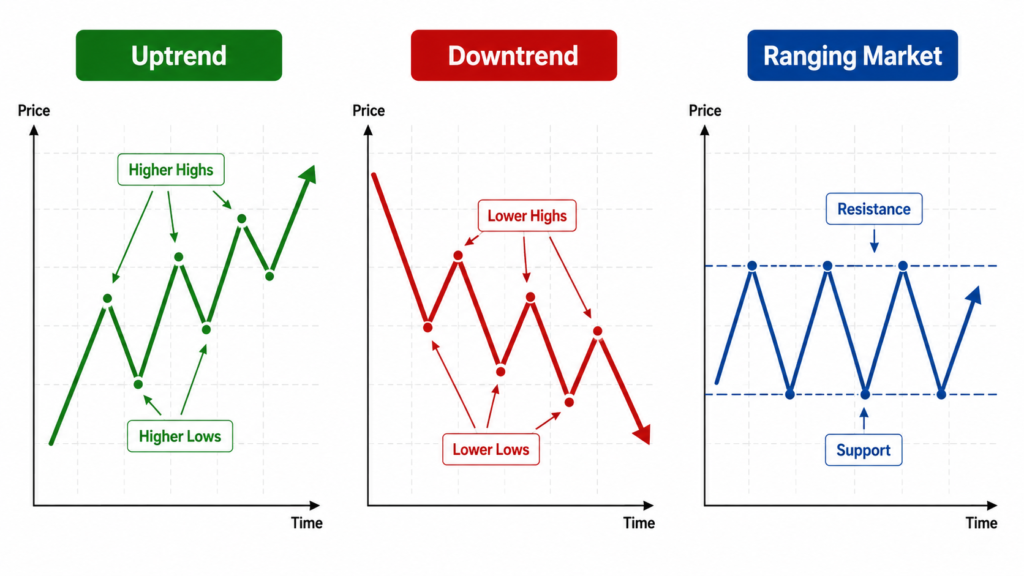
The single most important trading principle for beginners: trade with the trend, not against it. If the trend is up, look for opportunities to buy. If the trend is down, look for opportunities to sell. Fighting the trend — trying to pick reversals before they’re confirmed — is one of the most expensive habits a beginner can develop.
What is support and resistance?
Support is a price level where buyers have historically stepped in — a “floor” that price has bounced off multiple times. Resistance is a price level where sellers have historically stepped in — a “ceiling” that price has struggled to break through.
Think of it like a room. The floor is support (price bounces off it). The ceiling is resistance (price struggles to break through it). When price breaks through the ceiling, that ceiling often becomes the new floor — this is called a role reversal, and it’s one of the most reliable concepts in technical analysis.
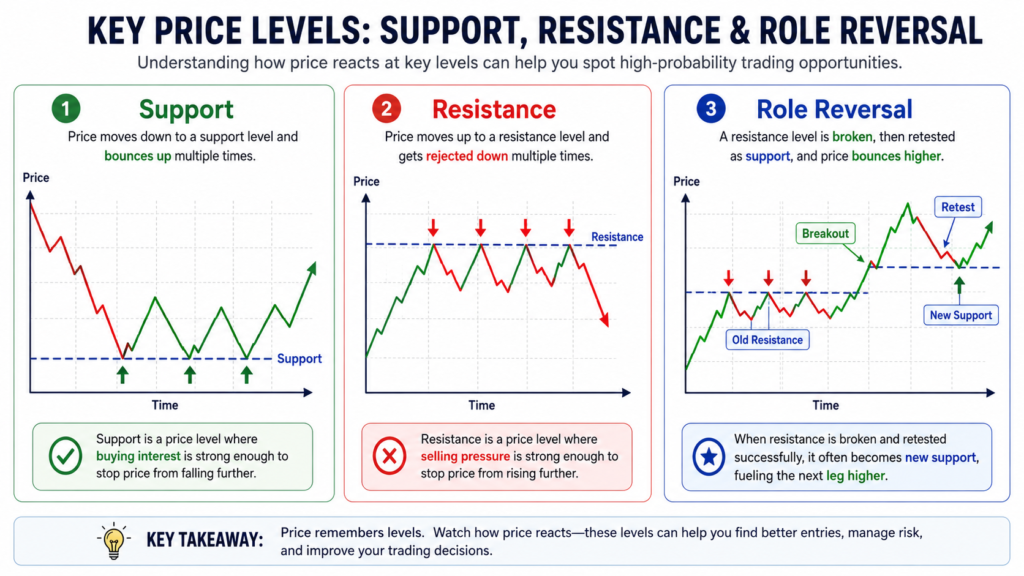
I learned support and resistance through a concept called Supply and Demand (S&D) rather than traditional horizontal S/R lines. The logic is similar but more specific: instead of drawing a single line, you mark a zone — the area where significant buying or selling previously occurred. Price doesn’t react to exact prices as precisely as a single line would suggest. It reacts to zones.
The most common beginner mistake with S/R: drawing too many lines. When I started, I saw potential support and resistance everywhere — every swing high, every swing low, every round number. My charts looked like a cage. The fix is simple: mark only the levels that price has clearly reacted to at least twice. If you have more than 3–4 active levels on a chart, you have too many.
What is a breakout?
A breakout occurs when price moves decisively beyond a support or resistance level. If price has been bouncing between $100 (support) and $120 (resistance) for weeks, and then closes above $120 on high volume — that’s a breakout.
Breakouts can be genuine (price continues in the breakout direction) or false (price briefly breaks the level then reverses — also called a “fakeout”). Beginners often get caught in false breakouts by entering immediately when price crosses a level, rather than waiting for confirmation — a candle close beyond the level, or a retest of the broken level from the other side.
Timeframes
What is a timeframe?
A timeframe is the time period each candle on your chart represents. A 1-hour (H1) chart shows one candle per hour. A daily (D1) chart shows one candle per day. A 5-minute (M5) chart shows one candle every 5 minutes.
Common timeframes and their uses:
| Timeframe | Used By | Candle = One… |
|---|---|---|
| M1, M5 | Scalpers | 1 or 5 minutes |
| M15, M30 | Short-term day traders | 15 or 30 minutes |
| H1, H4 | Day traders, swing traders | 1 or 4 hours |
| D1 | Swing traders | 1 day |
| W1, MN | Position traders, investors | 1 week or 1 month |
Why are there so many timeframes — and which one should you use?
This confused me for a long time. I was trading H1 and H4 charts but kept second-guessing myself when M5 showed something different. Why did a perfectly valid H4 setup look completely different on M15? Were they both right? Which one should I follow?
The answer came from a book called Trading for a Living by Alexander Elder. His description was the clearest I’ve ever read: think of timeframes like ocean waves.
A daily chart is like a large ocean wave — slow, powerful, covering a lot of distance. A 1-hour chart is a medium wave riding on top of the large wave. A 5-minute chart is a small ripple on the surface of the medium wave. All three are real. All three are moving. But the large wave determines the overall direction.
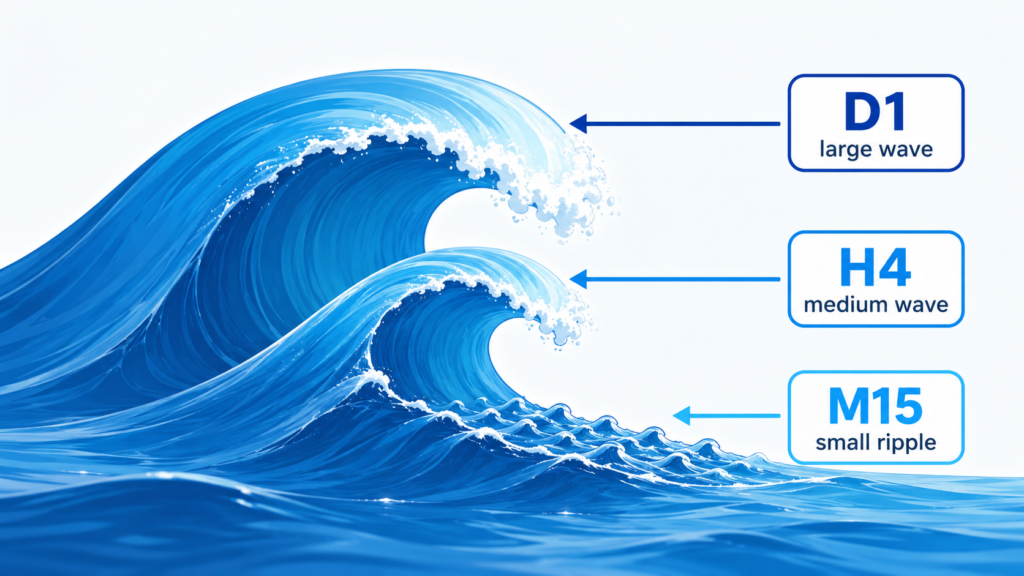
In practice, this means: use a higher timeframe to identify the trend and key levels, then drop to a lower timeframe to find your entry. If the daily chart shows a clear uptrend and price is pulling back to a support level, look at the H1 or H4 for a bullish candlestick pattern to enter. Never trade against the direction of your higher timeframe.
For beginners, I recommend: use the Daily chart for trend direction and key levels. Use the H4 chart for entry timing. Ignore anything below H1 until you have at least 6 months of consistent trading behind you. The lower the timeframe, the more noise — and noise is the enemy of a beginner trying to build pattern recognition.
Order Types
What is a market order?
A market order is the simplest type of order: you click buy or sell, and your trade opens immediately at the current market price. No waiting, no conditions — the order fills right now.
Use a market order when: you want to enter immediately and the exact entry price matters less than getting in now. Most beginners start with market orders because they’re the most intuitive.
What is a limit order?
A limit order tells your broker: “Open my trade only if price reaches this specific level — and only from this direction.” It’s a conditional order. You set it and wait.
There are two types:
- Buy Limit: “Buy if price drops down to this level.” You want to buy at a better (lower) price than the current market price. Example: EUR/USD is at 1.0900, you place a Buy Limit at 1.0850 — your trade opens only if price falls to 1.0850.
- Sell Limit: “Sell if price rises up to this level.” You want to sell at a better (higher) price than current. Example: price is at 1.0900, you place a Sell Limit at 1.0950 — your trade opens only if price rises to 1.0950.
What is a stop order?
A stop order is the opposite logic of a limit order — it triggers when price moves further in the same direction, beyond the current price.
- Buy Stop: “Buy if price rises up to this level.” Used for breakout entries — you expect price to continue upward once it breaks a resistance level. Example: price is at 1.0900, resistance is at 1.0950. You place a Buy Stop at 1.0960 — your trade opens when price breaks above resistance.
- Sell Stop: “Sell if price falls down to this level.” Used for bearish breakout entries.
A simple way I remember the difference: Limit = wait for price to come back to me. Stop = chase the breakout.
What is a stop loss?
A stop loss is a pre-set price level at which your trade automatically closes if it moves against you — limiting your loss to a defined amount.
This is not optional. Trading without a stop loss is not trading — it’s hoping. I learned this the expensive way: holding trades without stop losses, watching them go against me, telling myself “it’ll recover,” and eventually losing far more than I would have if I’d just taken the small loss at the start.
Without a stop loss, every trade becomes an emotional hostage situation. You can’t think clearly. You check your phone constantly. You can’t sleep properly. The stop loss isn’t just about limiting financial loss — it’s about preserving your mental state so you can make the next trade rationally.
Always place your stop loss before you enter a trade. Not after. Not “I’ll set it once I see how it goes.” Before. The moment price hits your entry, your stop loss should already be in the market.
What is a take profit?
A take profit is a pre-set price level at which your trade automatically closes when it moves in your favour — locking in your profit without you needing to watch the chart and decide manually.
Like the stop loss, set your take profit before you enter the trade. Decide in advance: “If this trade works, where will I exit?” The answer should be based on the next significant resistance level (for a buy trade) or support level (for a sell trade) — not on a gut feeling about how far price “should” go.
Lot Size, Pip & Position Sizing
What is a pip?
A pip (percentage in point) is the standard unit of price movement in forex trading. For most currency pairs, one pip is a move of 0.0001 — the fourth decimal place.
Example: if EUR/USD moves from 1.0900 to 1.0910, it has moved 10 pips.
Honestly? I never focused on pips much. What matters more — and what I actually calculate for every trade — is the dollar value of my maximum loss and my risk/reward ratio. Whether a trade is “50 pips” or “100 pips” matters less than whether it risks $10 to potentially make $20. Don’t get lost in pip counting. Focus on dollars risked and dollars targeted.
What is a lot size?
A lot is the unit of measurement for trade size in forex. The standard sizes are:
| Lot Type | Size | Approx. Pip Value (EUR/USD) |
|---|---|---|
| Standard Lot | 100,000 units | ~$10 per pip |
| Mini Lot | 10,000 units | ~$1 per pip |
| Micro Lot | 1,000 units | ~$0.10 per pip |
When I first started, I had no idea what lot size to use. My approach was: start at 0.01 (micro lot), then gradually increase without any real calculation. That was wrong — and expensive.
Here’s the correct approach: calculate your lot size backwards from your maximum acceptable loss.
The formula:
- Decide your maximum risk per trade (1–2% of account). On a $500 account: max risk = $5–$10.
- Identify where your stop loss will be in pips (e.g., 20 pips below entry).
- Divide your max risk by the pip value × pip distance: $10 ÷ (20 pips × $0.10 per pip for 0.01 lot) = 5 micro lots (0.05 lot).
Every single trade. No guessing. No increasing because “this one feels like a sure thing.” The lot size comes from the math, not from confidence in the trade.
What is position sizing?
Position sizing is the process of calculating the correct lot size for each trade based on your account size and maximum acceptable risk. It is, without exaggeration, the single most important practical skill in trading.
The rule is simple: never risk more than 1–2% of your total account on any single trade.
Why? Because with 1% risk per trade, you can lose 10 trades in a row and still have 90% of your account. With 10% risk per trade, 10 losses wipe you out entirely. And losing streaks of 10+ trades happen to every trader with every strategy — including profitable ones. Position sizing is what keeps you in the game long enough for your edge to play out.
Leverage & Margin
What is leverage?
Leverage allows you to control a position much larger than your actual account balance. With 1:100 leverage, $100 of your money controls a $10,000 position. With 1:500 leverage, $100 controls $50,000.
Brokers offer leverage because it makes smaller accounts capable of taking meaningful positions. It also makes it possible to lose your entire account on a single small price movement — which is why leverage is the most dangerous tool available to retail traders.
I did not pay attention to leverage when I first started trading. I just clicked the maximum available. Then one day, I had used almost all my available leverage across multiple positions. A small price movement — maybe 20–30 pips — was enough to trigger an automatic account closure. Everything gone. In minutes.
I hadn’t done anything obviously wrong in terms of direction. I was just using too much leverage, which meant the normal breathing room of the market — the small moves that happen every day — was enough to kill the account.
The practical rule: ignore the maximum leverage your broker offers. Use only the leverage implied by your position sizing calculation. If your correct lot size for a trade (based on 1% account risk) requires no leverage, don’t use leverage. The leverage limit should never be a factor in your trading — if you’re bumping up against it, your position is too large.
In regulated markets (EU, UK, Australia), retail leverage is capped at 1:30 for major forex pairs — a consumer protection that genuinely reduces account destruction rates. Higher leverage is available through offshore brokers but comes with significantly less regulatory protection.
What is margin?
Margin is the amount of money your broker holds as a deposit when you open a leveraged trade. It’s not a fee — it’s collateral. Think of it like a security deposit on a rental property: the money is yours, but the broker holds it as insurance while the trade is open.
Example: you open a 1 standard lot EUR/USD position (worth $100,000) with 1:100 leverage. The required margin is $1,000 — your broker holds $1,000 of your account as collateral. The remaining account balance is your “free margin” — available to open additional trades or absorb losses.
What is a margin call?
A margin call happens when your losing trades have consumed so much of your account that your remaining balance approaches the margin required to keep those trades open. Your broker warns you (the margin call) that you need to either deposit more funds or close some positions. If you don’t act, the broker closes your positions automatically — this is called a stop out.
I experienced this. A position went heavily against me overnight, and by the time I woke up, the account had been stopped out automatically. The trade was closed at the worst possible price — the forced liquidation price — not at a level I would have chosen. The feeling is unpleasant. More importantly, it’s entirely preventable through correct position sizing.
If you are trading with proper 1–2% risk per trade and reasonable lot sizes, you should never come close to a margin call. Margin calls happen to traders who are overleveraged — using too large a position relative to their account size.
Once you understand the trading basics, concepts like leverage, spread, margin, and stop loss become much easier to apply in real trades.
Trading Costs — Spread, Commission & Swap
What is a spread?
The spread is the difference between the buy price (ask) and the sell price (bid) of an instrument. It’s the primary way brokers make money on standard accounts.
Example: EUR/USD has a bid of 1.09000 and an ask of 1.09010. The spread is 1 pip. If you buy at 1.09010 and immediately close the trade, you sell at 1.09000 — a 1-pip loss before the trade has even moved. That 1 pip is the spread cost.
Spreads vary by instrument and by broker type:
- Major forex pairs (EUR/USD, GBP/USD): typically 0.1–1.5 pips on ECN brokers
- Minor/exotic pairs: significantly wider spreads — 5–20+ pips common
- Stocks: spread is usually quoted as a percentage of price or a fixed amount
- During news events: spreads can widen dramatically — sometimes 10× normal
For active traders, spread is a real cost that compounds over hundreds of trades. A 1-pip spread on EUR/USD costs $10 per standard lot. Execute 20 standard lots per day and that’s $200/day in spread costs before any commission. This is why choosing a low-spread broker matters more than beginners typically realise. See our IC Markets review for an example of what genuinely competitive ECN spreads look like.
Before choosing a broker or trading platform, beginners should learn the trading basics first.
What is commission?
Commission is a fixed fee charged per trade, typically on Raw/ECN accounts where the spread itself is near zero. Instead of paying a 1-pip spread, you pay a $3–$7 commission per lot and get a near-zero spread.
For active traders, Raw accounts with commission are almost always cheaper than Standard accounts with wider spreads. For casual traders making a few trades per month, the difference is negligible.
What is a swap (overnight fee)?
A swap (also called rollover or overnight fee) is charged or credited when you hold a leveraged trade open past the daily market close — typically 5pm New York time. It reflects the interest rate differential between the two currencies in a forex pair.
Sometimes you pay the swap. Sometimes you receive it — it depends on which currency you’re long and the current interest rate environment.
I learned about swaps the hard way. I was trading exotic currency pairs — pairs involving currencies from emerging markets — and holding positions overnight. The spreads on these pairs are already wide. The swap rates are often extreme. One morning I woke up to find a position had been effectively stopped out not by price movement, but by the combination of overnight spread widening and swap charges. The position simply vanished.
For beginners: stick to major pairs (EUR/USD, GBP/USD, USD/JPY) — they have the tightest spreads and the most predictable swap rates. Avoid exotic pairs until you fully understand the cost structure. And if you’re swing trading and holding positions for multiple days, always check the swap rate for your specific pair before entering — it affects your trade’s profitability more than most beginners expect.
Risk Management Terms
What is risk/reward ratio (R:R)?
Risk/reward ratio compares how much you’re risking on a trade to how much you stand to gain. A 1:2 R:R means you risk $10 to potentially make $20. A 1:3 R:R means you risk $10 to potentially make $30.
This is one of the most important concepts in trading — and one I now use as my primary way of evaluating any potential trade. I don’t think in pips. I think in R:R.
Before I enter any trade, I ask: if this trade hits my stop loss, I lose X. If it hits my take profit, I gain Y. Is Y at least 2× X? If not, the trade isn’t worth taking — regardless of how confident I feel about the direction.
Why does R:R matter so much? Because of this mathematical reality:
| Win Rate | R:R Ratio | Result Over 100 Trades |
|---|---|---|
| 50% | 1:1 | Breakeven (minus costs) |
| 40% | 1:2 | Profitable |
| 33% | 1:3 | Profitable |
| 60% | 1:0.5 | Losing money |
You can lose more trades than you win and still be profitable — if your winners are significantly larger than your losers. This is why win rate alone is a meaningless metric without knowing the R:R attached to it.
What is a drawdown?
Drawdown is the peak-to-trough decline in your account balance during a losing period. If your account reaches $1,000, then falls to $800 before recovering, you experienced a 20% drawdown.
All strategies have drawdowns — periods of consecutive losses or reduced performance. The question is not whether you’ll experience drawdown, but whether your position sizing keeps it survivable. A 20% drawdown requires a 25% gain to recover. A 50% drawdown requires a 100% gain to recover. A 90% drawdown is effectively unrecoverable for most traders.
Keep maximum drawdown below 20% through disciplined 1–2% position sizing, and you will always be in a recoverable position.
What is a win rate?
Win rate is the percentage of your trades that close in profit. A 60% win rate means 6 out of every 10 trades are winners.
Win rate sounds simple but is routinely misunderstood. High win rate feels good psychologically — winning more than you lose is emotionally satisfying. But a 70% win rate with a 1:0.3 R:R (risking $10 to make $3) is a losing strategy. Always evaluate win rate alongside R:R to understand whether a strategy is actually profitable.
What is expectancy?
Expectancy is the average profit or loss per trade, calculated across your full track record. It’s the single most honest measure of whether your strategy has an edge.
Formula: Expectancy = (Win Rate × Average Win) − (Loss Rate × Average Loss)
Example: 45% win rate, average winner $200, average loser $100.
Expectancy = (0.45 × $200) − (0.55 × $100) = $90 − $55 = +$35 per trade.
Positive expectancy = edge exists. Negative expectancy = edge does not exist. Calculate this after every 50+ trades and use it to evaluate whether your approach is working — not your gut feeling about recent performance.
Indicators & Analysis
What is a technical indicator?
A technical indicator is a mathematical calculation applied to price (and sometimes volume) data, displayed visually on or below your chart. Indicators are designed to help traders identify trends, momentum, volatility, and potential reversal points.
Common indicators and what they actually do:
| Indicator | Type | What It Shows |
|---|---|---|
| Moving Average (MA) | Trend | Average price over N periods — smooths out noise, shows trend direction |
| RSI (Relative Strength Index) | Momentum | 0–100 scale showing whether an asset is overbought (>70) or oversold (<30) |
| MACD | Trend/Momentum | Relationship between two moving averages — shows trend changes and momentum |
| Bollinger Bands | Volatility | Dynamic channel containing ~95% of price action — shows volatility expansion/contraction |
| Volume | Participation | How many units were traded — confirms or questions price moves |
The first indicator I ever used was Bollinger Bands. The logic appealed to me immediately: price spends most of its time inside the bands, and when it moves outside, it tends to return. That’s essentially mean reversion — a statistically sound concept. The band acts like a dynamic envelope around price, and extreme moves outside the envelope often precede a return to average.
What I did wrong afterwards: I added more indicators. RSI. MACD. Moving averages. Stochastic. At one point I had 6–7 indicators on one chart. The problem was they contradicted each other constantly — one said buy, one said sell, one said wait. I ended up paralysed, waiting for all of them to agree, and by the time they did, the move was over.
The lesson: more indicators do not produce more clarity. They produce more noise. Pick one or two that you understand deeply and that logically complement each other. Ignore the rest. A clean chart with price action, one trend indicator, and key S/R levels will outperform a cluttered chart with eight conflicting signals every time.
What is the difference between technical and fundamental analysis?
- Technical analysis: Uses price charts, patterns, and indicators to make trading decisions. Assumes all known information is already reflected in price. Focuses on what price is doing — not why.
- Fundamental analysis: Uses economic data, company financials, interest rates, geopolitical events to make trading decisions. Focuses on the underlying value and what should drive price over time.
Most active traders use technical analysis for timing entries and exits. Fundamental analysis provides context — understanding why a currency pair or stock is trending in a particular direction. For beginners, start with technical analysis. Add fundamental awareness (economic calendar, major news events) as you develop experience.
Trading Psychology Terms
What is FOMO (Fear of Missing Out)?
FOMO is the anxiety you feel when price moves sharply without you — and the impulse to enter a trade just to participate, even though your setup criteria aren’t met.
FOMO entries almost always lose. By the time FOMO is strong enough to override your hesitation, the move has typically already happened. You’re buying near the top of a spike or selling near the bottom of a crash — providing exit liquidity for the traders who entered correctly.
The rule: if you missed the entry, the trade does not exist for you. Move on. There will always be another setup.
What is revenge trading?
Revenge trading is the impulse to immediately re-enter the market after a loss, driven by the desire to “get the money back” rather than by a valid setup. It almost always results in a second loss — and sometimes a chain of losses that turns a manageable drawdown into an account-damaging session.
The fix: after any losing trade, enforce a mandatory break — at least 15–30 minutes away from the screen — before looking at another chart. This allows the emotional response to settle before you make your next decision.
What is loss aversion?
Loss aversion is the psychological phenomenon where losses feel approximately twice as painful as equivalent gains feel pleasurable. Losing $100 hurts more than winning $100 feels good.
In trading, loss aversion causes traders to hold losing positions too long (avoiding the pain of realising a loss) and cut winning positions too early (locking in the pleasure of a gain before it disappears). The result is the exact opposite of what profitable trading requires: small losses and large wins.
Understanding loss aversion doesn’t eliminate it. But knowing it’s happening helps you recognise when your decision to hold a loser or cut a winner is being driven by emotion rather than logic.
For a complete guide to the psychological side of trading, read: Trading Psychology — why you lose even when you know what to do
Market & Asset Terms
What is a currency pair?
In forex, you always trade one currency against another — they come in pairs. EUR/USD is the Euro against the US Dollar. The first currency (EUR) is the base currency. The second (USD) is the quote currency. The price tells you how many units of the quote currency you need to buy one unit of the base currency.
If EUR/USD is 1.0900, it means 1 Euro = 1.09 US Dollars.
Currency pairs are categorised as:
- Majors: Pairs involving the USD and a major world currency (EUR/USD, GBP/USD, USD/JPY). Highest liquidity, tightest spreads. Best for beginners.
- Minors (Crosses): Major currencies paired without USD (EUR/GBP, GBP/JPY). Wider spreads, less liquidity.
- Exotics: A major currency paired with an emerging market currency (USD/TRY, EUR/ZAR). Very wide spreads, high overnight costs, unpredictable movements. Avoid as a beginner.
What is a bull market and a bear market?
- Bull market: A sustained period of rising prices — buyers are in control, the trend is up. The term comes from the image of a bull thrusting its horns upward.
- Bear market: A sustained period of falling prices — sellers are in control, the trend is down. A bear swipes its claws downward.
Being “bullish” means you expect prices to rise. Being “bearish” means you expect prices to fall. These terms apply to individual assets, sectors, or entire markets.
What is liquidity?
Liquidity refers to how easily an asset can be bought or sold without significantly affecting its price. High liquidity means many buyers and sellers — tight spreads, fast execution, reliable fills. Low liquidity means fewer participants — wider spreads, slower execution, potential slippage.
Major forex pairs (EUR/USD, GBP/USD) are among the most liquid instruments in the world. Exotic pairs and small-cap stocks are much less liquid. For beginners, stick to highly liquid instruments — the execution is cleaner and the costs are lower.
What is slippage?
Slippage occurs when your order fills at a different price than you intended — typically during high volatility or low liquidity conditions. You place a market order to buy at 1.0900, but by the time the order processes, price has moved to 1.0910. You’ve slipped 10 pips.
Slippage is most common during major news events (NFP, CPI releases, central bank decisions). It’s one reason experienced traders avoid market orders immediately after high-impact news and use limit orders instead.
Your Next Steps
Now that you understand the language of trading, you’re ready to start building your actual skills. Here’s where to go next:
- 📖 Start here if you haven’t already: Complete Beginner’s Guide to Trading — the full roadmap from zero to first live trade
- 📊 Choose your strategy: Trading Strategies Explained — find the one that fits your lifestyle
- 🧠 Understand the mental game: Trading Psychology — the real reason most traders fail
- 🏦 Open your first account: IC Markets Review — regulated, beginner-friendly, low spreads
- 🌐 Learn about forex specifically: What is Forex Trading — how the world’s largest market works
This glossary reflects 4 years of personal trading experience across forex and stocks, combined with current industry data. It is written for educational purposes only and does not constitute financial advice. Trading involves significant risk of capital loss. Always conduct your own research before trading with real money.