
You deposited $5,000 with a forex broker. The trades went well. Then came the withdrawal request.
Three weeks later — nothing. Support tickets go unanswered. The “live chat” goes offline. Your money is gone.
This is not a hypothetical. It happens to thousands of traders every year. Not because they traded badly. Because they chose the wrong broker.
The stakes of this decision are unlike almost any other in trading. A bad strategy costs you money gradually, and you can learn from it. A bad broker can take everything at once — and there is often nothing you can do after the fact.
This guide is built around one mission: helping you find a forex broker you can trust. Not just one with good-looking spreads or a slick website — but one that is genuinely regulated, genuinely transparent about costs, and genuinely reliable when it matters most.
We have analyzed the leading brokers of 2026 across six categories: regulation quality, total trading costs, platform reliability, fund safety, withdrawal reliability, and suitability for different trader types. Here is what we found.
What Makes a Forex Broker Truly the “Best” in 2026?
The best forex brokers excel across several non-negotiable categories. These are the core features that directly affect your safety and ability to profit, separating a good trading experience from a frustrating one: top-tier regulation and trust, competitive spreads and fees, and reliable trading software.
But there is a fourth criterion that most guides skip: withdrawal reliability. A broker can have beautiful spreads, award-winning platforms, and a thick regulatory license — and still delay withdrawals, manufacture verification excuses, or simply become unresponsive when you try to move your money out. This is the criterion that separates brokers that work in theory from brokers that work in practice.
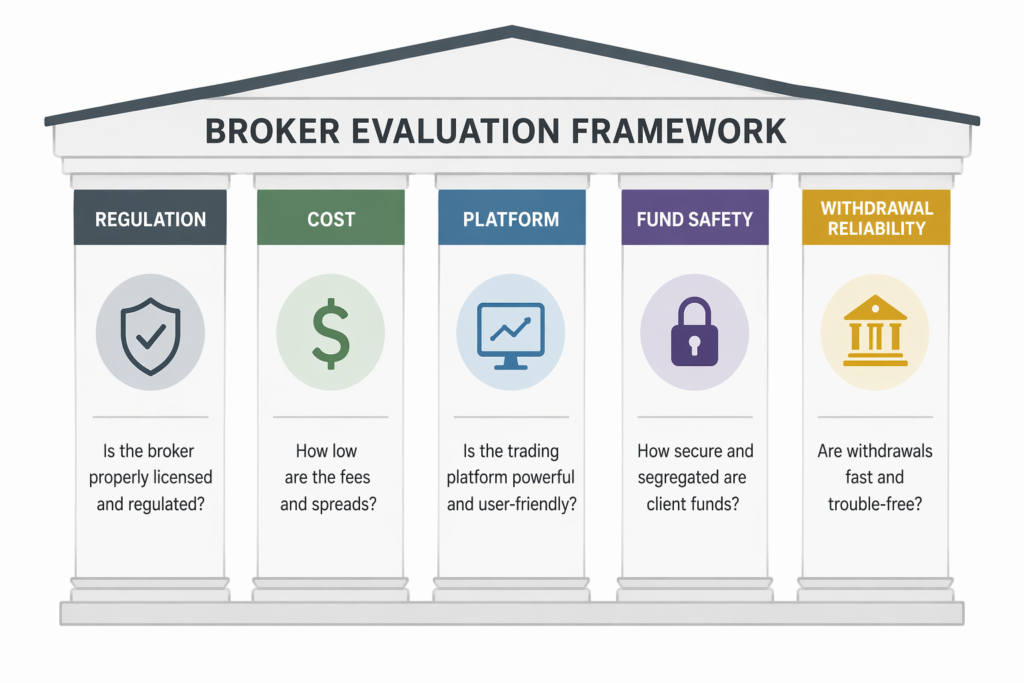
The five criteria we weight in this guide, in order of importance:
- Regulatory quality (Tier-1 licenses, jurisdiction, compensation schemes)
- Total cost of trading (spread + commission + swap + withdrawal fees)
- Platform reliability (execution speed, stability during volatility, mobile quality)
- Fund safety (segregation, negative balance protection, compensation coverage)
- Withdrawal reliability (speed, consistency, minimum friction)
Why is regulation the single most important broker criterion?
Key criteria determining a broker’s trustworthiness are the quality of regulation, the availability of investor protection, as well as a long and spotless track record.
Regulation is the single most important criterion because it determines what recourse you have when something goes wrong. A broker regulated by the UK’s Financial Conduct Authority (FCA) is subject to strict capital adequacy requirements, mandatory client fund segregation, and the Financial Services Compensation Scheme (FSCS) — which covers up to £85,000 per client if the broker becomes insolvent. An offshore broker regulated by a Caribbean island authority offers you essentially none of these protections.
The difference between a regulated and an unregulated broker is not merely legal compliance — it is the difference between trading with a safety net and trading without one. Always verify a broker’s regulatory license directly on the regulator’s website before depositing a single dollar.
What is the difference between Tier-1, Tier-2, and offshore regulation?
Not all regulation is equal. Understanding the tiers prevents you from being misled by an impressive-looking “regulated broker” claim that offers no real protection.
| Tier | Regulators | Client Protection |
|---|---|---|
| Tier-1 (highest) | FCA (UK), ASIC (Australia), NFA/CFTC (US), BaFin (Germany), MAS (Singapore) | Strongest — segregated funds, compensation schemes, strict capital rules |
| Tier-2 (moderate) | CySEC (Cyprus), FSCA (South Africa), FSA (Japan) | Moderate — some client protections, less stringent than Tier-1 |
| Offshore (lowest) | FSC (Vanuatu), SVG FSA (St. Vincent), FSC (Mauritius) | Minimal — weak enforcement, little to no investor compensation |
A broker holding a Tier-1 license operates under genuine scrutiny. A broker holding only offshore licenses is essentially self-regulated. Many unscrupulous brokers acquire offshore licenses specifically because they are easy to obtain and difficult for clients to leverage when disputes arise.
What Are the Best Forex Brokers in 2026? Our Top Picks
Based on our evaluation framework — regulation, total cost, platform quality, fund safety, and withdrawal reliability — here are the best forex brokers in 2026 across different use cases.
Which broker is best overall for most forex traders?
IG offers the ultimate forex trading package — excellent trading platforms, research tools, high-quality education, comprehensive market research, and an extensive list of tradeable products. IG is the best overall forex broker for traders around the world in 2026. Founded in 1974, IG is publicly traded (LON: IGG) and regulated in eight Tier-1 jurisdictions, making it a Highly Trusted broker for forex and CFD trading.
IG’s exceptional breadth — covering over 80 currency pairs, a proprietary platform alongside MT4, and the strongest trust score in the industry — makes it the safest and most versatile choice for the majority of global traders. Its decades-long track record means it has survived multiple market crises, regulatory changes, and industry upheavals without a significant scandal.
👉 Want a deeper breakdown of IG’s fees, platforms, and real trading experience?
Check our review ig forex broker
If you’re just starting out, you may also want to explore the best forex brokers for beginners for simpler platforms and lower-risk setups.
IG at a glance:
- Regulation: FCA, ASIC, BaFin, and 5 other Tier-1 authorities
- EUR/USD spread: From 0.6 pips (variable)
- Platforms: Proprietary web platform, MT4, L2 Dealer
- Minimum deposit: $0 (varies by region)
- Best for: All-around traders who prioritize trust above all
What I Actually Look For in a Forex Broker
I’ve been trading forex for over 4 years. Here’s what I’ve learned matters in practice — versus what sounds good on paper.
**1. Regulation is non-negotiable**
Not just any regulation — Tier-1. ASIC, FCA, CySEC.These regulators have real enforcement power and client fund protection. An offshore license from Vanuatu or Seychelles sounds legitimate until something
goes wrong.
I check the regulator’s website directly to verify the license number. Takes 2 minutes. Worth doing before depositing anything.
**2. Deposit and withdrawal needs to be simple**
This is underrated. I want to focus on trading — not spend time troubleshooting why a withdrawal is pending for 5 business days or why my card payment was declined.
The best brokers make this frictionless. The worst ones find reasons to complicate it. You only find out which kind you have when you try to move money.
**3. Execution quality during active sessions**
Spread on paper means nothing if execution slips during London open or NFP releases. I trade major pairs — EUR/USD, GBP/USD, USD/JPY — and execution consistency during volatile sessions is where brokers separate themselves.
**4. Platform stability**
I use TradingView for analysis and my broker’s platform for execution. MT4, MT5, cTrader — all work. What doesn’t work is a platform that freezes when you need to close a position.
**The broker I use:**
IC Markets — ASIC + CySEC regulated, straightforward
deposit and withdrawal, consistent execution on major
pairs.
For other brokers on this list that I haven’t personally tested, I’ve evaluated them based on publicly available regulatory data, spread comparisons, and verified user reports. Where I don’t have personal experience, I say so.
Which broker is best for beginners with low minimum deposits?
For beginner traders, the priorities shift from raw execution quality to three things: the quality of educational resources, the safety of the trading environment, and the accessibility of low minimum deposits. Brokers that dominate on both safety and beginner-friendliness in 2026:
Pepperstone: Trusted by more than 830,000 traders, it provides access to its own native platform and TradingView, and is favored for speed of execution especially during volatile sessions. Minimum deposit starts from $200 with excellent educational content. Dual regulation (FCA + ASIC) provides strong protection.
AvaTrade: Regulated across six jurisdictions (including FCA, ASIC, and CBI Ireland), AvaTrade offers a dedicated trading education program, fixed spreads that remove uncertainty about costs, and a generous demo account. Ideal for learners who want to practice without risking real capital.
Key insight for beginners: The broker with the lowest minimum deposit is not automatically the best beginner broker. The broker with the best education, the safest regulation, and the most forgiving fee structure for small accounts — that is the right choice for a beginner.
Which forex broker has the lowest spreads and trading costs?
IC Markets stands out for low trading costs, offering consistently tight spreads on major instruments that rank among the best I have tested. Crude oil and Bitcoin spreads are especially competitive. Costs are kept simple, with no inactivity fees and minimal commissions on raw spreads accounts.
IC Markets and Pepperstone consistently trade the top position for lowest-spread forex brokers. Here is how the top low-cost brokers compare on EUR/USD:
| Broker | Account Type | Avg EUR/USD Spread | Commission | Effective Cost |
|---|---|---|---|---|
| IC Markets | Raw | ~0.0–0.1 pips | $3.50/lot | ~0.45 pips equiv. |
| Pepperstone | Razor | ~0.09 pips | $3.50/lot | ~0.44 pips equiv. |
| FP Markets | Raw | ~0.0 pips | $3.00/lot | ~0.30 pips equiv. |
| OANDA | Standard | ~1.0–1.2 pips | $0 | ~1.1 pips equiv. |
| IG | Standard | ~0.6 pips | $0 | ~0.6 pips equiv. |
Important caveat: Always compare effective cost (spread + commission converted to pips), not just the advertised spread. A broker advertising “0.0 pip spreads” with a $7/lot commission may be more expensive than a broker advertising “0.8 pip spreads” with zero commission — depending on position size and frequency.
👉 Looking specifically for the lowest trading costs?
Explore our breakdown of the best low spread forex brokers
👉 Want a direct comparison between the top two?
See IC Markets vs Pepperstone to find which one fits your trading style better.
Which broker is best for US-based forex traders?
US traders face the most restrictive regulatory environment globally. The CFTC and NFA require forex brokers serving US residents to register with them directly — a process that the majority of international brokers have not pursued due to its cost and complexity.
tastyfx is the best forex broker in 2026 for US traders — with low FX fees, intuitive and simple trading platforms, a great AI chatbot, and extra offerings like an IRA account and high cash interest on Prime accounts.
Top brokers accepting US clients in 2026:
- tastyfx (formerly IG US): CFTC/NFA regulated, 80+ currency pairs, competitive spreads
- Forex.com: NFA member, excellent currency pair selection, advanced research tools
- OANDA: Long-established US presence, no minimum deposit, strong educational tools
- Interactive Brokers: Lowest margin rates in the industry, widest asset range, suitable for sophisticated US traders
US traders should verify that any broker they use is registered with the NFA. The NFA’s BASIC database (nfa.futures.org) allows you to confirm registration in seconds. Never trade with an unregistered broker as a US resident — it is illegal for them to solicit US clients, and you have no recourse if they disappear.
Which broker is best for advanced traders and large accounts?
For experienced traders managing larger account sizes ($50,000+), the priorities shift to execution quality at scale, multi-asset access, professional tools, and the ability to handle complex strategies including algorithmic trading.
Saxo Bank is best for traders who want depth. The platform feels like a business, not rushed or dumbed down to appeal to a lot of people. It’s very regulated, and you can tell because everything works according to rules, from margin rules to managing accounts. It’s not the cheapest choice, but when you’re trading bigger positions or managing more than one asset class with forex, the stability and access to the market become more important than the cost.
Interactive Brokers is equally compelling for advanced US-based traders: industry-leading low margin rates, access to 150+ markets worldwide, professional-grade API for algorithmic trading, and transparent pricing structure. The interface has a steep learning curve — but that is the price of professional-grade tools.
How Do We Compare Total Trading Costs Across Brokers?
Total trading cost is the single most misunderstood metric in broker selection. Most traders fixate on the advertised spread and ignore the three other cost components that can quietly double or triple their effective cost per trade.
Why is raw spread alone a misleading cost metric?
The total cost of a forex trade has four components:
- Spread: The difference between bid and ask prices
- Commission: Charged per lot on ECN/raw accounts (typically $3–$7 round-trip)
- Swap/overnight fee: Charged for each night a position is held open
- Withdrawal and currency conversion fees: Often overlooked until the first withdrawal
A broker advertising “EUR/USD from 0.0 pips” on a Raw account is telling the truth — but the complete truth includes the $3.50 per side commission that turns that 0.0-pip spread into an effective ~0.7-pip cost per trade. Compare that to a broker with a 0.6-pip no-commission spread, and the “zero spread” broker is actually more expensive.
Non-trading or service fees are charges that are not directly related to trades but can still eat into your profits over time, including withdrawal fees, inactivity fees, deposit charges, and account maintenance costs.
The total cost calculation framework:
- Trade 1 standard lot EUR/USD (100,000 units)
- Effective cost per trade = (spread in pips + commission in pip-equivalent) × $10/pip
- Annual cost for an active trader (200 trades/month) = (effective cost per trade × 200 × 12)
At $0.50 effective cost per trade: $1,200/year At $1.00 effective cost per trade: $2,400/year
The difference between a tight-spread ECN broker and an average market maker can easily represent $1,000+ per year in additional costs for an active trader.
How do swap rates silently eat swing trading profits?
Swaps — also called overnight financing charges — are assessed every night a position is held open. For scalpers and day traders who close all positions intraday, swaps are irrelevant. For swing traders holding positions for days to weeks, they become a significant, ongoing cost.
Swap rates vary dramatically between brokers for the same currency pair, and they also vary by direction (long vs. short) and by day of week (triple swap on Wednesdays). Before choosing a broker for swing trading, always download their swap rate table and calculate the expected annual cost for your typical trade duration.
For traders of Islamic faith, swap-free (Islamic) accounts are available at most top brokers, replacing interest-based overnight charges with administrative fees. Verify both the fee structure and the specific instruments available on swap-free terms before assuming the arrangement is truly cost-neutral.
Which Forex Broker Platform Is Best: MT4, MT5, or cTrader?
The trading platform is your primary interface with the market. Choosing the wrong one creates friction on every trade, every day.
When should you choose MT5 over MT4?
MT5 continues to be the most widely used platform in the forex industry, and in 2026 that hasn’t changed. Most traders already know how to use it. MT5 supports multiple asset classes, allows automated trading, and works well with most liquidity and risk-management setups. It’s not perfect, but it’s reliable and familiar. Rotex
Choose MT5 (over MT4) when:
- You want access to stocks, commodities, and crypto alongside forex (MT5 supports more asset classes)
- You use or plan to develop automated Expert Advisors (EAs)
- Your broker offers exclusive features only on MT5 (increasingly common in 2026)
Stick with MT4 when:
- Your existing EA library was built for MT4 and migration would require full redevelopment
- Your broker offers tighter spreads or better execution on their MT4 infrastructure
Reality check: MT4 is technically an older platform. Brokers are gradually sunsetting it. New traders should default to MT5 unless they have a specific reason not to.
Why do ECN traders prefer cTrader over MetaTrader?
cTrader is cleaner, more modern, and built with execution transparency in mind. Traders who focus on spreads, depth of market, and order control usually prefer it over traditional platforms. cTrader works especially well with ECN and no-dealing-desk models.
cTrader’s key advantages for active traders:
- Depth of Market (DOM): Real-time view of the order book — critical for scalpers and price action traders
- Detachable charts: Multiple chart windows without screen clutter
- cAlgo: A clean, C#-based algorithmic trading environment
- Execution transparency: Order fill prices and slippage are visible and auditable
The primary limitation: the cTrader ecosystem is smaller than MetaTrader. Fewer brokers offer it, fewer EAs are available for it, and the community resources are less extensive. But for traders who prioritize execution quality over ecosystem size, cTrader is the superior choice.
TradingView integration is the fastest-growing platform trend in 2026. Multiple top brokers (Pepperstone, FP Markets, OANDA) now allow direct trading execution from TradingView charts — combining the world’s best charting tool with live broker connectivity.
👉 Want to see how TradingView actually performs in real trading?
Read our TradingView review
👉 Curious about pricing before you upgrade?
Check the TradingView pricing plans and what each tier offers.
How Do You Verify a Forex Broker Is Safe and Not a Scam?
This is the section that most broker guides skip — and it’s the most important one for traders who have never used a particular broker before.
What are the red flags of a fraudulent forex broker?
The forex industry has an unfortunately high concentration of scam operations, particularly among offshore-regulated entities. Here are the most reliable red flags:
Regulatory red flags:
- Regulated only by offshore authorities (Vanuatu, SVG, Marshall Islands, Comoros)
- Claims regulation by a regulator that doesn’t exist or can’t be verified
- Regulatory license number is not searchable on the regulator’s official database
Operational red flags:
- Promises of guaranteed profits or “risk-free” returns
- Aggressive bonus offers with impossible withdrawal conditions (e.g., “must trade 50 lots before withdrawing”)
- No physical address or untraceable company registration
- Customer support only via WhatsApp or social media — no email or phone
Withdrawal red flags:
- Withdrawal requests require additional deposits to “release” funds
- Accounts suddenly frozen with no explanation
- Slow or non-responsive support once a withdrawal is requested
- No withdrawal processing within 5 business days without explanation
The most important check you can do: Before depositing, Google the broker name + “withdrawal problems” or “scam.” Real trader experiences on independent forums (Forex Peace Army, Reddit r/Forex, Trustpilot) will surface quickly. A legitimate broker may have some complaints; a fraudulent one will have a pattern of systematic withdrawal denials.
How do you check if a broker’s regulatory license is real?
Every major regulator maintains a public database of licensed firms. Use these to verify:
- FCA (UK): register.fca.org.uk — search by firm name or reference number
- ASIC (Australia): search.asic.gov.au — Australian Financial Services License (AFSL) lookup
- NFA (US): nfa.futures.org/BasicNet — BASIC database for NFA members
- CySEC (Cyprus): cysec.gov.cy — check “Regulated entities”
Do not rely on the license number displayed on the broker’s own website. Always go directly to the regulator’s database and search independently. Fraudulent brokers sometimes display fake license numbers that look legitimate but do not appear in the official registry.
What Happens When You Withdraw Money from a Forex Broker?
This is the real test of any broker — and the one that most guides conveniently avoid documenting in detail.
Which brokers have the fastest and most reliable withdrawals?
The top-tier regulated brokers — IG, Interactive Brokers, Pepperstone, OANDA, IC Markets — consistently demonstrate reliable, timely withdrawals. Here is the realistic timeline framework:
| Method | Typical timeline | Notes |
|---|---|---|
| Bank transfer (SWIFT) | 2–5 business days | Widely available, small fees possible |
| Credit/debit card | 1–3 business days | Often limited to original deposit amount |
| PayPal / Skrill | Same day to 24 hours | Subject to broker availability |
| Crypto (where offered) | Hours | Available at selected brokers |
Key rule: You must withdraw to the same method and in the same currency you deposited. Most brokers require source-of-funds verification before the first withdrawal — a normal anti-money-laundering (AML) compliance step. Prepare to submit ID, proof of address, and proof of payment method at account opening to avoid delays later.
What withdrawal problems should you watch out for?
The following withdrawal experiences are abnormal and should prompt immediate escalation or account closure consideration:
- Withdrawal pending for more than 5 business days with no communication
- Request for additional deposits to “verify” or “unlock” your balance
- Claims that taxes must be paid before withdrawal (brokers do not collect taxes)
- New verification requirements appearing only after a withdrawal request
- Support team suddenly becoming unavailable or unresponsive
If you experience systematic withdrawal denial and the broker is regulated, file a complaint directly with their regulatory authority. The FCA, ASIC, and NFA all have formal complaints processes and can intervene with regulated brokers. This is the practical value of Tier-1 regulation — the regulator has teeth.
Which Forex Brokers Accept Traders from the United States?
Why do most top forex brokers not accept US traders?
The US has the most stringent forex broker regulation in the world. The CFTC (Commodity Futures Trading Commission) and NFA (National Futures Association) require brokers to register directly with them, maintain substantial capital reserves, offer limited leverage (maximum 50:1 on major pairs), and comply with ongoing reporting requirements. This regulatory burden means most international brokers find it economically unviable to serve US clients.
Additionally, US law prohibits forex brokers from offering accounts to US persons unless they are registered — making it not just impractical but illegal for most international brokers to accept US clients. Brokers that do accept US traders without NFA registration are operating outside the law and should be avoided regardless of how attractive their conditions appear.
What are the best regulated forex brokers for US residents?
US traders have fewer options than their international peers, but the available regulated options are legitimate, safe, and competitive:
tastyfx (formerly IG US): Best overall for US traders. CFTC-registered NFA member. Competitive spreads on 80+ currency pairs, strong research tools, and the backing of IG’s global infrastructure.
Forex.com: Consistently ranked among the top NFA-regulated brokers. Excellent currency pair selection, multiple platform options (MT4, advanced web platform), and competitive spreads.
OANDA: No minimum deposit required, making it the most accessible option for US beginners. Strong research tools and a reliable proprietary platform. Long operating history with a spotless regulatory record.
Interactive Brokers: Best for sophisticated US traders who want forex as part of a broader multi-asset portfolio. Access to forex through their FOREX.COM subsidiary and broader trading through their well-known IBKR platform. Lowest margin rates in the industry.
US trader tip:
Only trade with regulated brokers.
👉 All links on this page lead to the broker’s official website.
Always verify NFA registration before depositing.
How Do You Choose the Right Forex Broker for Your Trading Style?
The “best” forex broker is not universal. The broker that is perfect for a scalper would frustrate a swing trader. The broker ideal for a beginner would limit an advanced algo trader. Match the broker to the strategy.
What broker features matter most for scalpers?
Scalpers require the most demanding technical environment of any trader type. Non-negotiables:
- ECN/STP execution (no dealing desk) — prevents conflict of interest on fast trades
- Raw spreads from 0.0 pips — spread drag on hundreds of daily trades is existential
- Sub-50ms average execution speed — requotes are unacceptable at scalping frequency
- Level 2 / Depth of Market — critical for reading order flow
- No restrictions on scalping — verify broker’s terms of service explicitly permit scalping
IC Markets is best known for its rock-bottom trading costs and professional-grade platforms. Average trade execution ranks among the fastest in the industry, making it an excellent choice for active, high-frequency traders.
Pepperstone and IC Markets are consistently the top two choices for scalpers, both offering sub-40ms average execution, near-zero raw spreads on ECN accounts, and explicit permission for scalping strategies in their terms.
👉 If you’re planning to scalp actively, broker choice is critical.
See the best forex brokers for scalping with ultra-low spreads and fast execution.
What should swing traders prioritize when choosing a broker?
Swing traders hold positions for days to weeks. Their cost calculus differs fundamentally from scalpers:
- Swap rates become a primary cost driver — compare them carefully before committing
- Stability and uptime matter more than execution milliseconds — positions should not be at risk during a platform outage
- Risk management tools (guaranteed stop-losses, negative balance protection) carry more weight when exposure is multi-day
- Research and market analysis help inform longer-duration trade decisions
For swing traders, IG and Saxo Bank stand out — both offer comprehensive research tools, stable platforms, and competitive swap rates on major pairs.
What do beginners need from a forex broker above all else?
Three things above all:
- Regulated by a Tier-1 authority — not negotiable, regardless of attractive bonuses from offshore brokers
- Quality education and demo account — the ability to practice with virtual money before risking real capital
- Responsive, English-language customer support — when a beginner makes a platform error at 2 AM, they need help
OANDA, AvaTrade, and Pepperstone consistently rank as the most beginner-friendly among genuinely regulated brokers. All three offer comprehensive educational libraries, unlimited demo accounts, and responsive multi-channel support.
👉 For longer-term trades, costs like swaps matter more.
Explore the best forex brokers for swing trading with stable platforms and competitive overnight fees.
The most expensive mistake a beginner can make is choosing a broker based on a high bonus offer, a low minimum deposit, or the recommendation of a social media influencer — rather than on regulatory quality and education depth.
How Do You Switch from One Forex Broker to Another Safely?
This is a topic competitors consistently ignore — yet thousands of traders want to switch brokers and don’t know the safest process.
What is the safest process for closing a broker account?
Follow this sequence to switch brokers without losing money or creating compliance problems:
- Open and fully verify your new account first — complete KYC verification, confirm withdrawal methods, and make a small test deposit
- Close all open positions at the old broker — you cannot transfer open positions between brokers
- Cancel any pending orders to avoid accidental fills during the transition
- Submit a withdrawal request for your full balance at the old broker
- Wait for full receipt of funds before considering the old account closed
- Submit account closure request in writing (email) to the old broker and retain confirmation
Critical: Never “just stop using” an old broker account without formally closing it. Inactivity fees can accumulate, and in some cases, small balances are subject to automatic withdrawal to your payment method.
What mistakes do traders make when switching brokers?
The three most common and costly mistakes:
1. Withdrawing before verifying the new account: If your new broker’s KYC verification gets delayed, you’re left without a trading account while funds sit in your bank. Open and verify the new account before initiating any withdrawal from the old broker.
2. Choosing the new broker too quickly: The frustration driving a switch often leads to impulsive new broker selection — sometimes choosing a worse broker than the one being left. Apply the same rigorous evaluation framework described in this guide to the replacement choice.
3. Assuming tax records transfer: Your trading history stays with each broker separately. Before closing an old account, download your complete transaction history and P&L reports for tax purposes. In many jurisdictions, you are required to report forex trading profits on your tax return, and you’ll need accurate records.
Ready to choose? Start by verifying your top three candidates on the FCA register, ASIC AFSL checker, or NFA BASIC database. Then open a demo account at each. Trade on demo for two weeks. The platform that feels right, executes cleanly, and matches your strategy costs is your answer.
Frequently Asked Questions About Best Forex Brokers
Is forex trading safe with a regulated broker?
Yes — with important caveats. A Tier-1 regulated broker (FCA, ASIC, NFA) operates under strict capital requirements, mandatory client fund segregation, and investor compensation schemes. This means your funds are protected even if the broker becomes insolvent. However, forex trading itself remains a high-risk activity — regulation protects your funds at the broker level, not the losses from your trades. Most retail CFD clients lose money. Always trade with risk capital only.
What is the minimum deposit needed to start forex trading?
It varies widely. Top brokers like OANDA and Interactive Brokers have no minimum deposit. Others start from $50–$200 (Pepperstone, IC Markets, AvaTrade). Practically speaking, $500–$1,000 is needed for meaningful position sizing with proper risk management. Accounts under $500 often force overleveraged trades that destroy capital quickly. Start with enough capital to manage risk correctly — not the bare minimum the broker will accept.
Can I trade forex on a phone or tablet?
Yes. Every major forex broker in 2026 offers a fully functional mobile trading app for iOS and Android. Most support full charting, order placement, account management, and alerts from mobile devices. MT4 and MT5 mobile apps are available on both platforms. In 2026, traders expect full functionality on mobile, not a stripped-down companion app xbtfx — and the top brokers deliver this. Verify that the mobile app includes the indicators and order types you need before selecting a broker based on desktop platform alone.
What is an ECN broker and is it better than a market maker?
An ECN (Electronic Communication Network) broker routes your orders directly to the interbank market and multiple liquidity providers — earning revenue from commissions, not from taking the opposite side of your trade. A market maker creates an internal market, often taking the opposite side of client trades. ECN brokers offer tighter spreads and no conflict of interest, making them generally preferred for active traders. Market makers may offer fixed spreads and lower minimum deposits, making them more suitable for beginners. Neither model is inherently better — the right choice depends on your trading frequency and style.
How many currency pairs should the best forex broker offer?
For most traders, 50–80 currency pairs is more than sufficient. The major pairs (EUR/USD, GBP/USD, USD/JPY, AUD/USD) account for the overwhelming majority of retail forex volume. Minor and exotic pairs are available for specialist strategies but carry wider spreads and lower liquidity. If you’re planning to trade emerging market currencies (USD/TRY, USD/ZAR, USD/MXN), verify your chosen broker offers them before committing. Brokers offering 100+ pairs are not inherently better — the quality of execution on core pairs matters far more than the length of the instrument list.
Choosing a forex broker is not a minor administrative task. It is one of the most consequential decisions you’ll make as a trader. Choose wrong and you risk your capital, your returns, and months of trading work. Choose right and you have a stable, transparent, cost-efficient foundation to build a lasting trading career on. Take the time. Verify the regulation. Test the platform. Check the withdrawal reviews. The broker that earns your trust — not just your business — is the one worth staying with.
Ready to start trading?
For US traders:
– IG →
– Forex.com →
– OANDA →
For international traders:
– Pepperstone →
– IC Markets →
👉 All links above take you directly to the broker’s official website.
Risk disclaimer: Trading involves risk. Only trade with money you can afford to lose.