
Most traders think MACD is the answer.
They see a crossover…
They enter…
And they lose.
Not because MACD is bad.
But because they don’t understand it.
MACD is not a signal generator.
It’s a context tool.
And once you understand that — everything changes.
👉 Most traders focus on signals.
But signals don’t make money — decisions do.
If you want to understand how traders actually make consistent profit, read this: how to actually make money from trading
What Is MACD and How Does It Work?
MACD (Moving Average Convergence Divergence) is a momentum indicator.
It is built using:
- EMA 12
- EMA 26
- Signal line (EMA 9)
It shows:
- Trend direction
- Momentum strength
- Potential reversals
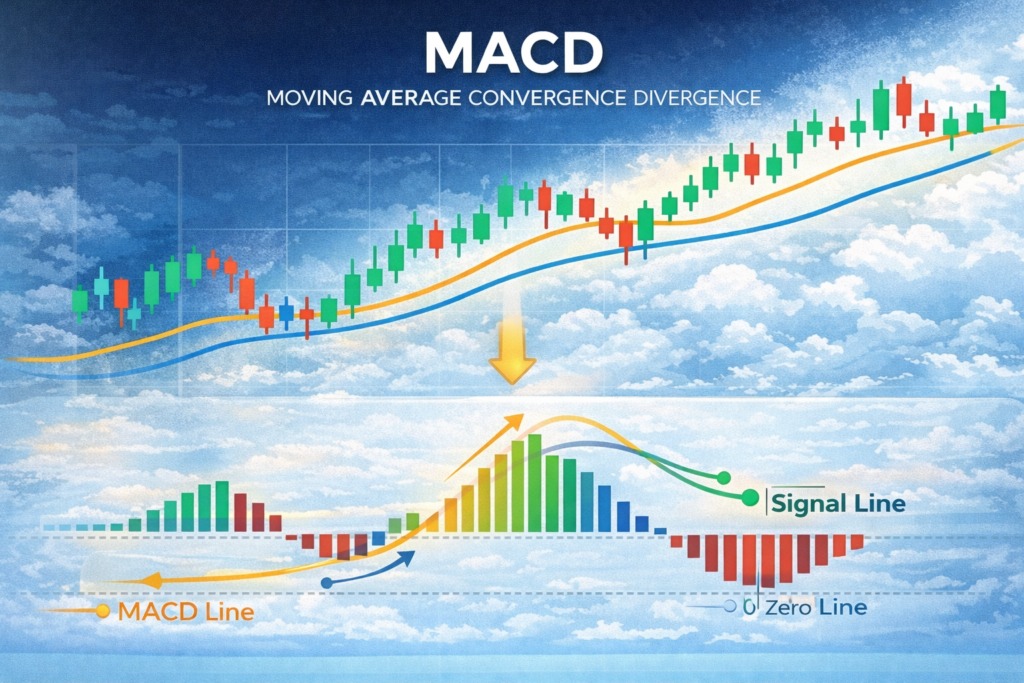
👉 Key idea:
MACD measures the distance between two moving averages.
That distance = momentum.
MACD is just one type of indicator.
👉 See how indicators actually work: what is an indicator in trading
Why Do Most Traders Fail With MACD?
Because they treat it like a magic signal.
Common mistakes:
- Trading every crossover
- Ignoring market structure
- Using MACD in sideways markets
👉 Truth:
MACD lags.
It reacts after price moves.
So if you use it blindly — you’re always late.
How Do You Read MACD Correctly?
What does MACD crossover mean?
A crossover happens when:
- MACD line crosses signal line
Buy signal:
- MACD crosses above
Sell signal:
- MACD crosses below
But:
👉 Not all crossovers are valid.
Strong crossover:
- Happens with trend
- Happens after pullback
Weak crossover:
- Happens in range
- Happens randomly
What does MACD histogram show?
Histogram shows:
👉 Momentum strength
- Increasing → momentum growing
- Decreasing → momentum weakening
This is critical for:
- Timing entries
- Spotting divergence
What Are the Best MACD Trading Strategies?
How to trade MACD crossover?
Basic system:
- Identify trend (EMA 50 or structure)
- Wait for pullback
- Enter when MACD crossover confirms
Example:
- Uptrend → wait for pullback
- MACD crosses up → buy
To use MACD properly, you need a clean chart and flexible setup.
👉 See our full platform review: TradingView review
How to trade MACD divergence?
Divergence = mismatch between price and momentum
Bullish divergence:
- Price makes lower low
- MACD makes higher low
Bearish divergence:
- Price makes higher high
- MACD makes lower high
👉 Important:
Divergence ≠ entry signal
It’s a warning.
Combine with structure break for entry.
How Do You Combine MACD With Price Action?
This is where edge comes from.
Best combo:
- Structure (HH/HL)
- Liquidity sweep
- MACD divergence
Example:
- Market in uptrend
- Price sweeps liquidity
- MACD shows bullish divergence
- Entry on confirmation
👉 This reduces false signals massively.
When Should You Avoid Using MACD?
MACD fails in:
- Sideways markets
- Low volatility
- Choppy price action
Signs to avoid:
- Flat EMA
- No clear structure
- Frequent crossover
👉 Rule:
No trend → no trade.
How Do You Manage Risk Using MACD?
MACD does NOT manage risk.
You must:
- Set stop loss (structure-based)
- Use fixed risk (1R per trade)
- Trail stop when in profit
Example:
- Entry: MACD + structure
- Stop: below last low
- Exit: structure break
Is MACD Effective in Forex and Crypto?
Yes — if used correctly.
Works best in:
- Trending forex pairs
- Crypto momentum phases
Fails in:
- Ranging markets
👉 Key:
MACD is a tool — not a system.
FAQ
Is MACD good for beginners?
Yes, but only with proper context.
Is MACD lagging?
Yes. It reacts to price.
Best timeframe?
H1, H4, Daily.
Best strategy?
Trend + pullback + confirmation.
Stop using MACD blindly.
Start using it with context.
Because indicators don’t make money.
Systems do.
If you’re still relying on MACD signals alone…
You’re missing the bigger picture.
👉 Start with the basics: trading for beginners
👉 Then learn how to turn that into profit: how to actually make money from trading