
ECN Forex Broker 2026: How to Choose a Real ECN Broker
Here’s a pattern that shows up in almost every trading forum: a trader switches brokers after one too many “technical issues” right when a winning trade is about to close. They ask around, someone mentions ECN, and suddenly they’re staring at a dozen review sites all claiming to list the “best ECN forex brokers” — except half the brokers on those lists aren’t running true ECN execution at all.
That’s the real problem with this topic. The label “ECN” has been stretched, rebranded, and occasionally faked so often that the term alone tells you almost nothing useful anymore. This guide fixes that. You’ll learn exactly what an ECN forex broker is, how to tell a genuine one from a relabeled market maker in under two minutes, what it actually costs you per lot, and which brokers on the current ecn broker list are worth your deposit in 2026 — broken down by the way you actually trade, not a generic ranking.
What Exactly Is an ECN Forex Broker?
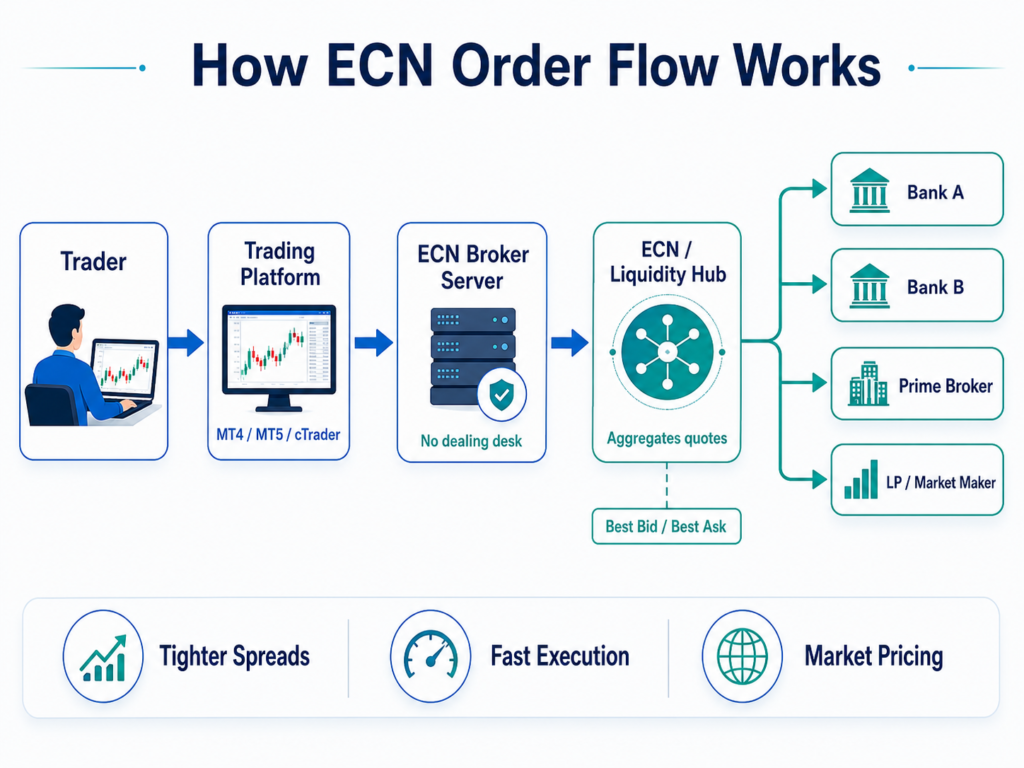
An ECN forex broker connects your orders directly to a network of liquidity providers — banks, hedge funds, and other large market participants — instead of filling your trade from its own internal book. The name itself, Electronic Communication Network, describes exactly what’s happening: a digital hub aggregates competing buy and sell prices from multiple sources and matches them with your order in real time. No human, and ideally no algorithm working against you, sits between your click and the market.
This matters more than it sounds. In a traditional dealing-desk setup, the broker is your counterparty — when you buy, they’re technically selling to you from their own inventory. That creates a structural conflict: your profit is, in a very direct sense, their loss. An ECN broker removes that conflict almost entirely. It earns a flat commission whether you win or lose, which means it has no financial incentive to slow your execution, widen your spread at the worst moment, or quietly reject your most profitable strategies.
How Does an ECN Actually Match Your Orders?
Picture an order book where dozens of banks and liquidity providers are constantly submitting bid and ask prices for, say, EUR/USD. The ECN system aggregates all of those quotes and displays the single best bid and best offer to you — the tightest spread available across the entire network at that exact moment. When you click buy, your order doesn’t sit and wait for a dealer’s approval. It’s matched instantly, anonymously, against whichever participant is offering the best opposing price. This is why true ECN accounts show “Market Execution” in your trading platform’s account properties, rather than “Instant Execution” or “Request Execution” — those labels signal a dealing desk is involved somewhere in the chain.
How Does an ECN Broker Make Money?
Unlike a market maker, an ECN broker isn’t profiting from a markup baked invisibly into your spread. It charges a transparent, fixed commission per lot traded — typically in the range of $2.50 to $7 per side, meaning $5 to $14 for a full round-turn trade. You see this charge listed separately on your statement, which is exactly the point: nothing is hidden inside the spread you’re quoted. This fee-based model is also why ECN brokers have little reason to restrict scalping, hedging, or algorithmic trading. Your trading volume is their revenue, regardless of whether your strategy wins or loses.
How Is ECN Different From STP and Market Maker Brokers?
The three models — ECN, STP, and Market Maker — sit on a spectrum of how directly your order reaches the real market, and understanding where each one sits changes how you should evaluate a broker’s claims.
| Model | Who Sets the Price | Conflict of Interest | Spread Type | Commission |
|---|---|---|---|---|
| ECN | Aggregated liquidity providers | None — broker earns flat fee | Variable, can hit 0.0 pips | Yes, fixed per lot |
| STP | Liquidity providers, passed through | Minimal — broker may add small markup | Variable | Usually none (markup instead) |
| Market Maker | The broker itself | Direct — broker is your counterparty | Often fixed | Usually none |
STP, or Straight-Through Processing, routes your order to a liquidity provider automatically, without manual intervention, but it doesn’t necessarily expose you to the full depth of the market the way ECN does. The broker may add a small markup to the raw spread instead of charging a visible commission — you’re still trading at close to real market prices, just with the cost folded in rather than itemized. Market makers, by contrast, create their own internal market and frequently become your direct counterparty. That’s not automatically a scam — the model is legal and many regulated market makers operate fairly — but the incentive structure means your win is, in some literal sense, their cost.
What Makes a Market Maker Different and Riskier?
A market maker can offer attractive features on the surface: fixed spreads, instant fills, and a simple experience that feels predictable to newer traders. The risk shows up specifically during volatility. Because the broker is taking the other side of your position, some market makers widen spreads dramatically during news events, delay execution on trades moving in your favor, or in worse cases, actively monitor for consistently profitable accounts and restrict them. Statistically, since most retail traders lose money on their own, a market maker doesn’t need to manipulate anything to profit — but the structural incentive to do so exists in a way it simply doesn’t for ECN.
When Does STP Make More Sense Than True ECN?
If you’re trading fewer than roughly 15 to 20 lots a month, or you’re still in the early stages of developing a strategy, STP can be the more sensible choice. You get genuine no-dealing-desk execution and prices close to the real market, without a per-trade commission line eating into small positions. The moment your volume increases, you start scalping seriously, or you notice the spread markup quietly costing more than a transparent ECN commission would, that’s the practical signal to move up to a true ECN account.
How Can You Verify a Broker Is a True ECN, Not a Fake One?
This is the question almost no comparison site answers in practical, step-by-step terms — and it’s the one that actually protects your money before you fund an account.
What Should Your MT4 or MT5 Account Properties Show?
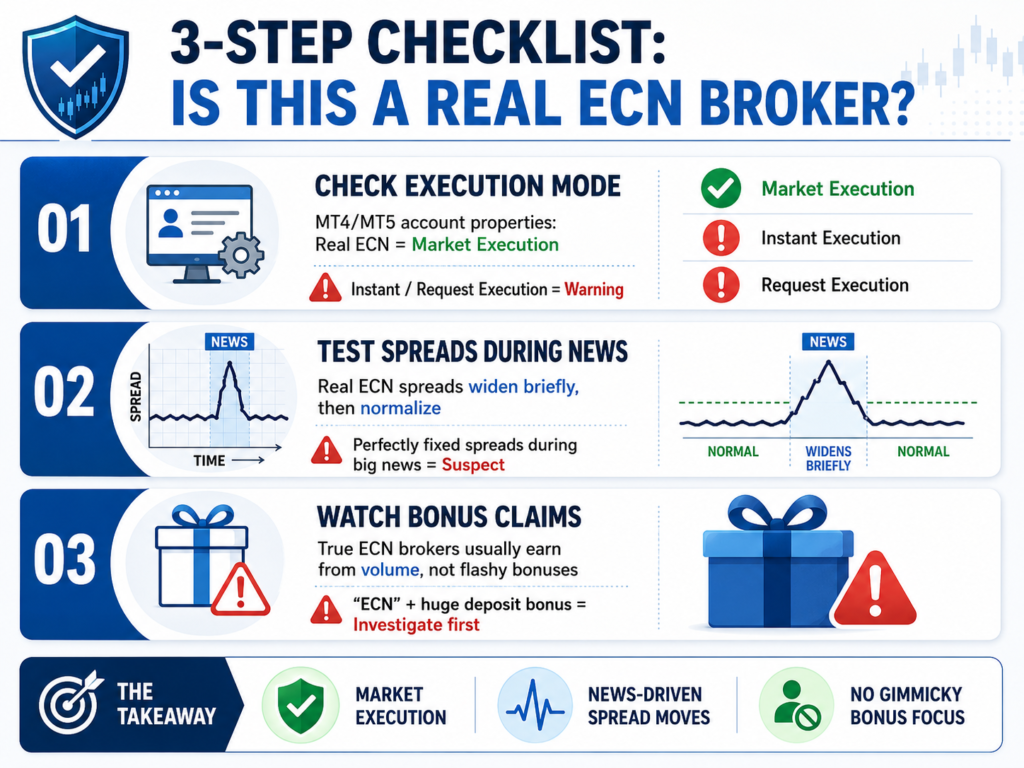
Open a demo account with the broker first. In MetaTrader, navigate to your account properties or right-click the account in the Navigator panel. A genuine ECN account will display “Market Execution” as the execution mode. If you see “Instant Execution” or “Request Execution” listed instead, you’re looking at a dealing-desk setup regardless of what the broker’s marketing page calls it. This single check takes under a minute and eliminates the majority of mislabeled “ECN” accounts immediately.
How Should Spreads Behave During News Events?
Leave a chart open on EUR/USD or another major pair during a high-impact news release — a central bank rate decision works well for this test. A true ECN spread will widen noticeably for a few seconds to minutes as liquidity providers pull back, then normalize once the market settles. If the spread stays perfectly constant through the entire event, that’s a strong indicator of synthetic pricing — a market maker’s software generating a price that looks market-like but isn’t actually sourced from real liquidity. Real markets are messy during news. A broker whose feed never reflects that mess is telling you something important about its execution model.
Why Do True ECN Brokers Rarely Offer Big Bonuses?
A true ECN broker’s entire revenue model depends on trading volume, not on your account balance shrinking. There’s little business logic in handing out large deposit bonuses or no-deposit cash, because the broker doesn’t profit from inflating your apparent capital — it profits from your commission-generating activity regardless of outcome. When you see a broker advertising itself as “ECN” alongside aggressive 100% deposit bonuses, treat that combination as a flag worth investigating further, not a red line automatically, but a prompt to run the execution-mode and news-spread tests above before depositing.
What Are the Real Pros and Cons of Trading With an ECN Broker?
Most content treats ECN as an unambiguous upgrade. It isn’t — it’s a trade-off, and being honest about both sides helps you decide if it actually fits you.
Genuine advantages:
- No conflict of interest: the broker earns the same whether you win or lose.
- Tighter pricing during normal market hours, often reaching 0.0 pips on major pairs.
- Full freedom for scalping, hedging, and algorithmic/EA trading, since the broker has no incentive to restrict profitable strategies.
- Faster execution in most cases — typically 20 to 40 milliseconds when the broker colocates servers near liquidity providers.
- Transparent cost structure: you can calculate your exact cost per trade in advance.
Real drawbacks rarely mentioned:
- Spreads are variable, which means they widen during low-liquidity windows — the Tokyo lunch session or the New York close transition are common examples — sometimes more than a fixed-spread account would.
- Commission costs add up fast for small or infrequent positions, making ECN comparatively expensive if you trade less than a few lots a month.
- Slippage is a normal, expected part of true ECN trading during fast-moving markets — it’s actually a sign of authentic execution, not a flaw, but it surprises traders coming from fixed-spread accounts who’ve never experienced it.
- Higher minimum deposits are common on the most institutional-grade ECN tiers, sometimes reaching $10,000 or more.
What Do ECN Spreads and Commissions Actually Cost You?
This is where most comparison tables quietly mislead readers — by mixing “per side” and “per round turn” commission figures without converting them to the same unit, making brokers look cheaper or more expensive than they really are relative to each other.
How Much Is a Typical ECN Commission Per Lot?
Across the current market, ECN commissions typically range from $2.50 to $7 per side, which translates to $5 to $14 per round-turn standard lot. Some brokers price more aggressively at the institutional tier — commissions as low as $1.50 per side appear on higher-deposit account tiers aimed at high-volume traders. The headline number alone tells you little; what matters is the combined cost once you add it to the spread you’re actually quoted.
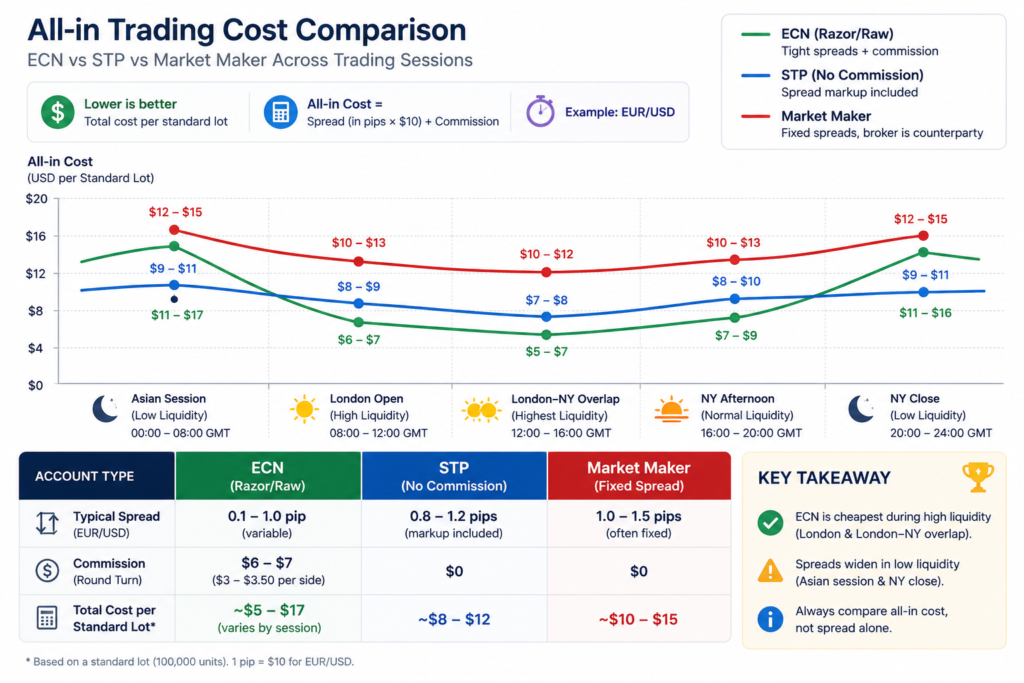
How Do You Calculate Your All-In Trading Cost?
Use this simple formula for a standard lot ($100,000 notional) trade:
All-in cost = (Spread in pips × $10 per pip) + Round-turn commission
For example, a EUR/USD trade with a 0.1 pip spread and a $7 round-turn commission costs you $1 (spread) + $7 (commission) = $8 total. Compare that directly against an STP account quoting a 1.0 pip spread with no commission: 1.0 pip × $10 = $10 total. In this example, the ECN account is actually cheaper despite the visible commission line — a result that surprises traders who assume “no commission” automatically means “cheaper.”
| Account Type | Spread (EUR/USD) | Commission (Round Turn) | Total Cost per Standard Lot |
|---|---|---|---|
| ECN (tight liquidity hours) | 0.1 pip | $6–$7 | ~$7–$8 |
| ECN (thin liquidity hours) | 0.5–1.0 pip | $6–$7 | ~$11–$17 |
| STP | 0.8–1.2 pips | $0 (markup included) | ~$8–$12 |
| Market Maker | 1.0–1.5 pips (often fixed) | $0 | ~$10–$15 |
Which Are the Best ECN Forex Brokers in 2026?
Based on execution model verification, liquidity provider depth, regulatory standing, and published cost structures, these are consistently among the strongest top ecn forex brokers currently available to retail traders.
- IC Markets — Widely cited across independent testing for deep liquidity (20+ liquidity providers), sub-30ms execution, and EUR/USD spreads from 0.0 pips on its Raw account with a $3 per side commission. Regulated across multiple jurisdictions including ASIC.
- Pepperstone — Operates a Razor account offering ECN-equivalent pricing from 0.0 pips with $3.50 per side commission, strong platform variety (MT4, MT5, cTrader, TradingView), and broad regulatory coverage.
- FP Markets — Established 2005, ASIC and CySEC regulated, Raw ECN account with $3 per side commission and independently tested average EUR/USD spreads around 0.19 pips, plus a wide platform suite including cTrader.
- Fusion Markets — Positioned as a low-cost specialist, with independently recorded average EUR/USD spreads near 0.01 pips on its Zero account, regulated by ASIC alongside offshore licenses.
- FOREX.com — A long-established option with over 20 years in the industry, ECN-style accounts with spreads near 0.1 pips plus roughly $6 commission, and a wide instrument range exceeding 80 currency pairs.
Which ECN Broker Is Best for Scalpers and Algorithmic Traders?
Scalpers and EA traders should prioritize raw execution speed and the absence of strategy restrictions over marginal spread differences. IC Markets and Pepperstone both consistently test under 30 milliseconds in independent execution audits, and neither imposes restrictions on high-frequency strategies or hedging. For this group, the deciding factor often comes down to platform preference — cTrader for traders who want Level II market depth visible directly, or MT4/MT5 for established EA libraries.
Which ECN Broker Has the Lowest Trading Costs?
Fusion Markets has repeatedly tested with some of the lowest raw spreads in independent reviews, making it the strongest fit if minimizing per-trade cost is your single priority and you’re comfortable with a leaner platform and educational offering compared to larger, more established names.
Which ECN Broker Offers the Most Platform Variety?
FP Markets stands out for combining MetaTrader 4, MetaTrader 5, cTrader, and TradingView under one roof, giving traders the flexibility to test multiple charting and execution environments without switching brokers.
Which ECN Broker Fits Your Trading Style and Account Size?
This is the question generic rankings skip entirely, because the honest answer depends on you, not a universal “best” broker.
Which ECN Broker Should Beginners With Small Capital Choose?
If you’re starting with $200 to $500, look specifically for ECN or Raw account tiers with no minimum deposit threshold above that range — IC Markets, Pepperstone, and Fusion Markets all offer entry-level ECN access without requiring the $10,000+ deposits some institutional tiers demand. At small capital, commission costs matter proportionally more, so run the all-in cost calculation above before committing, and seriously consider whether a low-volume STP account might actually cost you less until your trading frequency increases.
Which ECN Broker Is Best for High-Volume or Institutional-Style Traders?
Once you’re consistently trading large lot volumes, the lowest-commission institutional tiers become worth the higher deposit requirement — some brokers offer per-side commissions as low as $1.50 to $2 once you qualify, which compounds into meaningful savings at scale. At this volume, prioritize deep liquidity provider networks and verified low-latency execution over marginal spread differences, since slippage avoidance becomes more financially significant than shaving fractions of a pip off the quoted spread.
Is an ECN Broker Right for You, or Should You Stick With STP?
If your monthly volume is modest, you’re still refining a strategy, or you simply want the simplicity of not tracking a separate commission line, STP remains a perfectly reasonable choice — it’s still a no-dealing-desk model with minimal conflict of interest. ECN earns its place once your volume, strategy (especially scalping or EA-based), or sensitivity to execution quality reaches the point where transparent, commission-based pricing starts beating a spread markup on a real cost basis. Neither model is inherently “better” in the abstract — the right one is whichever matches where your trading actually is today.
What Regulatory Protections Should You Check Before Choosing an ECN Broker?
Execution model and regulation are two separate questions, and both matter independently. A broker can run genuine ECN execution while being weakly regulated, or claim ECN pricing while holding strong Tier-1 licenses — the label doesn’t guarantee the oversight, and the oversight doesn’t guarantee the label is accurate. Before funding any account, confirm regulation directly through the relevant authority’s public register — ASIC, FCA, or CySEC are the most commonly cited Tier-1 regulators among the brokers listed above — and check whether negative balance protection and segregated client funds are explicitly part of that license’s requirements, not just a marketing claim on the broker’s homepage.
Ready to put this into practice? Run the Market Execution check on a demo account before you fund anything live, and compare your shortlist using our Best forex brokers comparison to see how spreads, commissions, and regulation stack up side by side.
Frequently Asked Questions About ECN Forex Brokers
Is ECN Better Than STP for Beginners?
Not necessarily. Beginners trading small, infrequent positions often pay less overall with STP’s markup-included pricing than with ECN’s per-lot commission. ECN becomes more cost-effective as trading volume and frequency increase, particularly for scalping or algorithmic strategies.
Do ECN Brokers Allow Scalping and EA Trading?
Yes, almost universally. Since ECN brokers earn from commission rather than client losses, they have no financial incentive to restrict high-frequency strategies, hedging, or automated Expert Advisors the way some market makers do.
What Is the Minimum Deposit for an ECN Account?
It varies widely. Many retail-focused ECN accounts require as little as $0 to $200, while institutional-grade ECN tiers with the lowest commissions can require $10,000 or more. Always check the specific account tier, not just the broker’s general minimum.
Can ECN Brokers Manipulate Prices Against You?
Genuine ECN execution removes the broker’s direct incentive to manipulate prices, since it isn’t your counterparty. However, brokers falsely labeling a dealing-desk account as “ECN” retain that conflict — which is exactly why verifying execution mode before depositing matters.
Is a Low Spread Always a Sign of a True ECN Broker?
No. A consistently low or perfectly fixed spread can actually indicate synthetic pricing from a market maker. True ECN spreads fluctuate with real market liquidity, including widening during news events — variability is part of the authenticity signal, not a flaw.
Risk Disclosure: Forex and CFD trading involves substantial risk of loss and is not suitable for all investors. This article is for informational purposes only and does not constitute financial advice. Always verify a broker’s regulatory status and execution model independently before depositing funds.
Methodology: This guide is based on publicly available broker testing data, independently published spread and execution-speed figures current as of 2026, and verified regulatory information cross-referenced across multiple broker-comparison platforms cited throughout.