eToro Fees Explained 2026: Stocks, Crypto, Forex & Hidden Costs
You open your eToro app expecting “commission-free trading,” and the math doesn’t quite add up. A withdrawal request that came back $5 lighter than you expected. A crypto position that lost more to fees than to actual price movement. An ISA fee that looks nothing like the trading fees you read about everywhere else. None of this means eToro is hiding anything — it means the fee structure is spread across more moving parts than most “fees” pages bother to fully connect.
This guide pulls every one of those parts into one place. We’ll cover exactly what you pay for stocks, ETFs, crypto, forex, and CFDs, what the real round-trip cost of a crypto trade looks like once every layer is added up, whether copy trading really is free, how the separate eToro ISA pricing works, and the specific, practical steps that actually lower your total eToro fees — not just a list of numbers, but what to do with them.
What Are eToro’s Main Fees at a Glance?
Before the details, here’s the shape of eToro’s pricing in 2026: stocks carry a small per-trade commission, ETFs remain commission-free, crypto and CFDs are priced through spreads rather than visible commissions, and a handful of non-trading fees — withdrawal, inactivity, currency conversion — sit outside the trading screen entirely, which is exactly why they catch people off guard.
| Fee Type | Typical Cost |
|---|---|
| Stock trading | $1–$2 per trade |
| ETF trading | Commission-free |
| Crypto trading | ~1% spread on buy, 0.6–1% on sell |
| Forex spread (majors) | From 1.0 pip |
| CFD stock/ETF spread | 0.15% per side |
| Withdrawal | $5 flat (free for GBP/EUR accounts) |
| Inactivity | $10/month after 12 months |
| Overnight fee (CFD) | Varies by position, x3 on weekends |
The rest of this guide breaks down exactly how each of these works, where the real costs hide, and what you can actually do about them.
How Much Does eToro Charge for Stock and ETF Trading?
eToro charges a flat commission of $1 or $2 per stock trade, applied on both the buy and the sell side — so a complete round-trip position costs $2 to $4 in commission alone, separate from any market spread. The exact amount depends on your country of residence and which exchange the stock trades on, and the fee applies to both opening and closing the position. ETFs are treated differently and remain commission-free globally, which makes ETFs the structurally cheaper way to build diversified exposure on eToro compared to picking individual stocks one by one, assuming your strategy doesn’t specifically require single-stock positions.
Why Did eToro Start Charging a Stock Commission?
This is a genuine, recent shift worth knowing if you’ve used eToro before and remember it differently: stock trading on eToro used to be marketed as entirely commission-free in most regions. That changed with the introduction of the current $1–$2 per-trade fee. If you opened stock positions before this fee took effect in your country, eToro has stated those existing positions won’t retroactively incur the new charge when you eventually close them — but any new position you open today falls under the current pricing. ETFs were left untouched by this change, which is why the commission-free ETF angle is now eToro’s stronger value proposition for cost-conscious investors rather than individual stock picking.
What Are eToro’s Crypto Fees, Really?
This is the section where the gap between “what eToro advertises” and “what you actually pay” is widest, and it’s worth slowing down here specifically.
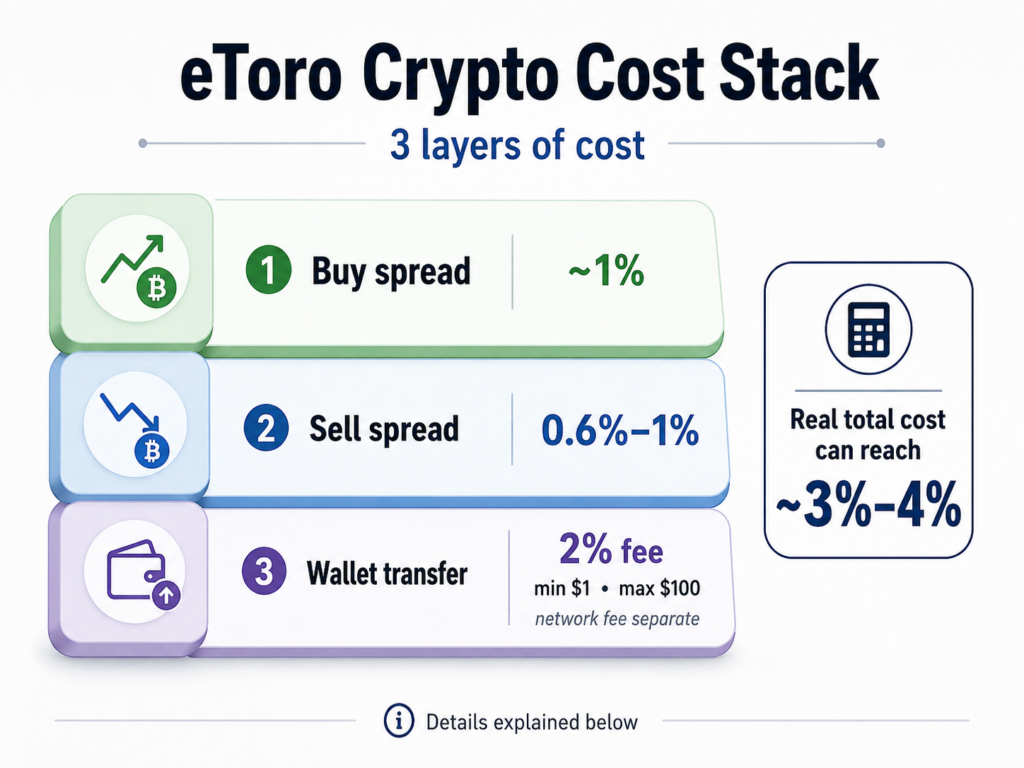
eToro doesn’t charge a separate crypto commission. Instead, it builds the cost into the spread: roughly a 1% spread when you buy, and 0.6% to 1% when you sell, depending on the asset and market conditions at that moment. Major coins like Bitcoin tend to sit toward the lower end of that range, while less liquid altcoins can carry noticeably wider spreads. Taken on its own, a single “1%” figure is the number most comparison pages quote — and it’s accurate, but only for one side of one transaction.
What Does a Full Crypto Round-Trip Actually Cost?
Add the buy spread and the sell spread together, and a complete round-trip — buying and later selling the same position — runs somewhere between 1.6% and 2% before you’ve touched a single external wallet. If you then decide to move that crypto off the platform entirely, a separate 2% transfer fee applies (with a $1 minimum and $100 maximum) to move it to the eToro Money wallet, on top of whatever blockchain network fee applies at that moment. Stack all three together — buy spread, sell spread, and wallet transfer — and a trader who buys, holds, sells, and then withdraws to their own wallet can realistically face a combined cost in the 3% to 4% range, not the 1% the headline figure implies. None of this is hidden in the fine print exactly — it’s documented — but it’s rarely added up in one place the way it should be before you size a crypto position.
How Much Does It Cost to Transfer Crypto Off eToro?
The 2% transfer fee to the eToro Money wallet app is calculated on the value being moved, bounded by a $1 minimum and $100 maximum per transfer — meaning very large transfers are effectively capped at $100 in eToro’s own fee, though the underlying blockchain’s network fee still applies separately and fluctuates with network congestion. Crypto transfers also require manual review and take roughly one business day to process before the blockchain transaction itself begins, which is worth planning around if you’re moving funds with any time sensitivity.
What Are eToro’s Forex and CFD Spreads?
Forex pricing on eToro runs entirely on spreads, with no separate commission layered on top. Major pairs like EUR/USD and USD/JPY start from around 1.0 pip, pairs like AUD/USD and EUR/GBP run closer to 1.5 pips, and GBP/USD has been cited around 2.0 pips — spreads that are reasonable for casual trading but not the tightest available if you’re a high-volume forex trader, where dedicated ECN brokers will typically undercut eToro on a like-for-like basis. CFDs on stocks and ETFs carry a 0.15% spread charged on both opening and closing the position, while CFDs on crypto carry the same 1% structure as regular crypto trading. These spreads are variable, not fixed, and tend to widen during high volatility or outside standard market hours — a detail that matters if you’re trading around news events or outside your local trading session.
How Do Overnight and Weekend Fees Work?
Any leveraged CFD position held open past a certain daily cutoff — 22:00 UK time on eToro — incurs an overnight financing fee, sometimes called a rollover or swap fee, reflecting the interest cost of the leverage you’re using. This fee can be either a charge or, less commonly, a credit, depending on the interest rate differential between the instruments involved. Crucially, this fee triples for positions held over the weekend, since the standard daily charge gets applied across Saturday and Sunday in one combined hit on a specific weekday’s rollover. Non-leveraged buy positions — genuine ownership of an asset rather than a leveraged CFD — don’t incur this fee at all, which is one of the clearest reasons to understand whether your specific position is structured as a CFD before holding it long-term.
Are There Fees for eToro’s Copy Trading?
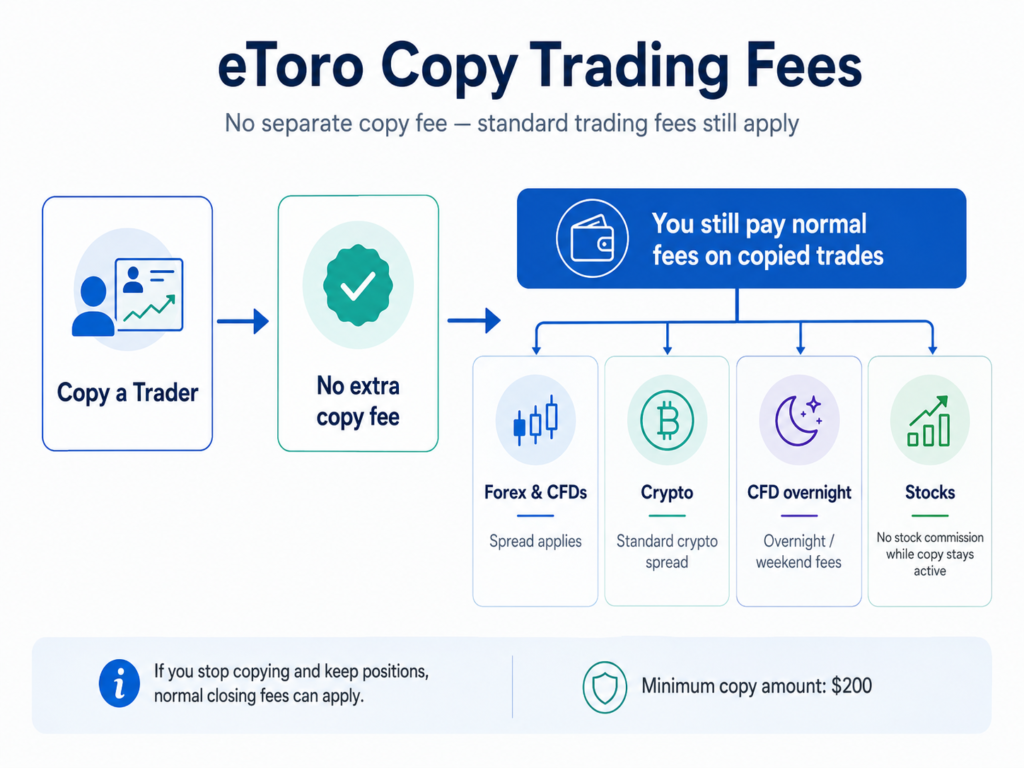
Short answer: no separate fee exists for the act of copying another trader. eToro states this directly, and it holds up — there’s no subscription cost, no percentage cut taken specifically because you’re using CopyTrader instead of trading manually.
What Fees Still Apply When You Copy a Trader?
The nuance that gets lost in “copy trading is free” headlines: every trade executed inside a copy relationship still carries eToro’s standard fees for that asset class. If the trader you’re copying buys crypto, you pay the same crypto spread on your proportional share. If they hold a leveraged CFD position overnight, you pay the same overnight fee. Copy trades are exempt from the stock commission specifically — but only while the copy relationship stays active. If you stop copying and choose to keep the resulting positions as your own manual holdings, those positions become subject to standard commission the next time you close them. The minimum to start copying a single investor is $200, and you can run up to 100 simultaneous copy relationships, though spreading allocation across that many doesn’t automatically improve diversification if the underlying strategies overlap heavily.
What Is the eToro Withdrawal Fee, and How Can You Avoid It?
eToro charges a flat $5 fee on every withdrawal request from a USD-denominated account, regardless of the amount withdrawn or the payment method used — a structure that stands out because most competing brokers have moved away from charging withdrawal fees at all. The minimum withdrawal amount is $30. The most direct way to avoid this fee entirely: open and fund your account using a GBP or EUR local currency account instead of USD, since withdrawals from those currency accounts are free. If you’re already on a USD account, batching withdrawals — taking out larger amounts less frequently rather than several small withdrawals — reduces how many times the flat $5 charge hits you over a year, even though it doesn’t eliminate the fee on each individual request.
What Other Non-Trading Fees Does eToro Charge?
Beyond withdrawals, two other fees sit outside the trading screen and are easy to forget about until they appear.
How Does the Inactivity Fee Work?
eToro charges $10 per month if you don’t log into your account for 12 consecutive months, deducted automatically from your remaining balance. The fix is almost embarrassingly simple: logging in even once within that 12-month window resets the timer completely, regardless of whether you actually place a trade. One important regional exception — clients of eToro (UK) Ltd, regulated under the FCA, are not subject to this inactivity fee at all, a protection tied specifically to UK regulatory requirements rather than a universal policy.
What Are eToro’s Currency Conversion Fees?
Because eToro accounts are primarily USD-denominated by default, depositing or withdrawing in a different currency triggers a conversion fee, which can reach up to 1.5% depending on your payment method and eToro Club tier — higher tiers generally unlock reduced conversion costs. The most reliable way around this is opening a local currency account (available in GBP, EUR, AUD, and DKK) if you qualify, which lets you deposit, hold, and trade local-currency-denominated assets without a conversion fee eating into either side of the transaction.
How Much Are eToro ISA Fees in the UK?
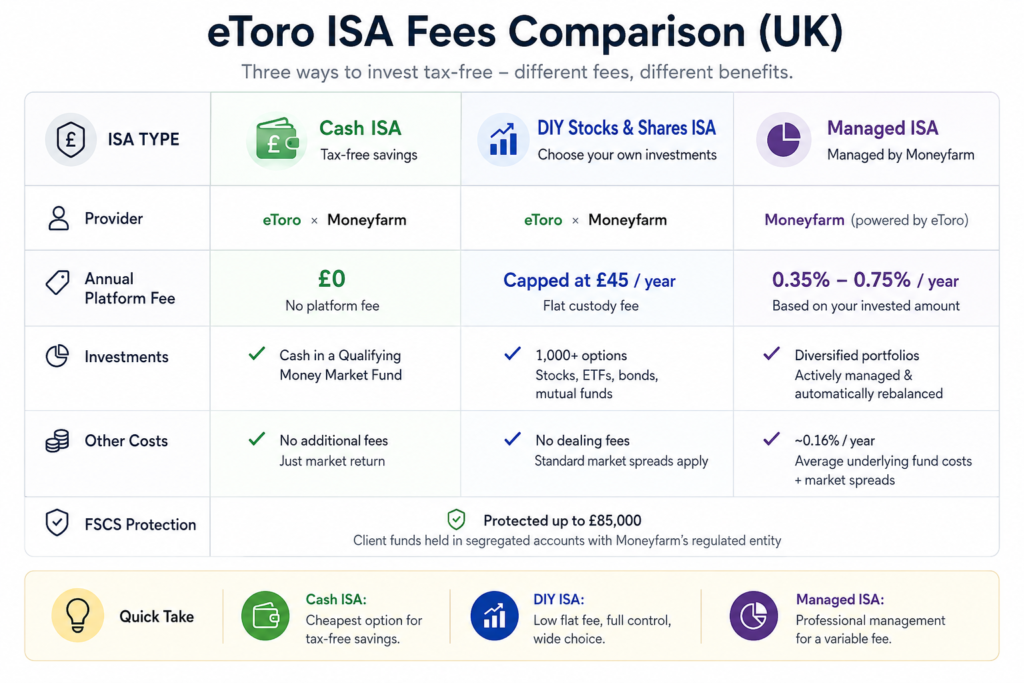
Here’s where eToro’s fee structure splits into something genuinely separate from everything covered so far: the eToro ISA isn’t run by eToro directly. It’s a partnership with Moneyfarm, launched in 2023 and expanded with a DIY Stocks and Shares ISA and a standalone Cash ISA through 2025. Because Moneyfarm operates and manages the ISA wrapper, its fee structure doesn’t match eToro’s standard trading fees at all — comparing the two directly is the single most common point of confusion in this entire topic.
What’s the Difference Between the DIY and Managed ISA Fees?
The DIY Stocks and Shares ISA, where you choose your own holdings from a list of 1,000+ stocks, ETFs, bonds, and mutual funds, carries a custody fee capped at £45 per year — a flat administrative cost rather than a percentage of your portfolio. The Managed ISA, where Moneyfarm’s team builds and actively rebalances a portfolio matched to your risk profile, charges a percentage-based management fee ranging from roughly 0.35% to 0.75% annually depending on your invested amount, on top of average underlying fund costs of around 0.16% per year and minor market spread effects. The Cash ISA, by contrast, holds your money in a Qualifying Money Market Fund and carries no platform fee for simply holding cash — making it the cheapest of the three options if you’re using it purely as a tax-free savings vehicle rather than an investment account. All three ISA types are protected by the FSCS up to £85,000, since client funds are held in segregated accounts with Moneyfarm’s regulated entity.
How Can You Reduce Your Overall eToro Fees?
A few concrete habits meaningfully lower what you pay over a year of using eToro, without changing your actual investment strategy:
- Open a GBP or EUR local currency account if you’re eligible, eliminating both the $5 withdrawal fee and ongoing currency conversion charges.
- Favor ETFs over individual stocks when your goal is broad diversification, since ETFs remain fully commission-free while stocks now carry a per-trade fee.
- Batch your withdrawals into fewer, larger requests rather than frequent small ones, since the flat $5 fee applies per request regardless of size.
- Avoid unnecessary CFD exposure for positions you intend to hold long-term — non-leveraged ownership positions skip overnight fees entirely, while CFDs accumulate financing costs the longer they stay open.
- Log in at least once a year, even without trading, to avoid the inactivity fee resetting against you unnecessarily.
- Account for the full crypto round-trip cost — buy spread, sell spread, and any wallet transfer fee — before sizing a crypto position, rather than budgeting around the simplified “1%” figure alone.
Is eToro Expensive Compared to Other Brokers?
The honest answer depends entirely on what you’re trading. For ETF investing and using CopyTrader, eToro’s pricing is genuinely competitive, since neither carries a commission beyond standard spreads. For frequent individual stock trading, dedicated low-cost brokers — Trading 212’s commission-free model or Interactive Brokers’ tiered pricing for high-volume traders — will generally undercut eToro’s $1–$2 per-trade fee at scale. For crypto specifically, eToro sits well above dedicated crypto exchanges like Binance, where spreads and fees are typically a fraction of eToro’s combined buy-sell-transfer cost — the trade-off being eToro’s regulatory oversight (FCA, CySEC, ASIC) and the convenience of trading crypto alongside stocks and forex in one account, rather than managing a separate exchange relationship.
Want to see exactly how these fees play out against a specific alternative? Check our etoro review for the complete platform breakdown, or compare costs directly in our best broker for Meta trade 5 before you decide where to put your next deposit.
Frequently Asked Questions About eToro Fees
Does eToro Charge Deposit Fees?
No, eToro does not charge a deposit fee in most regions. However, if you deposit in a currency other than your account’s base currency, a separate currency conversion fee applies — which can feel like a deposit cost even though it’s technically a conversion charge.
Are eToro’s Fees the Same in Every Country?
Mostly, but not entirely. Stock commission amounts can vary slightly by country and exchange, US-based clients trade through eToro USA LLC with some product differences (no CFDs), and the UK’s FCA-regulated entity is exempt from the inactivity fee that applies elsewhere.
Does eToro Charge for Holding Cash?
No, eToro does not charge a fee simply for holding uninvested cash in your trading account. The only cash-related charge to watch for is the inactivity fee, which applies only after 12 consecutive months without logging in, not for holding cash while actively using the account.
Is There a Fee for Using the Demo Account?
No. eToro’s demo account, which comes preloaded with $100,000 in virtual funds, is completely free to use and carries no fees of any kind, since no real money or real trades are involved.
Does eToro Charge Fees on Dividends?
No, eToro does not charge a fee for receiving dividends from stocks or ETFs you hold. Dividends are credited to your account automatically according to each company’s own distribution schedule, with no additional eToro charge layered on top.
Risk Disclosure: CFDs are complex instruments and come with a high risk of losing money rapidly due to leverage. The majority of retail investor accounts lose money when trading CFDs with this provider. Cryptoassets are highly volatile and unregulated in some jurisdictions; you could lose all of your invested capital. This article is for informational purposes only and does not constitute financial advice. Always verify current fees directly on eToro’s official fees page before trading, as pricing can change.
Methodology: This guide is based on eToro’s publicly published fee schedules, independently verified broker-comparison data current as of 2026, and official Moneyfarm ISA pricing documentation cited throughout.