eToro Review 2026: Is It Still Worth Using for Copy Trading and Stocks?
Search “eToro review” and you’ll find a hundred articles telling you it’s great for beginners, great for copy trading, great for commission-free stocks. What you won’t easily find is someone telling you about the $25 withdrawal fee that catches new users off guard, or why eToro is genuinely the wrong choice if you’re a day trader, or what it really means when a “top trader” on eToro has 50,000 copiers paying them 1.5% of assets annually.
This review gives you that.
eToro is one of the most innovative trading platforms built in the last two decades. It pioneered social investing, and its CopyTrader feature genuinely changes what’s possible for non-professional investors. But “innovative” and “right for your situation” are different things. By the end of this eToro review, you’ll know exactly which category you fall into.
What is eToro and what makes it different from other brokers?
eToro was founded in 2007 in Tel Aviv, Israel, with a mission to make financial markets accessible to everyone. Over the past 17 years, it has grown to serve more than 35 million registered users across approximately 75 countries — making it one of the largest retail trading and investing platforms in the world.
What separates eToro from every other broker is its social trading DNA. Where traditional brokers are purely transactional — you log in, place a trade, log out — eToro was built as a community. Every trade, every portfolio, every comment is visible to the community. You can follow other traders like you’d follow someone on Instagram. You can see their performance history, their current positions, and their trade rationale. And with CopyTrader, you can automatically mirror every trade they make in real time.
This concept sounds simple. But the execution matters, and the implications run deep — particularly around incentives, which we’ll address in the CopyTrader section.
eToro offers trading and investing across:
- Real stocks and ETFs (0% commission on non-CFD US stocks)
- Crypto (100+ coins, 1% commission per trade from July 2025 + spread)
- CFDs on forex (49+ currency pairs)
- CFD indices, commodities, and more
- Smart Portfolios (thematic, pre-built investment baskets)
In May 2025, eToro became a publicly traded company on the Nasdaq exchange under the ticker ETOR — a significant structural change that added public reporting obligations and a new layer of regulatory accountability on top of its existing FCA, CySEC, and ASIC licenses.
Is eToro safe and trustworthy to use in 2026?
Which regulators oversee eToro and how does it protect funds?
eToro operates under multiple Tier-1 regulatory licenses — the strongest category of regulatory oversight available for retail brokers:
| Regulatory Body | Jurisdiction | License |
|---|---|---|
| FCA | United Kingdom | 583263 |
| CySEC | Cyprus (EU) | 109/10 |
| ASIC | Australia | 491139 |
| FinCEN | United States | Registered MSB |
| + 3 additional | Various | Regional |
The FCA and CySEC licenses are the most meaningful for most traders. Under the UK FCA framework, client funds held by eToro (UK) Ltd are protected by the Financial Services Compensation Scheme (FSCS) up to £85,000. EU clients under CySEC are covered by the Investor Compensation Fund up to €20,000.
eToro holds client funds in segregated accounts — your money is held separately from eToro’s operating capital and cannot be used to meet the company’s own obligations. The broker has operated continuously since 2007 without any major regulatory sanctions, fund access issues, or documented client payment failures.
Is eToro trustworthy? Yes — by every measurable indicator. Regulatory standing, fund segregation, operational history, and now public company accountability all support a high trust rating.
What did eToro’s Nasdaq IPO in 2025 change for traders?
In May 2025, eToro listed on the Nasdaq under ticker ETOR — completing an IPO that had been discussed since 2021. This was a meaningful structural change, not just a financial milestone.
As a publicly traded company, eToro is now subject to SEC reporting requirements, quarterly earnings disclosures, and public shareholder accountability. The firm’s financials, client numbers, revenue breakdown, and operational costs are now a matter of public record. This transparency is genuinely valuable for traders trying to assess whether eToro is financially stable.
The IPO also raised capital that strengthens eToro’s balance sheet — reducing (though not eliminating) the theoretical risk that the business could face the kind of liquidity issues that have historically threatened smaller brokers.
For practical purposes: an eToro trading with a Nasdaq listing is a more transparent, more financially accountable version of the company than existed before. That’s good news for users of the platform.
What does eToro actually cost? The complete fee breakdown
Most people discover that eToro is not quite as “free” as it appears. Here is every fee, explained without softening.
What are eToro’s trading fees on stocks, forex, and crypto?
Stocks and ETFs:
- US listed stocks: 0% commission on buy and sell (non-CFD)
- Non-US stocks: typically held as CFDs with spread-based pricing
- ETFs: 0% commission on most major ETFs
This zero-commission model is genuine for US stocks. It’s how eToro generates revenue from stock traders: through the bid-ask spread on your trades and through the other fees listed below.
Forex (CFDs):
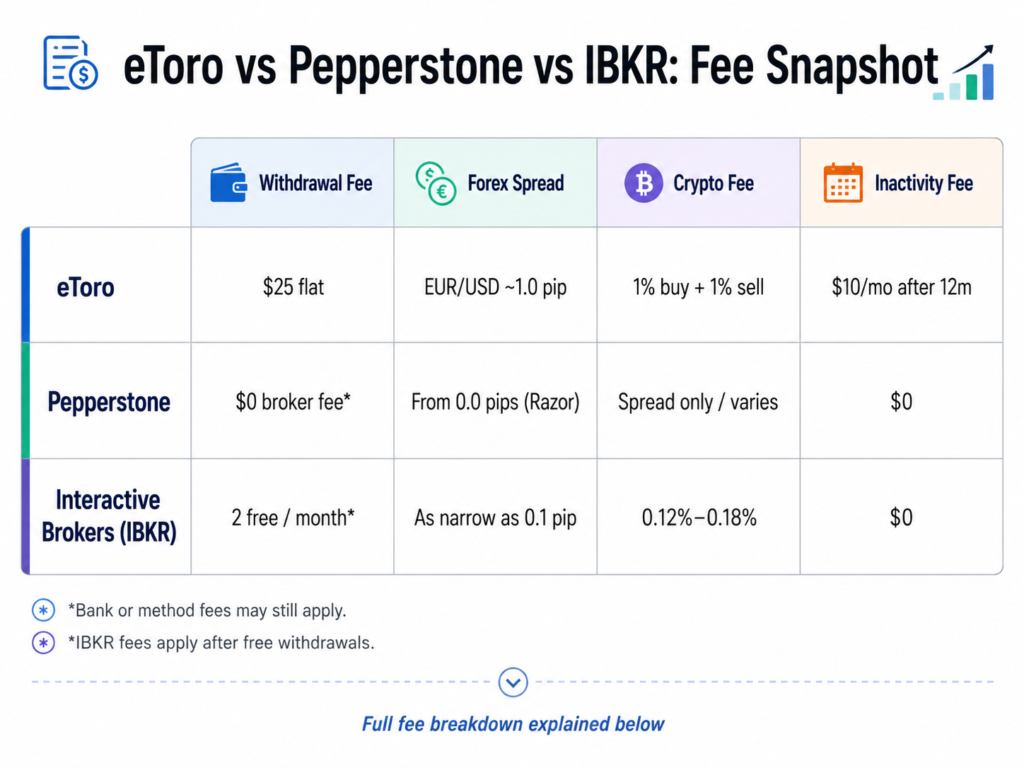
- EUR/USD average spread: approximately 1 pip (equivalent to $10 per standard lot round-trip)
- This is higher than ECN brokers like Pepperstone (avg. 0.10 pips) or IC Markets (avg. 0.0 pips raw)
- No additional commission on CFD forex trades — all cost is embedded in the spread
Crypto:
- From July 2025: 1% commission per trade at open AND close, charged separately from spread
- So buying $1,000 of Bitcoin costs $10 at entry and $10 at exit — plus the spread
- This transparent structure replaced the previous all-in spread model — costs are equivalent but now clearly visible
- Crypto withdrawal fee: $5 for Bitcoin, $30 for Ethereum (to the eToro Money wallet)
What hidden fees does eToro charge that most reviews mention but don’t emphasize?
This is where eToro’s cost story gets complicated — and where many traders get caught off guard.
$25 withdrawal fee — flat, per withdrawal:
Every time you withdraw money from eToro to your bank account or e-wallet, you pay $25. This is a flat fee regardless of withdrawal amount. Withdraw $100 — pay $25 (25% of your withdrawal). Withdraw $10,000 — pay $25 (0.25%). The fee is documented but systematically underemphasized in eToro’s own marketing. For small investors making frequent withdrawals, this fee is disproportionately damaging to returns.
$10/month inactivity fee:
If you don’t log into your eToro account for 12 consecutive months, a $10 monthly charge begins. This fee is charged against your available balance and will continue until your balance reaches zero or you log back in. For traders who open accounts, fund them, and then step away from the market for a year, this fee can erode a significant portion of small balances.
Currency conversion fee:
eToro accounts are denominated in USD. If you deposit in GBP, EUR, or another currency, eToro applies a currency conversion fee. The rate varies by deposit method but can reach 1.5%. This is an invisible cost that compounds on every deposit and withdrawal for non-USD account holders.
FX conversion on stock dividends:
If you hold non-USD stocks and receive dividends in local currency, eToro converts them to USD before crediting your account — applying another currency conversion in the process.
The eToro Club fee structure:
eToro’s tiered membership (Silver starts at $5,000 equity, Diamond at $250,000+) reduces certain fees for higher-balance clients. This creates a two-tier system where high-net-worth users get meaningfully better terms than small investors.
Total cost reality check:
A trader with $1,000 who makes 4 withdrawals per year pays $100 in withdrawal fees alone — a 10% annual fee drag before any trading activity. For this trader, eToro is not a low-cost platform.
How does eToro CopyTrader work and is it worth using?
CopyTrader is the feature that made eToro famous — and it’s genuinely excellent if you understand how it works and choose the right traders to follow.
The mechanics are simple. You browse eToro’s community of traders, filter by performance, risk score, assets traded, and copy duration. You allocate a minimum of $200 to any trader you want to copy. From that moment, every trade they execute — open, modify, close — is replicated in your account automatically and proportionally. If they allocate 5% of their portfolio to Apple, your copy allocates 5% of your copy amount to Apple.
You can copy up to 100 traders simultaneously. You can start or stop copying at any time. You maintain full control — the ability to close individual copied positions manually, or stop the entire copy with one click. Trade execution within the copy system happens in under one second from when the original trader acts.
There is no direct fee for using CopyTrader. eToro does not charge a percentage of your copy allocation for this feature. The cost is indirect — you pay the same spread and commission structure on copied trades that you would on manual trades.
Who are the best top traders on eToro to copy?
Selecting eToro top traders is the skill that determines whether CopyTrader makes money or loses it. The platform provides filtering by:
- Return (gains over 6 months, 12 months, 2 years, etc.)
- Risk score (1–10 scale — lower is more conservative)
- Assets traded (stocks, forex, crypto, mixed)
- Number of copiers (social proof signal)
- Drawdown (maximum loss from peak — critical metric)
eToro’s “most copied” ranking is not the best selection criterion. The most copied traders are often those with the longest marketing visibility, not necessarily the best risk-adjusted returns. Traders with 50,000+ copiers face an unusual incentive problem (see next section).
For more reliable selection:
- Filter for minimum 2-year track record — eliminates traders who had one good quarter
- Prioritize maximum drawdown below 20% — indicates controlled risk management
- Look for risk score of 5 or below — higher scores mean more volatile equity curves
- Check monthly vs annual return consistency — consistent 2–5% monthly beats inconsistent 30% months followed by -20% months
Some of the traders community members discuss frequently as strong performers include long-term stock investors with diversified portfolios, low-leverage strategies, and public explanations of their trade rationale. Specific trader names change over time as performance evolves — always verify current metrics on the platform before allocating.
What is the Popular Investor Program and why does it matter?
This is the most important and least discussed aspect of eToro copy trading — and understanding it changes how you evaluate which traders to copy.
The Popular Investor Program pays eToro’s most-copied traders an annual payment of up to 1.5% of assets under copy (AUC) — the total amount allocated to them by their copiers. A trader with $5 million in copy allocations earns up to $75,000 per year from eToro, regardless of their trading performance.
This creates a structural incentive misalignment: a Popular Investor earns money based on how many people copy them, not on how much money they make for those copiers. The incentive is to attract and retain copiers — to maintain a stable, not-too-volatile equity curve that keeps people from stopping their copy — rather than to maximize returns.
This doesn’t mean Popular Investors are dishonest. Many genuinely try to perform well. But understanding this incentive structure helps you select traders more thoughtfully: look for traders who have voluntarily maintained reasonable risk profiles even at low copier counts, not just those who have optimized their visible metrics for attracting copiers.
Is eToro good for day trading and active forex traders?
This is the question most eToro reviews dance around. Here is a direct answer: eToro is not a good platform for day trading or active forex trading. Here’s why.
Day trading requires: low spreads (to keep per-trade cost minimal on frequent entries/exits), fast execution with no re-quotes, and typically access to advanced charting tools, hotkeys, and in many cases, Expert Advisors or algorithmic execution.
eToro delivers on none of these for day traders:
Spread problem: The EUR/USD spread averages around 1 pip on eToro. A day trader making 20 trades per day at one mini-lot each would pay approximately $200 per day in spread costs alone. At Pepperstone’s Razor account (avg. 0.10 pips + $7 round-trip commission), the same 20 trades cost approximately $20 per day — a 10x difference.
No EA or algorithmic trading support: eToro does not support MetaTrader 4 or MetaTrader 5. There is no API for automated strategy execution. Day traders who rely on EAs, bots, or algorithmic entries and exits cannot use eToro for that purpose.
Platform limitations for active traders: eToro’s ProCharts mode (the more advanced charting interface) is restricted to higher-tier eToro Club members. Standard users get basic charting that is adequate for casual investing but insufficient for the kind of technical analysis most day traders rely on.
The honest conclusion: eToro forex trading works for occasional position traders and investors who occasionally take a view on a currency pair. For anyone who defines themselves as a forex day trader or scalper, a dedicated ECN broker with raw spreads and MT4/cTrader support is the appropriate choice. eToro is not built for that use case and should not be used for it.
What is the eToro ISA and is it worth it for UK investors?
The eToro Stocks & Shares ISA is a relatively recent addition to the platform that gives UK investors tax-efficient access to stocks and ETFs within an ISA wrapper.
The ISA allows UK residents to invest up to £20,000 per tax year (the current annual ISA allowance) and pay zero tax on capital gains and dividends within the wrapper. This is the same tax benefit available from all UK Stocks & Shares ISA providers — what matters is what eToro offers within that structure.
eToro ISA advantages:
- 0% commission on US stock purchases (consistent with eToro’s main account)
- Access to eToro’s social features — you can see how other investors are allocating within their ISAs
- CopyTrader available within the ISA (unique in the ISA market — no other major UK ISA provider offers structured copy investing)
- eToro pays interest on uninvested USD cash balances (up to 4.05% for larger balances)
eToro ISA limitations:
- The $25 withdrawal fee applies to ISA withdrawals as well — a meaningful friction for ISA holders who withdraw periodically
- GBP deposits do not currently earn interest — only USD balances
- Currency conversion from GBP to USD applies to all deposits
- The platform’s forex spread markup means ISA-held positions in non-US assets carry higher costs than specialist ETF ISA providers
eToro ISA vs alternatives:
Compared to Hargreaves Lansdown (which offers a broader UK share universe but charges dealing fees), or Vanguard (which is lower cost for index fund ISAs), eToro ISA is most competitive for investors who specifically want US stocks at 0% commission and who value the social/copy investing features. For pure index fund ISA investors focused on minimizing long-term costs, Vanguard or a specialist ISA provider likely offers a lower total cost of ownership.
How good is the eToro app and trading platform for everyday use?
The eToro app is one of the platform’s strongest assets. Available for both iOS and Android, the app offers full functionality — CopyTrader, portfolio management, market exploration, the social news feed, and trade execution — in a clean, intuitive interface that genuinely works for non-technical users.
The web platform shares the same design philosophy: easy navigation, clear portfolio visualization, and CopyTrader integration at every level. The social news feed integrates naturally into the investment flow — you see what other traders are doing while managing your own portfolio.
For the target audience — retail investors who want an engaging, easy-to-use platform to invest in stocks, ETFs, and crypto — the eToro app review is positive. The experience is one of the most polished in retail investing.
Where the platform falls short:
- Advanced charting: Standard charting is basic. ProCharts is better but restricted to eToro Club members.
- No MT4/MT5 integration: Eliminates the platform for anyone who needs MetaTrader infrastructure.
- Order types: Limited to market orders, limit orders, and stop orders. No OCO (one-cancels-other) or more sophisticated conditional orders.
- Research tools: Adequate for retail investors but not up to professional standards.
The eToro app excels at what it was designed for: simple investing with a social layer. It is not designed to replace a professional trading terminal.
What can you actually trade on eToro’s platform?
eToro offers a broad multi-asset range, though availability varies significantly by country and regulatory jurisdiction:
Stocks: 5,000+ stocks across 17 exchanges (US, UK, European, and more). US stocks trade as real shares (non-CFD) at 0% commission. Non-US stocks are typically CFDs in most regions.
ETFs: 680+ ETFs from major providers (BlackRock iShares, Vanguard, etc.) at 0% commission on most major funds.
Crypto: 100+ cryptocurrencies available as real coins or CFDs depending on jurisdiction. 1% commission per trade since July 2025. Note: Availability of specific coins varies by country — US traders (where available) currently have limited crypto access due to state-level regulatory variation.
Forex CFDs: 49+ currency pairs. All traded as CFDs, spread-only pricing, average EUR/USD around 1 pip.
Indices: 15+ major global indices (S&P 500, NASDAQ, FTSE 100, DAX, Nikkei, etc.) as CFDs.
Commodities: Oil, gold, silver, and agricultural commodities as CFDs.
Smart Portfolios: Pre-built thematic investment baskets (technology, renewable energy, healthcare, crypto themes, etc.) with no eToro management fee. Underlying asset costs apply.
Who should use eToro — and who should look elsewhere?
Use eToro if:
- You want to invest in US stocks and ETFs with 0% commission and a clean, social-enabled experience
- You want to try copy trading — CopyTrader remains the best-executed version of this concept in the industry
- You’re a UK investor who wants a Stocks & Shares ISA with social features and US stock access
- You’re a complete beginner who wants to learn by observing how experienced investors manage their portfolios
- You want thematic portfolio exposure via Smart Portfolios without paying management fees
- You prioritize platform simplicity and community over the lowest possible execution cost
Do not use eToro if:
- You are an active forex day trader or scalper — the spread structure makes eToro prohibitively expensive
- You need MetaTrader (MT4/MT5), cTrader, or automated EA trading support — eToro does not offer any of these
- You are a high-frequency trader of any kind — eToro’s platform is not built for it
- You plan to make frequent small withdrawals — the flat $25 withdrawal fee destroys returns on small frequent exits
- You are an advanced technical trader who needs professional-grade charting and order management tools
- Your primary goal is minimizing total trading costs — specialist ECN brokers offer dramatically lower forex and CFD costs
The honest summary: eToro is an excellent platform for passive investors, copy trading users, and beginners exploring markets for the first time. It is a poor choice for active traders, scalpers, or anyone who needs infrastructure-grade trading tools.
→ Compare eToro against our top-rated regulated forex brokers for beginners to find the right fit for your strategy.
How does eToro compare to its main competitors?
| Feature | eToro | Pepperstone | Interactive Brokers |
|---|---|---|---|
| Regulation | FCA, CySEC, ASIC + | FCA, ASIC, BaFin + | FCA, SEC, FINRA + |
| US Stock Commission | 0% | N/A (CFDs only) | $0 (IBKR Lite) |
| EUR/USD Spread | ~1.0 pip | ~0.10 pip (Razor) | ~0.1–0.2 pip |
| Copy Trading | ✅ CopyTrader | ❌ | ❌ |
| MT4/MT5 | ❌ | ✅ | ❌ |
| cTrader | ❌ | ✅ | ❌ |
| Withdrawal Fee | $25 | $0 (most methods) | $0 (most methods) |
| Inactivity Fee | $10/month | None | None |
| ISA (UK) | ✅ | ❌ | ✅ |
| Demo Account | ✅ | ✅ | ✅ |
| Minimum Deposit | $50 | $0 | $0 |
The comparison tells the story clearly. eToro wins on social investing, copy trading, and US stock accessibility. It loses on execution cost for active traders and platform sophistication. The right choice depends entirely on what you’re actually trying to do.
eToro is one of the most genuinely innovative platforms in retail investing. It solved a real problem — making investing accessible and understandable for people who don’t have hours to spend on market research. CopyTrader, at its best, is a legitimate path to market participation for people who otherwise wouldn’t invest at all.
That’s worth something. But understanding its limitations is equally important. Use eToro for what it’s good at — and use a different tool for what it’s not.
→ See the best forex brokers for active traders if day trading or scalping is your goal.
→ Read our IC Markets review for the lowest-cost ECN alternative to eToro for serious forex trading.
Frequently Asked Questions About eToro
Is eToro good for beginners with no trading experience?
Yes — eToro is one of the most beginner-friendly platforms available. The interface is intuitive, real US stocks are commission-free, and CopyTrader lets new investors mirror experienced traders while learning how markets work. The social feed provides context for market moves. The main caution: beginners should understand all fees (especially the $25 withdrawal fee) before depositing. Start with the unlimited demo account to familiarize yourself before trading real money.
Can US traders use eToro for stocks and crypto?
Yes, eToro is available in the United States (as eToro USA LLC, registered with FinCEN). US users can trade select stocks and cryptocurrencies. However, availability is more limited than for non-US users — some crypto assets are unavailable in certain states, and new US users can initially trade only BTC, ETH, and BCH. CFD trading is not available to US clients.
How long does an eToro withdrawal actually take?
Once you submit a withdrawal request, eToro typically processes it within 1–2 business days. After processing, funds arrive in your account depending on the method: e-wallets (PayPal, Skrill, Neteller) within 2–4 business days; bank transfers 3–8 business days. The $25 withdrawal fee applies to every withdrawal regardless of method or amount. Minimum withdrawal is $30.
Does eToro offer a demo account to practice trading?
Yes. eToro offers an unlimited virtual portfolio with $100,000 in virtual funds — no time limit and no expiration. The demo environment reflects real market prices and allows you to practice manual trading and copy trading without risking real money. This is one of the better demo implementations in retail brokerage because it includes the social and copy trading features, not just basic chart trading.
What is eToro’s minimum deposit to start trading?
The minimum deposit is $50 for most regions (previously $200, reduced to improve accessibility). Some regions may have different minimums. The minimum to use CopyTrader is $200 per trader you want to copy. Deposits via bank transfer may have a higher minimum depending on the region. There is no minimum balance requirement to keep the account open, but the $10/month inactivity fee applies after 12 months without logging in.
Methodology: This eToro review is based on publicly available platform data, regulatory disclosures from FCA (license 583263), CySEC (109/10), and ASIC (491139), eToro’s official fee documentation, eToro’s Nasdaq IPO filing (May 2025), independent testing data from DayTrading.com and Commodity.com, and community feedback from investor forums as of June 2026. All fees and features are subject to change — verify directly with eToro before opening an account. This content does not constitute investment or financial advice. CFD trading involves significant risk of loss.