
Vantage Markets Review 2026: Is This Broker Still Worth Using?
You’ve probably seen the ads. Tight spreads, 15 years in the business, a name that keeps popping up next to IC Markets and Pepperstone in every “best forex broker” list. But then you scroll down to the reviews, and you hit a wall of contradictions: one trader calling Vantage Markets a scam because their profits got wiped out, another saying withdrawals landed in their bank account the next morning, no questions asked.
That gap between the marketing page and the comment section is exactly where this vantage markets review lives. I’m not here to repeat Vantage’s own pitch back to you. I’m here to answer the question you actually came with: can you trust this broker with your money, and does it fit how you trade? By the end, you’ll know exactly which Vantage entity would hold your account, what it actually protects, what the real costs are, and whether the complaints you’ve read about are dealbreakers or noise.
Is Vantage Markets a Legit Broker or a Scam?
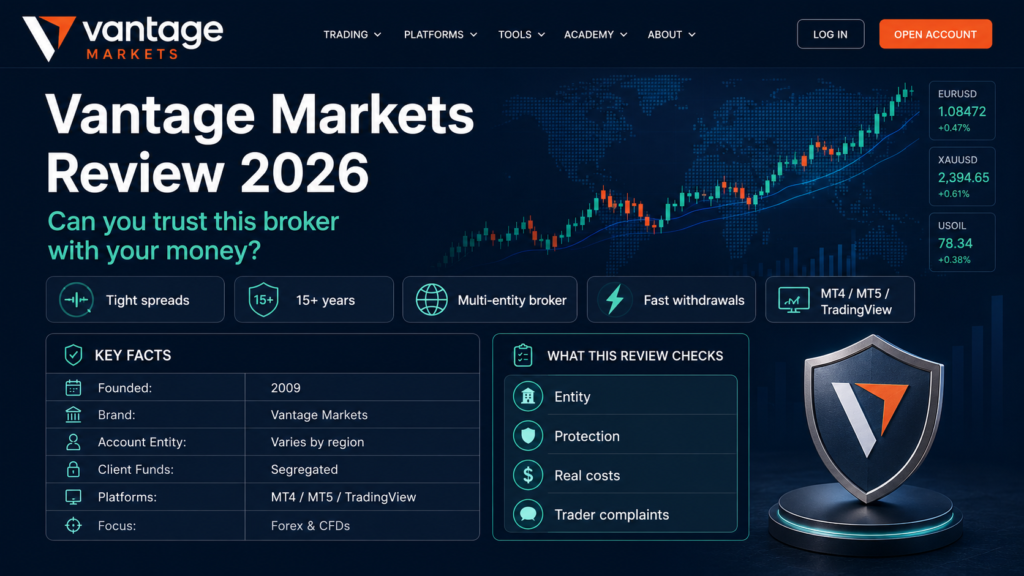
Let’s deal with the scary word first, because it’s the reason you’re reading this. Vantage Markets is not a scam in the legal sense — it’s a real company, founded in 2009 in Sydney, Australia, operating for over 15 years, and holding active licenses from multiple recognized regulators including ASIC and the FCA. That’s a fact you can verify yourself in under five minutes on the official regulator registers. A genuine scam broker doesn’t survive 15 years and pass repeated regulatory checks in tier-1 jurisdictions.
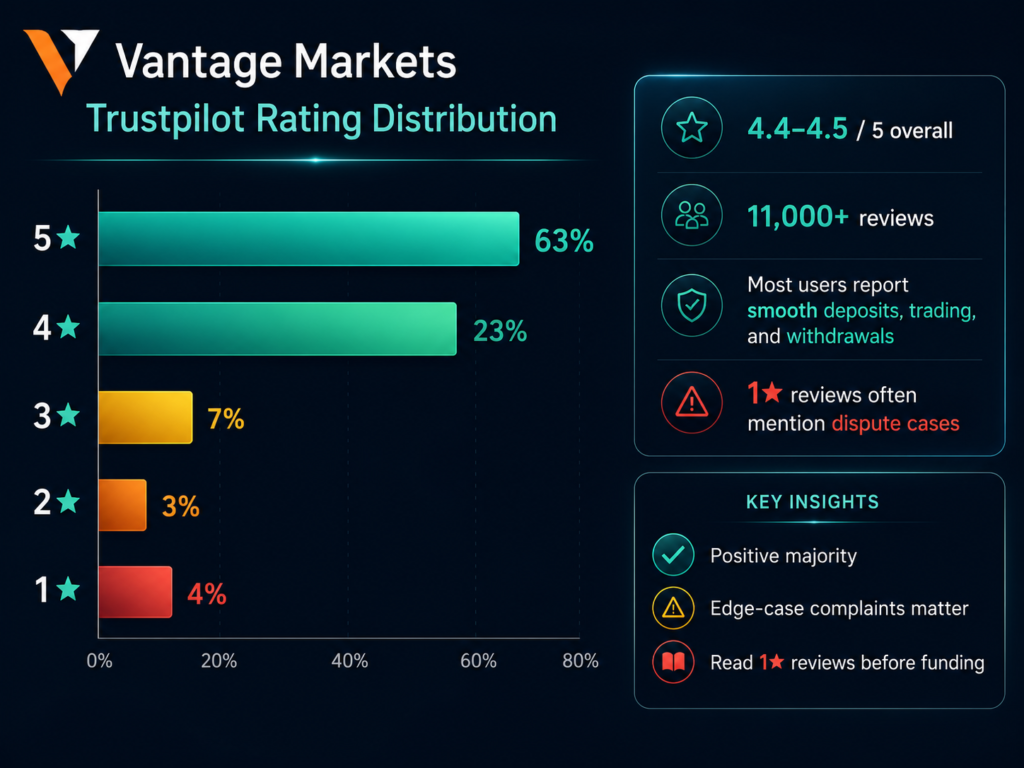
But “not a scam” and “no risk of losing money to disputes” are two very different claims, and conflating them is where most reviews fail you. Vantage holds a Trustpilot rating in the 4.4 to 4.5 out of 5 range from more than 11,000 reviews — a genuinely strong number for a CFD broker, where dissatisfied traders are statistically far more vocal than satisfied ones. At the same time, a recurring pattern shows up across Trustpilot and Forex Peace Army: traders who built up profit, then had it removed under a clause referencing “suspicious trading activity,” with the company declining to specify which trade or rule was violated. That’s not a hypothetical risk. It’s a documented friction point you should walk in aware of, not blindsided by.
What Does Vantage Markets’ Trustpilot Score Actually Tell You?
A 4.4-star average across 11,000+ reviews tells you that the typical experience — opening an account, depositing, trading, withdrawing normal profits — works as advertised for most people. It does not tell you what happens in the edge cases that matter most: large profitable runs, bonus-funded accounts, or trades flagged by an automated risk system. Those edge cases generate a disproportionate share of the 1-star reviews, and they’re the ones worth reading in full before you decide how much capital to risk.
Why Do Some Traders Call Vantage Markets a Scam?
The “scam” accusations almost never describe fraud in the criminal sense — no one is alleging Vantage disappeared with deposits. Instead, the pattern centers on three specific triggers: profit removal tied to vague “abnormal trading behaviour” clauses, bonus credits vanishing the moment account equity drops (sometimes triggering a premature stop-out), and slow or contested withdrawal cycles during disputes. If you trade manually, avoid bonus promotions, and keep records of every trade, your exposure to this category of complaint drops significantly. If you plan to use bonuses or copy-trading at scale, read the terms before you fund the account, not after a dispute starts.
Which Vantage Markets Entity Actually Holds Your Money?
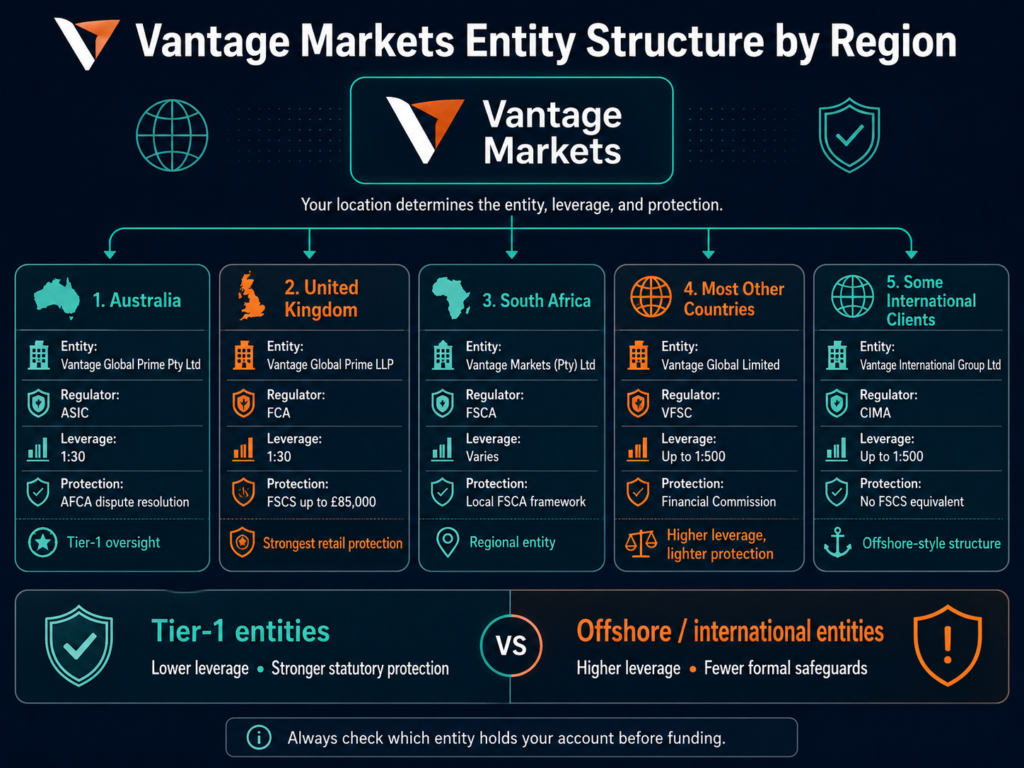
This is the single most important section in this review, and it’s the one most competitor articles skip past in a single sentence. Vantage Markets is not one company — it’s a brand operated by at least four separate legal entities, each regulated differently, each offering you a different level of protection. The entity that ends up holding your account depends entirely on where you live, and you may not even notice the switch happening during signup.
| Your Location | Entity That Holds Your Account | Regulator | Retail Leverage Cap | Compensation Scheme |
|---|---|---|---|---|
| Australia | Vantage Global Prime Pty Ltd | ASIC | 1:30 | AFCA dispute resolution |
| United Kingdom | Vantage Global Prime LLP | FCA | 1:30 | FSCS up to £85,000 |
| South Africa | Vantage Markets (Pty) Ltd | FSCA | Varies | Local FSCA framework |
| Most other countries | Vantage Global Limited | VFSC (Vanuatu) | Up to 1:500 | Financial Commission (non-statutory) |
| Some international clients | Vantage International Group Ltd | CIMA (Cayman) | Up to 1:500 | None equivalent to FSCS |
If you’re trading from outside Australia, the UK, or South Africa, you are almost certainly being onboarded under the Vanuatu or Cayman entity — not the ASIC or FCA one you saw mentioned on the homepage. That’s not a hidden trick; Vantage’s own regulatory disclosure pages state it directly. But it’s easy to miss when you’re focused on the leverage and bonus offer, not the legal fine print.
What Happens If You’re Not From Australia or the UK?
You get access to higher leverage (up to 1:500, sometimes cited as 1:1000 on certain forex pairs) and to promotions like deposit bonuses and copy trading — none of which are available to ASIC or FCA clients, because those regulators restrict or ban them outright. In exchange, you give up the protections those regulators enforce: no guaranteed negative balance protection, no FCA leverage caps, no access to the Financial Ombudsman Service, and no FSCS compensation if the company became insolvent. Vantage states it applies negative balance protection as a matter of policy on the VFSC entity, but policy is not the same as regulatory mandate — it can be withdrawn or applied unevenly in a way no regulator would intervene on.
How Much Protection Do You Lose Under the VFSC or CIMA Entity?
In practical terms: your deposited funds are still held in segregated accounts at recognized banks (commonly cited as Standard Chartered and ANZ), and Vantage carries supplementary insurance through Lloyd’s of London reportedly up to $50 million in aggregate. That’s a real layer of protection most offshore-only brokers don’t bother with. But it is not a statutory guarantee. If a dispute arises — like the profit-removal cases mentioned earlier — you don’t have access to the Financial Ombudsman Service or AFCA. Your recourse is the Financial Commission (for VFSC-onboarded clients) or direct legal action, both of which move slower and carry less enforcement weight than a Tier-1 regulator standing behind you.
How Is Vantage Markets Regulated, and What Does That Mean for You?
Regulation isn’t a checkbox — it’s a specific set of rules that determine what happens to your money in a worst-case scenario. Vantage holds licenses across a genuine spread of tiers: two Tier-1 regulators (ASIC and FCA), one Tier-2 (FSCA), and offshore licenses (VFSC, CIMA) that sit lower on almost every independent trust-scoring framework. Knowing which tier governs your account changes what you should expect if something goes wrong.
What Does the ASIC License Actually Guarantee?
Vantage’s Australian entity (AFSL 428901) operates under ASIC’s strict capital adequacy and client-money segregation rules. Client funds cannot be commingled with company operating capital, retail leverage is capped at 1:30 on major forex pairs, and disputes can be escalated to AFCA, an independent and binding resolution body. This is the closest thing to a “no surprises” regulatory environment Vantage offers, but it’s only available if you’re an Australian resident or qualify as a wholesale client.
What Does the FCA License Actually Guarantee?
UK clients onboard through Vantage Global Prime LLP, regulated under the FCA’s CASS (Client Assets Sourcebook) rules. This adds FSCS coverage up to £85,000 per person if the firm fails, mandatory negative balance protection, and the same 1:30 retail leverage cap the FCA applies industry-wide. If FCA-grade protection matters more to you than leverage or bonus access, this is the tier to insist on — and the only way to get it is to sign up specifically through Vantage’s UK-facing site as a verified UK resident.
Is Vantage Markets Regulated in the US or Canada?
No. Vantage Markets does not accept US clients at all — there’s no CFTC/NFA-regulated entity, and US residents should not attempt to bypass this restriction. Canada, China, Singapore, and Romania are also explicitly excluded, along with countries on FATF and EU/UN sanctions lists. If you’re a US-based trader who landed on this page, the honest answer is to look at NFA-regulated alternatives instead — Vantage simply isn’t a legal option for you.
What Are Vantage Markets’ Fees, Spreads, and Commissions in 2026?
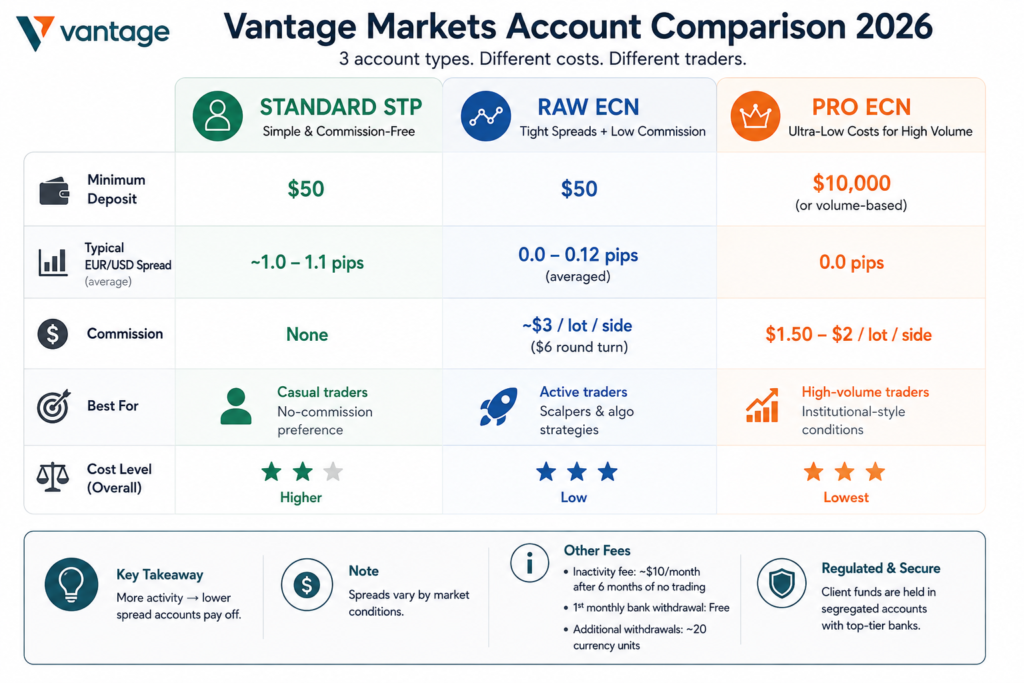
Marketing pages love the phrase “spreads from 0.0 pips.” That’s technically true and almost meaningless on its own, because it only applies to one specific account type under ideal market conditions. Here’s what the cost structure actually looks like across Vantage’s three core accounts.
| Account Type | Minimum Deposit | Typical EUR/USD Spread | Commission | Best For |
|---|---|---|---|---|
| Standard STP | $50 | ~1.0–1.1 pips | None | Casual traders, no-commission preference |
| Raw ECN | $50 | 0.0–0.12 pips (averaged) | ~$3/lot/side ($6 round turn) | Active and algorithmic traders |
| Pro ECN | $10,000 (or volume-based) | 0.0 pips | $1.50–$2/lot/side | High-volume, institutional-style traders |
The Raw ECN account is the realistic comparison point against competitors like IC Markets and Pepperstone — independent test data has cited average spreads around 0.12 pips during October trading, which is competitive but not category-leading once you factor in the $6 round-turn commission. The Standard account’s commission-free structure looks appealing to beginners but actually costs more per trade once spread is converted to dollar terms — a detail that’s easy to miss if you’re only comparing headline numbers.
How Do the Standard, Raw ECN, and Pro ECN Accounts Compare?
If you’re trading small, infrequent positions, the Standard account’s simplicity (no commission line to calculate) might genuinely suit you better despite the wider spread. If you trade frequently or scalp, Raw ECN’s tighter spread pays for its commission within a handful of trades. Pro ECN only makes sense once your volume justifies a $10,000 deposit — for most retail traders, that threshold simply isn’t worth chasing.
Are There Hidden Non-Trading Fees You Should Know About?
Yes, and this is the gap most reviews leave out: Vantage charges an inactivity fee, commonly cited around $10 per month after six months without a trade. Deposits via card or e-wallet are typically free, and the first monthly international bank withdrawal is free, but subsequent withdrawals in the same month can incur a fee (cited around 20 currency units in some independent breakdowns). None of this is unusual for the industry, but it’s the kind of line-item that adds up if you open an account, get busy, and forget about it for half a year.
What Trading Platforms Does Vantage Markets Offer?
Vantage gives you more platform choice than most brokers in its class: full MetaTrader 4 and MetaTrader 5, a TradingView-powered platform branded ProTrader, and its own native Vantage App for mobile. This isn’t padding — each platform genuinely serves a different trading style.
Is MetaTrader 4/5 or ProTrader Better for You?
MT4 and MT5 remain the standard for algorithmic traders running Expert Advisors, and both support scalping without restriction at Vantage. ProTrader, built on TradingView’s charting engine, is the stronger choice if your edge depends on visual technical analysis, multi-timeframe layering, or drawing-tool-heavy setups — TradingView’s charting is simply more advanced than MetaTrader’s native charts. If you’re not running automated strategies, ProTrader is worth testing on demo before defaulting to MT4 out of habit.
Does Vantage Markets Support Copy Trading and Automated Strategies?
Yes, but with an important catch tied directly back to the entity issue covered earlier: copy trading through ZuluTrade and DupliTrade integrations is only available to clients onboarded under the offshore VFSC or CIMA entities. If you’re an Australian or UK client under the ASIC or FCA entity, copy trading is not available to you at all — another consequence of the regulatory split that most comparison pages don’t connect clearly.
What Leverage Can You Access on Vantage Markets?
Leverage at Vantage is entirely dependent on which entity regulates your account, and the gap is enormous. ASIC and FCA retail clients are capped at 1:30 on major forex pairs, 1:20 on major indices and gold, 1:10 on minor commodities, and 1:5 on equities — these are regulatory ceilings, not Vantage’s choice. Clients onboarded offshore under VFSC or CIMA can access leverage as high as 1:500 on major forex pairs, with some sources citing up to 1:1000 on specific pairs, scaling down for exotics and smaller indices.
Higher leverage is not automatically better. It amplifies both gains and losses identically, and the regulators capping it at 1:30 for retail clients are doing so based on documented research into retail CFD trading outcomes — the FCA’s own data is part of why that cap exists. If you’re newer to trading, defaulting to maximum available leverage because it’s offered is one of the fastest ways to turn a manageable drawdown into a margin call.
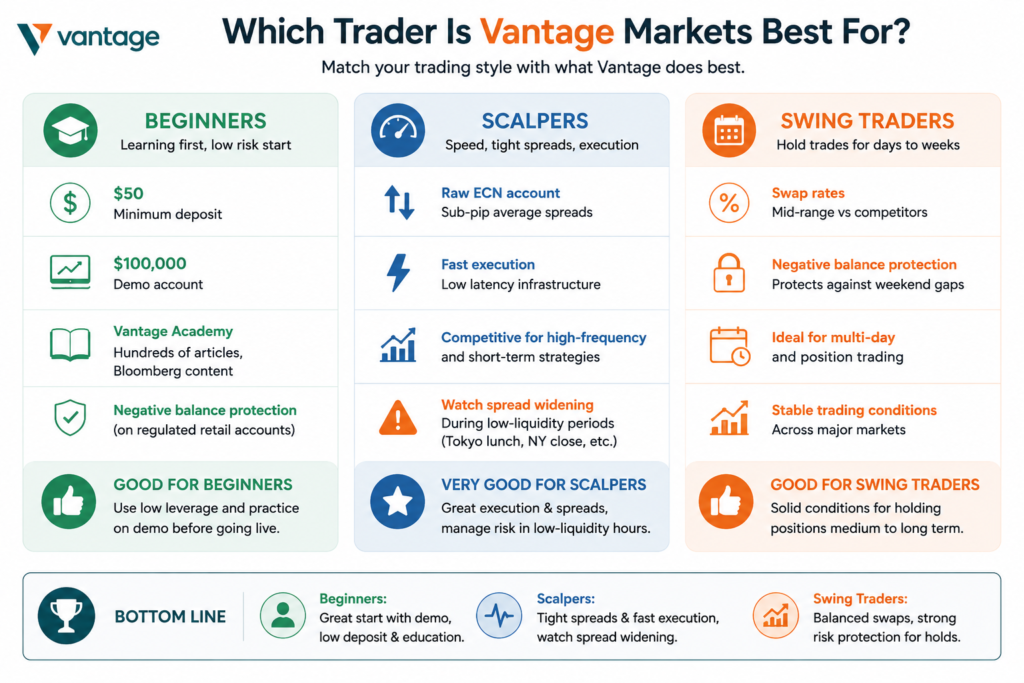
Is Vantage Markets Good for Beginners, Scalpers, or Swing Traders?
This is the question generic broker reviews almost never answer directly, because the honest answer is “it depends on what you actually do,” not a single verdict.
Should Beginners Choose Vantage Markets?
The $50 minimum deposit, a demo account with up to $100,000 in virtual funds, and an education portal (Vantage Academy, with several hundred articles and Bloomberg-collaborated content) make Vantage a reasonable on-ramp for someone learning the mechanics of forex and CFD trading. The risk for beginners isn’t the broker — it’s the offshore entity’s higher leverage ceiling combined with inexperience. If you’re new, deliberately choosing lower leverage than what’s offered, and treating the demo account as more than a formality before going live, matters more than which broker you pick.
Is Vantage Markets Good for Scalping?
For scalpers, the Raw ECN account’s sub-pip average spreads and fast execution infrastructure are genuinely competitive. The trade-off shows up during low-liquidity windows — spreads on Raw ECN can widen noticeably during thin sessions like the Tokyo lunch break or the New York close transition, which matters if your strategy depends on consistently tight spreads rather than a fixed-spread model.
Is Vantage Markets Suitable for Swing Trading?
If you’re holding positions for several days, your main cost driver shifts from spread to overnight swap rates, and Vantage’s swap rates land in the middle of the pack compared to competitors — not a standout advantage, but not a disadvantage either. Negative balance protection on regulated retail accounts means a weekend gap won’t put you in debt to the broker, which matters more for swing positions held over weekends than for scalpers who close out same-day.
How Reliable Is Withdrawal and Customer Support at Vantage Markets?
This is where the gap between Vantage’s marketing and its review section is widest, and it’s worth separating the routine experience from the dispute experience.
How Long Do Withdrawals Actually Take?
For straightforward, non-disputed withdrawals, multiple independent user reports describe next-business-day processing, even for small test withdrawals — a pattern consistent with a broker that isn’t structurally trying to trap your funds. The friction shows up specifically when a withdrawal coincides with an account flag, a bonus dispute, or a profit-removal review. In those cases, reviewers report multi-week delays and repetitive, templated support responses that don’t address the specific complaint. If your trading is straightforward and bonus-free, the data suggests withdrawals work as expected. If you’re disputing anything, expect the process to slow considerably.
What Should You Know About Vantage Markets’ Bonus Terms?
Deposit bonuses (commonly 50% to 100%, offshore-entity only) come with a structural risk that isn’t obvious until you’re in a drawdown: bonus credit can be reduced or withdrawn as your account equity falls, which can trigger a stop-out earlier than you’d expect if you were mentally counting the bonus as real trading capital. Multiple reviewers describe exactly this scenario — a bonus that “disappears exactly when the trader needs it most to support their margin.” If you take a deposit bonus, the safest approach is to trade as if the bonus capital doesn’t exist for position-sizing purposes, treating it purely as a buffer rather than tradable equity.
What Do Real Vantage Markets Traders Say in Reviews?
Aggregating across Trustpilot, Forex Peace Army, and forum discussions, a consistent split emerges. On the positive side, traders frequently cite fast standard withdrawals, helpful live chat for routine account questions, and a platform that “just works” for day-to-day execution. On the critical side, the recurring themes are profit removal under vague rule citations, slow resolution during disputes, and customer support that — in the words of more than one reviewer — relies on scripted responses rather than addressing the specific evidence a trader presents.
It’s worth noting a pattern independent of Vantage’s own conduct: some negative reviews stem from traders conflating ordinary trading losses with broker misconduct, which inflates the apparent complaint rate without reflecting an actual broker problem. Separating “I lost money trading” from “the broker took my money unfairly” is essential when reading any broker’s review section — Vantage’s is no exception.
How Does Vantage Markets Compare to IC Markets and Pepperstone?
| Factor | Vantage Markets | IC Markets | Pepperstone |
|---|---|---|---|
| Tier-1 Regulation | ASIC, FCA | ASIC, CySEC | ASIC, FCA |
| Raw/ECN Spread (EUR/USD) | ~0.0–0.12 pips | ~0.0–0.1 pips | ~0.0–0.1 pips |
| Minimum Deposit | $50 | $200 | $0–$200 |
| US Clients Accepted | No | No | No |
| Copy Trading | Offshore entities only | Available | Available |
| Standout Feature | Lloyd’s of London supplementary insurance | Deep liquidity, raw spreads | Strong TradingView integration |
None of the three is objectively “best” — IC Markets edges out on raw liquidity depth for high-frequency strategies, Pepperstone has arguably the smoothest TradingView integration, and Vantage’s differentiator is the combination of a low $50 entry point with genuine Tier-1 regulatory access for UK and Australian clients specifically. If you don’t qualify for the ASIC or FCA entity, the comparison shifts — you’re effectively choosing between three offshore experiences with different insurance and dispute-resolution structures, not three regulatory tiers.
Is Vantage Markets Worth It in 2026? Final Verdict
Vantage Markets is a legitimate, well-established broker — 15 years in operation, genuine Tier-1 regulation available to UK and Australian clients, competitive Raw ECN pricing, and an unusually broad platform lineup. It is not, and has never been, a scam in the sense of disappearing with client funds. That much is verifiable and not seriously in dispute.
What it is, honestly, is a broker whose experience splits sharply along entity lines. If you qualify for the ASIC or FCA entity, you get a regulatory safety net that most competitors in this price range can’t match. If you’re onboarded offshore — which most readers of this article will be — you get higher leverage and bonus access in exchange for materially thinner protection if a dispute arises, and the documented profit-removal and bonus-clawback complaints are concentrated almost entirely in that offshore population.
My take, after going through the regulatory filings, the fee schedules, and a wide cross-section of trader reviews: Vantage Markets earns a place on a serious shortlist, but only if you go in knowing exactly which entity holds your account, trade without leaning on bonus capital, and keep your own records in case a dispute ever needs evidence behind it. Treat the broker relationship the same way you’d treat any leveraged position — manage the risk you can see, and don’t assume the marketing page describes the account you’re actually going to get.
Ready to compare your options before depositing? See our full ic markets review for a side-by-side look at the Tier-1 alternative, or check our guide for choosing a forex broker beginner before you commit any capital.
Frequently Asked Questions About Vantage Markets
Is Vantage Markets Safe for Beginners?
Yes, with caveats. The $50 minimum deposit and demo account make entry accessible, but beginners should manually choose lower leverage than what’s offered, especially on offshore entities where caps reach 1:500. Safety depends more on your own risk choices than on the broker itself.
What Is the Minimum Deposit at Vantage Markets?
$50 for both the Standard STP and Raw ECN accounts. The Pro ECN account requires $10,000 minimum, aimed at high-volume traders seeking the lowest per-lot commission.
Can US Traders Use Vantage Markets?
No. Vantage Markets does not accept clients from the United States, along with several other restricted jurisdictions including Canada and Singapore. US traders need an NFA/CFTC-regulated broker instead.
Does Vantage Markets Offer a Demo Account?
Yes. Vantage provides a free demo account with virtual credit reportedly up to $100,000, available across MT4, MT5, and ProTrader, mirroring live market conditions for practice before committing real capital.
Is Vantage Markets Better Than IC Markets?
Neither is universally “better” — Vantage offers a lower $50 entry point and genuine ASIC/FCA access for qualifying clients, while IC Markets is often cited for marginally deeper liquidity on Raw spreads. The right choice depends on which entity you’d be onboarded under and your specific trading style.
Risk Disclosure: CFDs are complex instruments and carry a high risk of losing money rapidly due to leverage. This article is for informational purposes only and does not constitute financial advice. Always verify a broker’s current regulatory status directly on the relevant regulator’s official register before depositing funds.
Methodology: This review is based on publicly available regulatory filings, independently published fee and spread data current as of 2026, and aggregated trader feedback from Trustpilot, Forex Peace Army, and broker-comparison platforms cited throughout.