
You set your entry. The price touches resistance. It pushes through. You buy. Then — nothing. The price drifts back down, below your entry, and your stop gets hit.
Sound familiar?
False breakouts are the single biggest account-killer for traders who haven’t mastered the breakout trading strategy properly — especially those trading on the wrong platform with poor execution, spreads, or fees, as explained in best forex brokers for beginners
And yet, when executed with discipline, breakout trading is one of the most powerful methods to capture massive price moves at their very beginning — before the crowd piles in.
This guide is different from what you’ve read before. You won’t just get a definition and a pretty chart. You’ll get the complete framework: how to identify real breakouts, which strategies produce the best results, how to build a trade execution checklist, and — critically — how to set realistic expectations so you stop blowing up on fakeouts.
Let’s build your edge.
What Is a Breakout Trading Strategy and Why Does It Work?
A breakout trading strategy is a method that seeks to enter a trade at the precise moment price escapes from a defined range — moving above resistance or below support — and then rides the momentum that follows. It is fundamentally a momentum strategy: you are betting that the force that broke the barrier will continue pushing price in the same direction.
The core logic is simple. When price has been trapped inside a range, energy builds. Buyers and sellers compress. The longer the compression, the more explosive the eventual release. A breakout trading strategy is the discipline of waiting for that compression to end — and being positioned to profit when it does.
A breakout trading strategy is the discipline of waiting for that compression to end — and being positioned to profit when it does, which is a core concept every trader should understand in a solid trading for beginners foundation
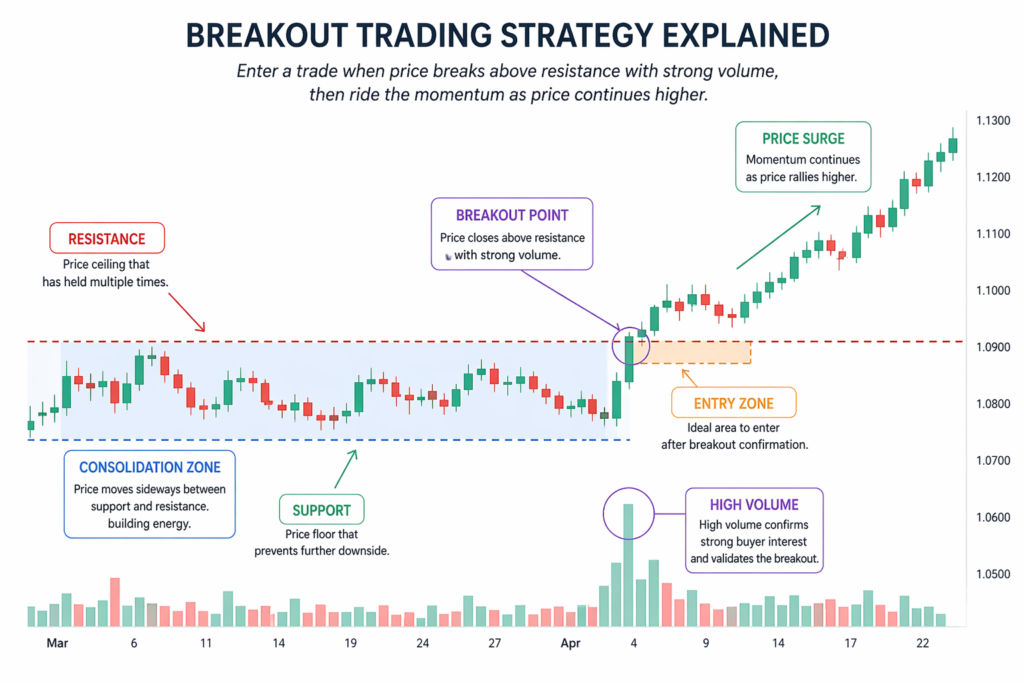
What actually happens during a price breakout?
During a breakout, price moves beyond a level where it has repeatedly been rejected. As price crosses that level, several things happen simultaneously: pending buy-stop orders are triggered, short sellers are forced to cover (adding buying pressure), and new buyers enter anticipating further gains. This cascade of order flow is what turns a breakout into a sustained move — rather than a simple price tick above resistance.
Volume is the engine. When a breakout happens on thin volume, that cascade doesn’t occur. There aren’t enough participants behind the move to sustain it. The price pokes above resistance, finds no follow-through, and reverses. That is a false breakout. When volume surges alongside the price breach, it signals that institutional and retail participants alike are committed to the new direction.
This is why volume is not optional in a breakout trading strategy. It is mandatory.
Why do breakouts create such explosive price moves?
Breakouts trigger a self-reinforcing feedback loop. At key resistance levels, large numbers of traders have placed stop-loss orders (if they are short) and pending buy orders (if they are waiting for confirmation). The moment price breaks through, those orders execute in the same direction, accelerating the move.
Additionally, algorithmic trading systems — which now account for the majority of volume on major exchanges — are programmed to enter on momentum signals, many of which are triggered by breakouts. This institutional participation is why genuine breakouts can produce moves of 10–30% in stocks within days, or hundreds of pips in forex within hours. You are not just catching a technical signal. You are stepping into the same river as the largest market participants.
How Do You Identify the Best Breakout Setups Before They Happen?
Identifying a breakout before it happens is not guesswork. There are specific, observable conditions that mark a high-probability breakout setup. The traders who consistently profit from this strategy are not better at predicting the future — they are better at reading the present conditions that make a breakout likely.
Which support and resistance levels matter most for breakouts?
Not all support and resistance levels are created equal. The strength of a level determines the significance of its eventual breakout. A level is stronger when:
- It has been tested multiple times — three or more touches make it a major level
- It has held for a long period — weeks or months carry more weight than days
- High volume was present when price previously reversed at that level
- It aligns with a round number (e.g., $100, $1.2000, $50,000) where traders psychologically cluster orders
The strongest breakouts tend to come from levels that have rejected price at least three times. Every failed attempt adds frustrated bulls or bears who will be desperate to exit if price finally breaks through — creating the wave of forced orders that drives the move.
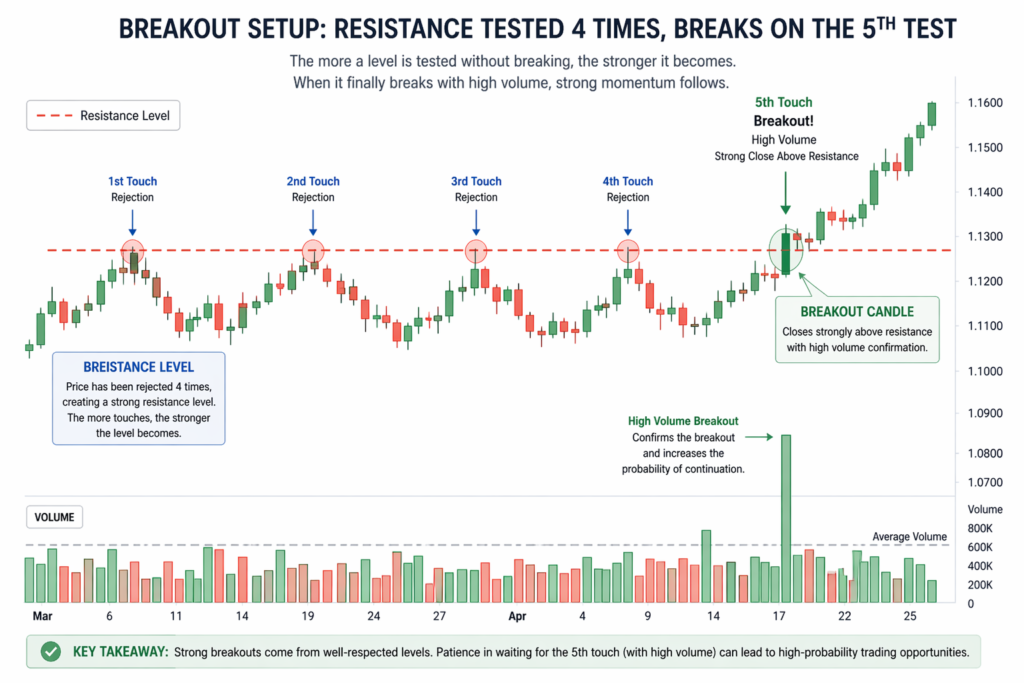
What chart patterns signal the highest-probability breakout setups?
Several chart patterns are particularly reliable precursors to breakouts because they visually represent the compression of price before a release. …especially when paired with trading indicators that help confirm momentum and direction.
Ascending Triangle: Price makes higher lows while resistance holds flat. Bullish bias. The compression becomes visible as each swing low is higher than the last, indicating buyers gaining control.
Descending Triangle: Price makes lower highs while support holds flat. Bearish bias. Sellers are pressing harder with each wave.
Symmetrical Triangle: Both support and resistance converge. Direction of breakout is unknown, but the eventual move is often explosive in whichever direction it breaks.
Bull Flag / Bear Flag: After a strong impulse move, price consolidates in a tight, slightly counter-trend channel. Flags have among the highest continuation rates of any pattern — studies suggest 67–70% reliability in trending markets.
Bollinger Band Squeeze: When the bands narrow to their tightest point in weeks, it signals low volatility compression. This is often the calm before the storm.
The key insight most competitors miss: the shape of the consolidation matters less than the duration and tightness of it. A longer, tighter consolidation represents greater energy storage — and typically a stronger eventual breakout.
How does volume tell you if a breakout is real or fake?
Volume is your lie detector. Here is the rule: a valid breakout should be accompanied by volume that is at least 1.5x to 2x the average volume of the previous 20 candles on the same timeframe. When that surge is present, you are seeing institutional conviction. When volume is average or below average, treat the breakout as suspect.
A practical technique: watch the candle close, not just the intraday pierce. Many false breakouts show a candle that temporarily pushes through resistance but fails to close above it. Waiting for a confirmed close above the level — especially on the daily chart — dramatically reduces false entries.
What Are the Most Profitable Breakout Trading Strategies?
There is no single “best” breakout strategy. There are strategies suited to different styles, timeframes, and risk tolerances. Understanding the full menu lets you choose the approach that fits your personality and schedule.
How does the Opening Range Breakout (ORB) strategy work?
The ORB strategy focuses on the first few minutes of a trading session. You define a high and low price range from the first 5, 15, or 30 minutes. A position is typically opened when the price moves above or below this range, often on increased volume following overnight news or economic data.
The ORB works because the opening of a major session (New York open for stocks, London open for forex) concentrates the highest volume of the day. News from overnight catalysts creates directional bias. The first 15–30 minutes establish the “opening range” — and when price breaks that range with momentum, it frequently continues in the same direction for hours.
A well-optimized ORB strategy on the Nasdaq E-mini futures has demonstrated triple-digit annual returns making just one trade per day — and it can be fully automated.This doesn’t mean results are guaranteed, but it illustrates how structurally powerful the setup is when applied consistently.
ORB Execution Rules:
- Identify the high and low of the first 15 minutes
- Set a buy-stop 1–2 ticks above the range high; sell-stop 1–2 ticks below the range low
- Cancel the unfilled order after the first hour if not triggered
- Stop-loss goes on the opposite side of the opening range
- Target equals 1.5x–2x the opening range width
What is the pullback-after-breakout strategy and when should you use it?
The pullback-after-breakout strategy suits more patient traders. Instead of entering immediately, the trader waits for the price to break out and then retrace to the previous support or resistance level, entering when the price resumes the breakout direction on renewed volume. It offers a more balanced risk-to-reward ratio, allows for a tighter stop-loss, and reduces the likelihood of trading a false breakout.
This is also called the “retest entry” and it is arguably the highest-probability breakout entry available. When old resistance is broken and then retested as new support — with the price bouncing off it — you have multiple layers of confirmation working in your favor. The trade-off is that some breakouts never retest, meaning you’ll miss a portion of fast-moving setups.
How do momentum breakout strategies use RSI and MACD?
Momentum indicators serve as a secondary confirmation layer — they answer the question: “Is there real force behind this price move?”
For RSI: on a bullish breakout, you want the RSI to be above 50 and ideally rising through 60. A breakout that occurs while RSI is below 50 or in overbought territory (>70 with divergence) is a yellow flag.
For MACD: a bullish breakout is most reliable when the MACD histogram is rising and the MACD line is crossing above the signal line. A breakout that occurs while MACD is diverging from price (price makes new highs, MACD does not) is a classic warning sign of a potential fakeout.
What is the Bollinger Band squeeze breakout method?
The Bollinger Band squeeze is a pre-breakout radar system. When the upper and lower bands contract tightly around price — reaching a multi-week low in bandwidth — it signals that volatility is compressing. Markets alternate between expansion and contraction. A squeeze tells you an expansion (breakout) is coming; you just don’t know the direction yet.
The technique: Set an alert when band width reaches a 20-period low. Then watch for the candle that breaks out of the squeeze. Enter in the direction of the breakout, with a stop below the squeeze zone. The target equals the band width at the time of squeeze, projected forward.
How Do You Enter, Manage, and Exit a Breakout Trade Step by Step?
Having a framework is useless without a systematic execution checklist. Here is the complete step-by-step process for taking a breakout trade.
Where exactly do you place your entry order for a breakout?
You have three entry options, which can be easily tested and refined using platforms like TradingView
| Entry Method | Timing | Risk | Best For |
|---|---|---|---|
| Market order at breakout | Immediate | High slippage risk | Fast-moving stocks |
| Buy-stop order above resistance | Automatic on trigger | May be faked out | Forex, futures |
| Pullback/retest entry | After confirmation | May miss trade | Patient swing traders |
For most traders, especially beginners, the retest entry is the most forgiving. It allows you to see whether the level holds as new support before committing capital.
How do you set stop-loss and take-profit for a breakout trade?
Stop-loss placement:
- For direct entries: just below the breakout candle’s low (or below the broken resistance level, now acting as support)
- For retest entries: just below the retest candle’s low
- Never place your stop inside the consolidation zone — if price re-enters it, the breakout has failed
Take-profit placement:
- Measured move method: measure the height of the prior consolidation or pattern and project it upward from the breakout point
- Previous swing highs/lows: use visible chart structure as natural exits
- Partial exits: consider taking 50% of the position at the first target and letting the remainder run with a trailing stop
Risk-to-reward: Aim for a minimum of 1:2 (risking $1 to make $2) on every breakout trade. Given that false breakouts are frequent, you need your winners to more than compensate for your losers, which is one of the core principles behind consistent trading for profit.
When should you exit a breakout trade early?
Exit early if:
- Price re-enters the breakout zone (the pattern has failed)
- Volume collapses after the initial breakout candle
- A bearish candlestick reversal pattern (e.g., shooting star, bearish engulfing) forms near a logical resistance level
- The broader market reverses sharply and your asset starts correlating to it
The discipline to exit early — accepting a small loss — is what separates consistent traders from gamblers.
How Do You Avoid False Breakouts That Kill Your Account?
This is the most critical section in this entire guide. Research and practitioner experience consistently show that the majority of initial breakout attempts fail. Understanding why, and how to filter them, is what makes or breaks a breakout trader.
Why do false breakouts occur so frequently?
False breakouts are not random accidents, …and understanding this behavior is critical if you want to avoid the common traps explained in trading psychology.
They are often engineered. Large institutional players and market makers are fully aware of where retail stop orders and buy-stop orders cluster — directly above resistance and below support levels. These players can temporarily push price through those levels to trigger the orders, collect liquidity, and then reverse. This is called a “stop hunt” or “liquidity grab.”
In addition, even without manipulation, genuine breakouts often require multiple attempts before they succeed. The first push above resistance exhausts early buyers; price retraces; a second attempt, with fresh buying pressure, finally carries through. False breakouts are the market testing conviction.
Estimated reality check: Studies and backtests across major markets suggest 60–70% of apparent breakouts — particularly on short timeframes with low volume — fail to follow through. If you’re entering every breakout you see without confirmation, you are playing a losing game by the numbers.
Which confirmation signals filter out the most fakeouts?
The most effective filters, ranked by reliability:
- Volume surge (1.5x–2x average): the single most important filter
- Candle close above the level (not just an intraday pierce)
- RSI > 50 on the breakout timeframe
- Daily chart alignment (even if you trade on a shorter timeframe, check the daily trend)
- No major news/event risk within 24 hours (economic data can reverse a breakout instantly)
- Pattern quality (a tight, multi-week consolidation vs. a sloppy few-day range)
The more of these filters are present, the higher the probability. Ideally, require at least 3 of these 6 before entering.
How does the second-chance breakout entry reduce false signal risk?
The second-chance breakout strategy involves waiting until a legitimate breakout occurs, but only entering a position after the price moves and retests the original breakout point. Rather than having to deal with a maddening procession of fakeouts, traders can instead exercise patience and trade on a proven breakout.
This is perhaps the most underused yet powerful technique in breakout trading. By definition, you are entering after confirmation — the price has broken out AND come back to prove that the old resistance now holds as support. Yes, you’ll miss a small portion of the move. You’ll also avoid the majority of fakeouts that catch early entrants.
Does Breakout Trading Work the Same for Stocks, Forex, and Crypto?
The core principles of breakout trading are universal. However, the application differs meaningfully across asset classes. Failing to understand these differences is a common and costly mistake.
How is breakout trading different in the stock market vs. forex?
In stocks, breakouts are often catalyzed by earnings reports, analyst upgrades, or news events. Volume data is highly reliable and available in real-time. Stock breakouts tend to be cleaner because sessions have defined opens and closes — creating the all-important Opening Range Breakout setup. Additionally, stocks can “gap up” through resistance overnight, creating opportunities (and risks) that don’t exist in 24-hour markets.
In forex, the market trades 24 hours during the weekday, meaning support and resistance can be pierced during low-liquidity hours (e.g., the Tokyo session for EUR/USD pairs) without meaningful follow-through. The most reliable forex breakouts occur at the London or New York open when volume is highest. Volume data in spot forex is less reliable (tick volume is used as a proxy), so traders rely more heavily on price action confirmation.
This is also where broker quality starts to matter – execution speed, spreads, and slippage can make or break a breakout trade, as shown in this IC Markets vs Pepperstone comparison
Key difference: In stocks, volume confirms. In forex, session timing and price candle close confirm.
Why are crypto breakouts riskier and how do you adapt?
Cryptocurrency markets run 24/7 with no session structure, no official market close, and — on smaller exchanges — low liquidity that can be manipulated by large holders (“whales”). This creates a uniquely high rate of false breakouts. A large wallet can push Bitcoin above a key resistance level on thin overnight volume, trigger a wave of retail buy orders, and then dump their position into that demand.
Adaptation strategies for crypto:
- Require higher volume confirmation — look for 2x–3x average volume, not just 1.5x
- Focus on larger timeframes (4-hour or daily chart setups, not 5-minute)
- Use on-chain data (exchange inflows, whale wallet movements) as secondary confirmation
- Avoid breakouts during low-liquidity weekend hours unless you have strong additional signals
The potential returns from crypto breakouts are enormous — but the structural environment demands extra discipline and stricter confirmation requirements.
How Do You Build a Complete Breakout Trading Plan with Realistic Expectations?
The gap between knowing a strategy and profiting from it consistently is always a trading plan — a written set of rules that governs every decision before, during, and after a trade.
What win rate should you realistically expect from breakout trading?
Here is the number most trading educators won’t give you: a well-executed breakout trading strategy with proper confirmation typically has a win rate of 40–55%. That means you will lose more than half of your trades.
This is not a flaw. It is the design. Breakout trading is not about winning most trades — it is about having your winners be significantly larger than your losers. A trader with a 45% win rate and an average win-to-loss ratio of 2.5:1 is highly profitable. The math is clear:
- 10 trades × 45% win rate = 4.5 wins, 5.5 losses
- Average win: $250. Average loss: $100.
- Result: (4.5 × $250) – (5.5 × $100) = $1,125 – $550 = +$575 profit
This is why position sizing and stop-loss discipline are not optional accessories to your breakout strategy — they are the strategy.
How do you backtest a breakout strategy before risking real capital?
Backtesting is the process of applying your strategy rules to historical chart data to see how it would have performed. It is the most under-utilized tool among retail traders and among the most important. And tools like TradingView determine how efficiently you can test and refine your strategy.
Simple backtesting process:
- Define exact rules (entry trigger, confirmation filters, stop-loss placement, target method)
- Open a charting platform (TradingView, MetaTrader) and set it to a historical date
- Scroll through charts and manually mark every setup that meets your criteria
- Log the outcome of each trade (win/loss, R-multiple)
- After 50–100 trades, calculate win rate, average R, maximum drawdown
- Refine rules based on results; repeat
Platforms like TradingView’s replay feature, or dedicated backtesting tools like Edgeful, allow you to do this efficiently. Aim for at least 100 historical setups before trading live with real money. If your backtest shows consistent profitability across different market conditions — trending, ranging, high-volatility — you have a strategy worth deploying.
Ready to put this into practice? Open a demo account on your preferred platform and spend 30 days trading breakout setups with paper money before risking real capital. The psychological lessons from even simulated trading are invaluable.
You should also make sure you’re trading with the right broker — see our breakdown of the lowest spread forex brokers before going live.
Frequently Asked Questions About Breakout Trading Strategy
Is breakout trading suitable for beginners?
Yes — with the right framework. Breakout trading is actually one of the more learnable strategies for beginners because the entry signal is visual and rule-based. The main challenge is emotional discipline: waiting through false starts and not chasing every price push above resistance. Start with the retest entry method and the daily chart to reduce noise.
What is the best timeframe for breakout trading?
There is no single best timeframe — it depends on your style. Day traders use 5–15 minute charts for ORB strategies. Swing traders prefer 4-hour or daily charts for better signal quality. Position traders watch weekly charts for major breakouts. Shorter timeframes produce more signals but also more false breakouts. Start with the daily chart and work inward as your skills develop.
What is the difference between a breakout and a breakdown?
A breakout is when price moves above resistance — a bullish signal. A breakdown is when price moves below support — a bearish signal. The same strategy logic applies to both; you simply take short positions on breakdowns rather than long positions on breakouts. The same confirmation rules (volume, candle close, momentum indicators) apply equally.
Can breakout trading be automated?
Yes, and it is one of the most automatable strategies in trading precisely because the rules can be made explicit. Many traders automate ORB strategies on TradingView using Pine Script or on MetaTrader using Expert Advisors. Automation removes emotion — the biggest enemy of any systematic trader. However, automated strategies must be monitored and adjusted as market conditions change. A strategy that worked perfectly last year may underperform in a new market regime.
What is the biggest mistake breakout traders make?
Entering too early — before the breakout candle closes, before volume confirms, before the level is truly broken. The fear of missing the move is far more expensive in the long run than occasionally missing a fast breakout by waiting for confirmation. The second biggest mistake is sizing too large on any single trade. False breakouts are a statistical certainty in breakout trading. A single overleveraged false breakout can wipe out weeks of gains. Keep position sizes consistent and small enough that no single loss is catastrophic.