
Here’s the problem with most IC Markets vs Pepperstone comparisons: they give you the same answer every time.
“IC Markets for costs. Pepperstone for beginners.”
That verdict has been copied and pasted across dozens of review sites for three years. But in 2026, things have changed. IC Markets raised its commissions. Pepperstone added a Tokyo server. The platforms, regulations, and pricing structures have all shifted.
So this isn’t going to be another copy-paste comparison. This is a data-first, strategy-first breakdown that tells you exactly which broker to choose — based on how you actually trade.
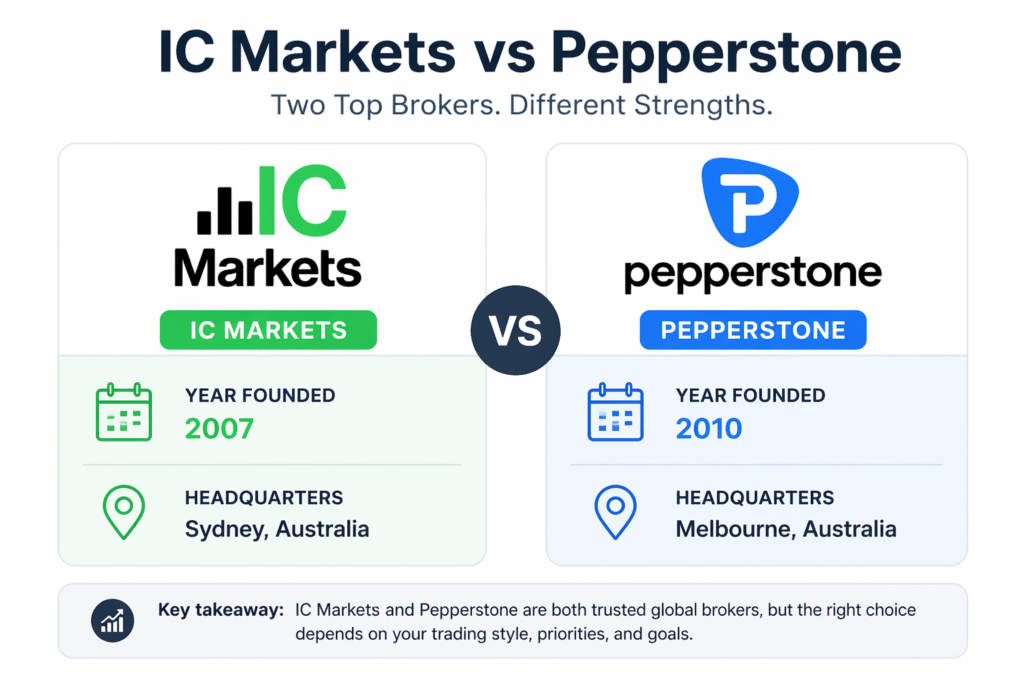
A Trader’s Honest Take: IC Markets vs Pepperstone
I’ve traded on IC Markets and here’s what I actually noticed — not from a spreadsheet, but from real sessions.
On shorter timeframes, IC Markets execution feels cleaner. Entries on EUR/USD during London session fill quickly with minimal slippage. If you’re scalping or doing intraday entries, the spread difference is noticeable in practice — not just on paper.
For swing trading — holding positions overnight across major pairs — the spread difference between IC Markets and Pepperstone becomes less critical. What matters more at that point is swap rates and withdrawal reliability.
What I care about when choosing a broker
– Regulated by a real authority (ASIC, CySEC, FCA) — not just a logo on a website
– Deposit and withdrawal process is straightforward — I want to focus on trading, not troubleshooting payment issues
– Execution is consistent during London and NY sessions
IC Markets ticks all three. Pepperstone does too — the choice between them comes down to your trading style and which entity you’re onboarded to.
**My recommendation:**
– Scalpers and active intraday traders → IC Markets
cTrader Raw, lowest all-in cost
– Swing traders in UK/Germany wanting FCA/BaFin
protection → Pepperstone is worth considering
👉 Open IC Markets Account
👉 Open Pepperstone Account
Which broker has lower actual trading costs in 2026?
Trading costs are where this comparison gets decided for most active traders. Both brokers advertise spreads “from 0.0 pips.” That headline is accurate — but deeply misleading. What you actually pay is the all-in cost: raw spread plus commission. And that number tells a very different story.
Here’s the full cost picture based on updated 2026 data:
Standard Accounts (no commission):
| Pair | IC Markets Standard | Pepperstone Standard |
|---|---|---|
| EUR/USD | ~0.62 pips avg | ~1.0–1.1 pips avg |
| GBP/USD | ~0.82 pips | ~1.0 pips |
| AUD/USD | ~0.47 pips | ~0.69 pips |
IC Markets’ average spread is 38% lower than Pepperstone’s based on the nine most traded currency pairs. Pepperstone only had a lower average spread on the EUR/GBP currency pair.
Raw/Razor Accounts (commission-based):
| Account | Avg EUR/USD Spread | Commission (round turn) | All-in Cost |
|---|---|---|---|
| IC Markets cTrader Raw | ~0.02 pips | $6.00 | ~0.62 pips equiv |
| IC Markets MT4/5 Raw | ~0.02 pips | $7.00 | ~0.72 pips equiv |
| Pepperstone Razor | ~0.09–0.10 pips | $7.00 | ~0.80 pips equiv |
Based on listed averages, IC Markets generally comes in cheaper on EUR/USD. The all-in cost on IC Markets cTrader Raw is near 0.62 pips, compared to Pepperstone’s Razor at 0.80 pips.
On pure spread math, IC Markets wins — clearly.
How do IC Markets and Pepperstone spreads compare on raw accounts?
The cTrader Raw account at IC Markets is the single cheapest option between the two brokers. With commission at $3/side and average raw spreads near zero, it delivers the lowest all-in cost for forex majors of any retail-accessible ECN account.
Pepperstone’s Razor account is competitive — and still far cheaper than most market makers — but it consistently trails IC Markets by roughly 0.10–0.18 pips all-in on major pairs. For a trader doing 100 standard lots per month, that gap compounds into real, measurable dollars.
For occasional traders doing under 10 lots per month, the difference is negligible. But once you cross 30–50 lots/month, IC Markets’ cost edge becomes material.
Did IC Markets’ 2026 commission increase change the cost equation?
Yes — and almost no comparison article has addressed this yet.
In 2026, IC Markets increased their commission rates and now charges a higher commission compared to Pepperstone for AUD, GBP, EUR, CAD, and SGD base currency accounts on MetaTrader 4.
This is significant. Traders using MT4 with non-USD base currencies now face a higher cost at IC Markets than they did in 2025. If your account is denominated in EUR or AUD, Pepperstone has closed the gap — and in some currency combinations may now be the cheaper option.
The nuance: This applies mainly to MT4/MT5 Raw accounts. The cTrader Raw account at IC Markets remains the lowest-cost option. If you’re a cost-first trader, the answer is clear: open an IC Markets cTrader Raw account specifically.
Which broker is safer and better regulated?
Both IC Markets and Pepperstone are legitimate, well-regulated brokers. Neither is a scam risk. But there are meaningful differences in their regulatory depth.
Pepperstone operates through four entities licensed by Tier-1 regulators: CySEC (Cyprus), FCA (UK), ASIC (Australia), and BaFin (Germany). Two additional entities are licensed by Tier-2 regulators — DFSA (Dubai) and CMA (Kenya).
IC Markets operates under two entities licensed by Tier-1 regulators: CySEC (Cyprus) and ASIC (Australia). One of its entities is licensed by the Tier-3 regulator FSA (Seychelles), which does offer insurance coverage up to $1 million from Lloyds of London.
Pepperstone has a Trust Score of 94/99, placing it in the highly trusted range (90–99). IC Markets scores 83/99, which falls in the trusted range (80–89).
For most traders, both are safe. The difference matters most if:
- You’re in the UK or Germany → Pepperstone’s FCA/BaFin licenses apply directly 👉 Open Pepperstone Account
- You’re a high-value account → IC Markets’ Lloyds insurance on its Seychelles entity is an interesting differentiator 👉 Open IC Markets Account
Why does Pepperstone hold more Tier-1 licenses than IC Markets?
Pepperstone has built a deliberate regulatory expansion strategy, adding BaFin (Germany) and FCA (UK) licenses to serve European clients under local protection. This broader regulatory footprint offers European traders superior investor compensation coverage.
Pepperstone offers diverse investor protection levels up to €100,000, contrasting with IC Markets’ €20,000. For traders holding larger account balances, this five-fold difference in insurance coverage is not trivial.
How does each broker protect your funds in a worst-case scenario?
Both brokers hold client funds in segregated accounts, separate from operational capital. Neither has faced insolvency or client fund losses in their operating histories.
However, IC Markets lacks FCA and BaFin licenses. UK and German traders should verify which entity serves them — as the protection level depends entirely on which regulated entity your account falls under.
Regulation verdict: Pepperstone wins on breadth and European protection. IC Markets wins on longevity and institutional credibility. For non-European traders, both are equally safe for practical purposes.
Which trading platforms does each broker support?
This is where a concrete, practical difference emerges — one that directly affects your day-to-day trading experience.
Both brokers offer MT4, MT5, and cTrader. Those are table stakes. The key differentiator is TradingView.
Pepperstone uses MT4, MT5, cTrader, and TradingView. IC Markets runs on MT4, MT5, and cTrader. IC Markets does not offer native TradingView integration as of 2026.
For modern traders who chart exclusively on TradingView — and there are millions of them — this is a dealbreaker-level difference. TradingView’s charting is widely considered the best available, and its direct execution integration via Pepperstone is a genuine competitive advantage.
Does Pepperstone’s TradingView integration give it an edge?
Direct TradingView integration allows trading from TradingView charts. For technical analysts, it’s the best charting in the industry with an excellent indicator library, and you can execute directly.
If your entire workflow is built on TradingView — Pine Script indicators, custom layouts, alerts-to-orders automation — Pepperstone is the only choice between these two. There’s no workaround or equivalent in IC Markets’ platform stack currently.
This is the single biggest practical advantage Pepperstone holds over IC Markets for a large and growing segment of traders.
Which broker has the better MT4/MT5 and cTrader setup?
Traders at Pepperstone receive the best MT4/MT5 upgrade available among all brokers, closely followed by what IC Markets offers. DailyForex Pepperstone’s Smarttrader Tools package adds 28 MT4 plugins — including correlation matrix, sentiment tools, and alarm manager — that IC Markets doesn’t offer natively.
For cTrader, both brokers provide equivalent environments. cTrader is the preferred platform for discretionary scalpers due to its Level II Depth of Market display and one-click order functionality.
Platform verdict: Pepperstone wins on breadth (TradingView + MT4 plugin suite). IC Markets wins for pure EA developers who prefer a lean, high-performance MT4/MT5 environment without plugin overhead.
Which broker is faster for scalping and algo trading?
For scalpers and EA traders, execution infrastructure is not a minor technical detail. It’s the variable that determines whether your strategy is profitable or not.
Both brokers are No Dealing Desk (NDD), using Straight-Through Processing (STP) to route orders directly to liquidity providers — no manual intervention, no conflict of interest.
How do IC Markets and Pepperstone execution speeds compare?
IC Markets caters to advanced short-term traders with its competitive ECN-style pricing and lightning-fast trade execution, averaging under 40 milliseconds. With a zero requote policy and no minimum order distance restrictions, it is particularly well-suited for short-term traders and those employing algorithmic strategies.
Pepperstone edges ahead on accessibility and has slightly faster execution in some tests. Pepperstone operates from NY4, LD5, and TY3 servers in New York, London, and Tokyo. IC Markets operates from NY4 and LD5.
That Tokyo server is underappreciated. If you’re trading Asian sessions heavily and want minimal latency, Pepperstone’s Tokyo server is an advantage. For traders in Asia or those running strategies during the Tokyo/Sydney overlap session, this infrastructure difference produces measurable latency advantages.
Which broker has better VPS and server infrastructure?
Both offer free VPS when you meet volume requirements, typically 15+ lots per month. The VPS is co-located near their servers, giving EAs sub-5ms execution. This is essential for latency-sensitive strategies.
IC Markets operates a robust order matching engine at the New York Equinix NY4 data center, handling over 500,000 trades daily, processing more than $29 billion USD in FX trades every day. This liquidity depth matters during news events — deeper liquidity means lower slippage when the market moves fast.
Execution verdict: IC Markets’ deeper liquidity wins during high-volatility news trading. Pepperstone’s Tokyo server wins for Asian session execution. For pure speed during London/New York hours, it’s effectively a draw — both are well within acceptable thresholds for professional scalping.
Which account type should you open at each broker?
Choosing the wrong account type at either broker is the most common and costly mistake new clients make. Here’s the clear decision framework.
IC Markets Accounts:
- Standard: Commission-free, spread from 0.6 pips avg. For casual traders doing under 20 lots/month.
- Raw Spread (cTrader): $3/side commission, raw spreads from 0.0 pips. The cheapest option for active traders.
- Raw Spread (MT4/MT5): $3.50/side commission, raw spreads. Slightly more expensive than cTrader.
Pepperstone Accounts:
- Standard: Commission-free, spread from ~1.0 pips avg. Slightly more expensive than IC Markets Standard.
- Razor: $3.50/side commission, raw spreads from 0.0 pips. Best for active Pepperstone traders.
What is the difference between IC Markets Raw and Pepperstone Razor?
The structures are similar but the costs differ slightly. IC Markets Raw on cTrader is $6 round turn vs Pepperstone Razor at $7 round turn. On 100 standard lots per month, that’s $100/month saved with IC Markets cTrader Raw — a meaningful number for consistent traders.
Both accounts provide true raw interbank spreads — the same prices institutional traders access. Both have no requotes. Both support EAs and scalping without restriction.
Which broker is better for beginners with small starting capital?
IC Markets requires a minimum deposit of $200 versus Pepperstone’s no minimum deposit requirement. For traders starting with under $200, Pepperstone is the only option between the two.
Pepperstone is the more flexible choice for traders who want similar quality with easier onboarding and a wider platform mix.
For beginners: open a Pepperstone demo account first (zero friction), learn the ropes, then decide whether to go live with Pepperstone ($0 minimum) or switch to IC Markets ($200 minimum) once you’re confident.
Which broker offers more markets and instruments?
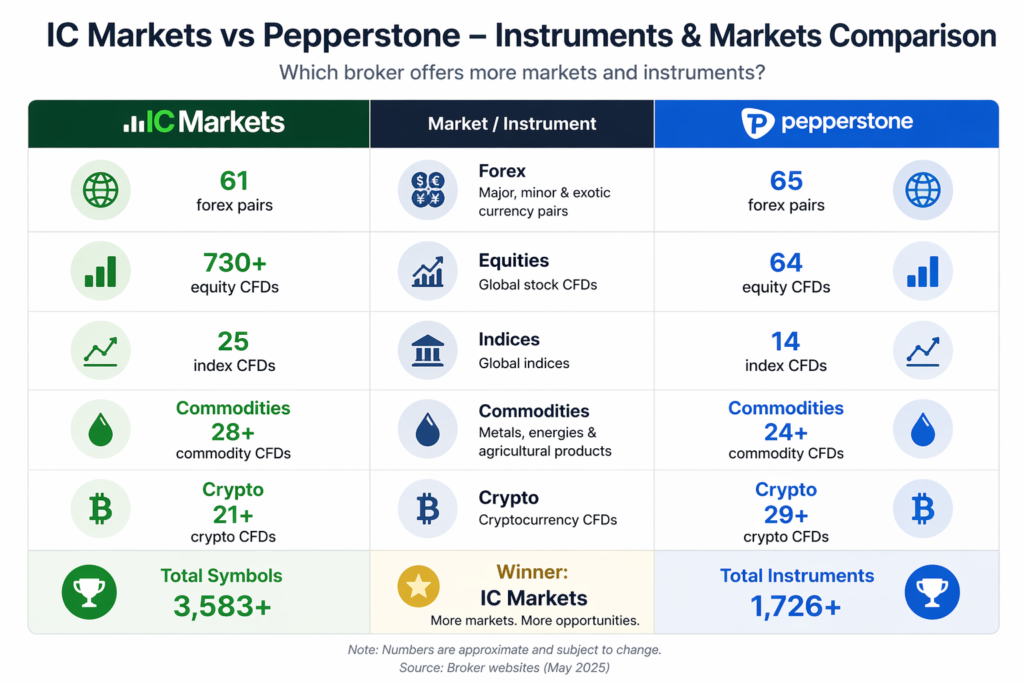
IC Markets pulls ahead significantly with equities, where traders get 730+ equity CFDs and 25 index CFDs. Pepperstone only has 64 equity CFDs and 14 index CFDs. IC Markets also features eleven bond CFDs versus zero at Pepperstone.
Pepperstone lists 1,726 tradeable instruments with 65 forex pairs. IC Markets offers 3,583 symbols with 61 forex pairs.
For forex-only traders, the instrument count doesn’t matter much — both cover all major, minor, and most exotic pairs. But for traders wanting to diversify into global equities, indices, and bonds alongside their forex activity, IC Markets is the clear choice with dramatically more coverage.
If you trade only forex and crypto CFDs, both brokers are equivalent on market range. If you want to trade European, Asian, or Australian equities alongside forex from the same account and platform — IC Markets wins decisively.
What do real traders say on Reddit and forums?
Review sites often tell one story. Reddit tells another. Here’s what the trading community consistently says about both brokers:
On IC Markets:
- Widely praised for execution quality and raw spread pricing
- EA traders consistently prefer IC Markets for its liquidity depth and no-requote policy
- Most complaints center on customer support response times and the 2026 commission increase for non-USD accounts
- Seen as the “professional’s broker” — minimal bells and whistles, just execution
On Pepperstone:
- Praised for responsive customer support and smooth onboarding
- TradingView integration is consistently cited as a major differentiator in 2025–2026
- Some traders note wider standard account spreads compared to IC Markets
- Generally viewed as more “beginner-friendly” without sacrificing professional execution quality
The key Reddit insight: traders who have used both brokers tend to keep IC Markets for their high-volume ECN trading and Pepperstone for their discretionary/TradingView-based accounts. Having both isn’t unusual among serious traders.
IC Markets vs Pepperstone: Which broker wins for your trading style?
Stop looking for a universal winner. There isn’t one. The better question is: which broker wins for you?
Here’s the decision matrix:
| Trading Profile | Recommended Broker | Reason |
|---|---|---|
| Scalper / High-frequency trader | IC Markets (cTrader Raw) | Lowest all-in cost, deepest liquidity |
| EA / Algorithmic trader | IC Markets | Zero requotes, $29B+ daily volume, optimal NY4 co-location |
| TradingView user | Pepperstone | Only broker of the two with native TV integration |
| Asian session trader | Pepperstone | Tokyo TY3 server for lower Asian latency |
| Beginner / Small account | Pepperstone | $0 minimum deposit, better education, smoother onboarding |
| Multi-asset trader (forex + equities) | IC Markets | 730+ equity CFDs vs Pepperstone’s 64 |
| European trader (UK/Germany) | Pepperstone | FCA/BaFin licenses, €100K investor protection |
| Swing trader / Part-time trader | Either | Difference negligible at lower volumes |
Put simply: IC Markets is the sharper price-first choice for active traders, while Pepperstone is the more flexible choice for traders who want similar quality with easier onboarding and a wider platform mix.
👉 New to trading? Start here: Trading for beginners
👉 👉 Still unsure which broker fits you? Compare the best forex brokers here
How do you open an account at IC Markets or Pepperstone?
Both processes are fully digital and take under 15 minutes.
IC Markets:
- Visit icmarkets.com → click “Start Trading”
- Choose account type: Standard, Raw cTrader, or Raw MT4/MT5
- Complete personal details and residency verification
- Upload ID + proof of address
- Fund account (minimum $200 via most methods)
- Download your chosen platform and start trading
Pepperstone:
- Visit pepperstone.com → click “Create Account”
- Choose Standard or Razor account
- Complete application (takes ~10 minutes)
- Verify identity documents
- Deposit any amount (no minimum for most methods)
- Access MT4, MT5, cTrader, or TradingView immediately
Pro tip for both brokers: Open a demo account before funding. Both offer unlimited demo accounts with real market data. Test your strategy and verify execution quality before committing capital. IC Markets’ demo mirrors its live ECN environment closely — more so than many other brokers.
Ready to decide? If cost and liquidity are your priority, open an IC Markets cTrader Raw account. If platform flexibility and zero minimum deposit matter more, start with Pepperstone. Either way — both are among the top 10 ECN brokers globally, and you won’t go wrong with either choice.
Frequently Asked Questions About IC Markets vs Pepperstone
Is IC Markets or Pepperstone better for scalping?
IC Markets is famous for its razor-thin spreads, deep liquidity, and execution speed — it is the go-to broker for scalpers, high-frequency traders, and algorithmic traders. TraderFactor For pure scalping, the IC Markets cTrader Raw account gives the lowest all-in cost. However, Pepperstone is also fully authorized for scalping, offering the Razor Account with raw spreads from 0.0 pips and fast execution averaging around 30ms. Both work well for scalping; IC Markets has a slight cost edge.
Does Pepperstone or IC Markets charge inactivity fees?
Neither broker charges a standard inactivity fee for most account types. This is an advantage both share over brokers like IG (which charges after 24 months) or OANDA. Always verify your specific entity’s terms, as some regional subsidiaries may differ.
Which broker is better for US traders?
Neither IC Markets nor Pepperstone is available to US retail forex traders for standard CFD/forex accounts. US traders must look at CFTC/NFA-regulated brokers such as tastyfx, OANDA, or FOREX.com.
Can I use copy trading at IC Markets and Pepperstone?
Pepperstone and IC Markets both support forex trading as CFDs and include copy trading. IC Markets supports copy trading via its cTrader Copy feature and third-party solutions. Pepperstone offers copy trading via its social trading integrations. Neither has a fully proprietary copy trading ecosystem comparable to eToro — for heavy copy trading, a dedicated platform may serve you better.
Final Verdict: IC Markets vs Pepperstone in 2026
After analyzing spreads, regulation, platforms, execution speed, and market range — there’s one honest conclusion:
IC Markets wins on cost and liquidity. Pepperstone wins on accessibility, regulation breadth, and platform variety.
For high-frequency traders, scalpers, and EA developers who measure success in basis points — IC Markets cTrader Raw is your answer. Every pip saved compresses over time into real performance advantage.
For traders who value TradingView, live in Europe (UK/Germany), are just starting out, or trade during Asian sessions — Pepperstone delivers equivalent execution with meaningfully better onboarding and regulatory protection.
The good news? You’re not making a bad choice either way. These are two of the best-regulated, most liquid, lowest-cost ECN brokers in the world. The difference between them is measured in fractions of a pip and a few hundred milliseconds.
What matters more than which broker you pick is that you understand your trading strategy, manage your risk, and stop leaving money on the table with a high-spread market maker. If you want to actually make money long-term, read Trading for Profit
Risk Warning: CFDs and forex trading are complex instruments that carry a high risk of rapid capital loss due to leverage. Between 51% and 89% of retail investor accounts lose money when trading CFDs. Always ensure you fully understand these instruments and can afford the risk involved.