
Good Forex Brokers UK 2026: FCA-Regulated Brokers Ranked by Real Trading Costs
Good forex brokers UK traders can trust are not just the ones with the biggest brand names or highest star ratings. The real test is FCA regulation, total trading cost, platform quality, withdrawal reliability, and whether the broker actually fits your trading style.
Most “best forex brokers UK” guides list the same ten names, add a star rating, and call it done. What they don’t tell you is the thing that makes the UK forex market fundamentally different from every other country on earth: you can trade forex completely tax-free, legally, through a product called spread betting — and most beginners never hear about it until years into their trading journey.
They also don’t explain what FSCS protection actually covers (spoiler: not your trading losses), what the FCA leverage cap means for your strategy, or why an offshore broker offering “higher leverage” is taking a legal and financial risk with your capital that no responsible guide should recommend.
This is the UK forex broker guide that fills those gaps. Every broker listed here is FCA-authorised. Every recommendation is tied to a specific trader type. And the tax question gets a real answer.
What makes a forex broker genuinely good for UK traders?
A broker that is good for a US trader, an Australian trader, or a trader in Singapore may be actively unsuitable for a UK trader. The UK regulatory environment creates a specific set of requirements that any credible broker recommendation must satisfy.
Five non-negotiable criteria for UK forex brokers:
1. FCA Authorisation
The Financial Conduct Authority is the sole relevant regulator for retail forex brokers serving UK traders. A broker must appear on the FCA Register (register.fca.org.uk) with authorisation status “Authorised” — not just “Registered.” This distinction matters: a “Registered” entity has lighter obligations. An FCA-Authorised broker must meet capital adequacy requirements, segregate client funds, and comply with the full retail client protection framework.
2. Spread Betting Availability (UK tax advantage)
The UK is one of the only countries where spread betting on financial instruments is a tax-free product. FCA-regulated brokers offer spread betting accounts alongside CFD accounts. For UK traders whose annual forex profits exceed the Capital Gains Tax annual exempt amount (£3,000 in 2026), the spread betting tax exemption is worth quantifying — not just mentioning.
3. Negative Balance Protection
FCA rules mandate that all retail client accounts receive negative balance protection — you cannot lose more than your deposited funds. This is not universal globally. Every broker on this list provides it by default for UK retail accounts.
4. Segregated Client Funds
All FCA-authorised brokers must hold retail client funds in segregated accounts at Tier-1 UK banks, separate from the firm’s operating capital. This protects your funds if the broker becomes insolvent.
5. FSCS Eligibility
The Financial Services Compensation Scheme provides up to £85,000 of protection per eligible person per FCA-authorised firm in the event of firm insolvency. The conditions and coverage limits matter — detailed in the regulation section below.
Which are the best FCA regulated forex brokers in the UK right now?
The following brokers hold full FCA authorisation, maintain strong operational track records, and have been selected based on real trading costs, platform quality, and suitability for specific UK trader needs.
Which UK forex broker has the best spread betting platform?
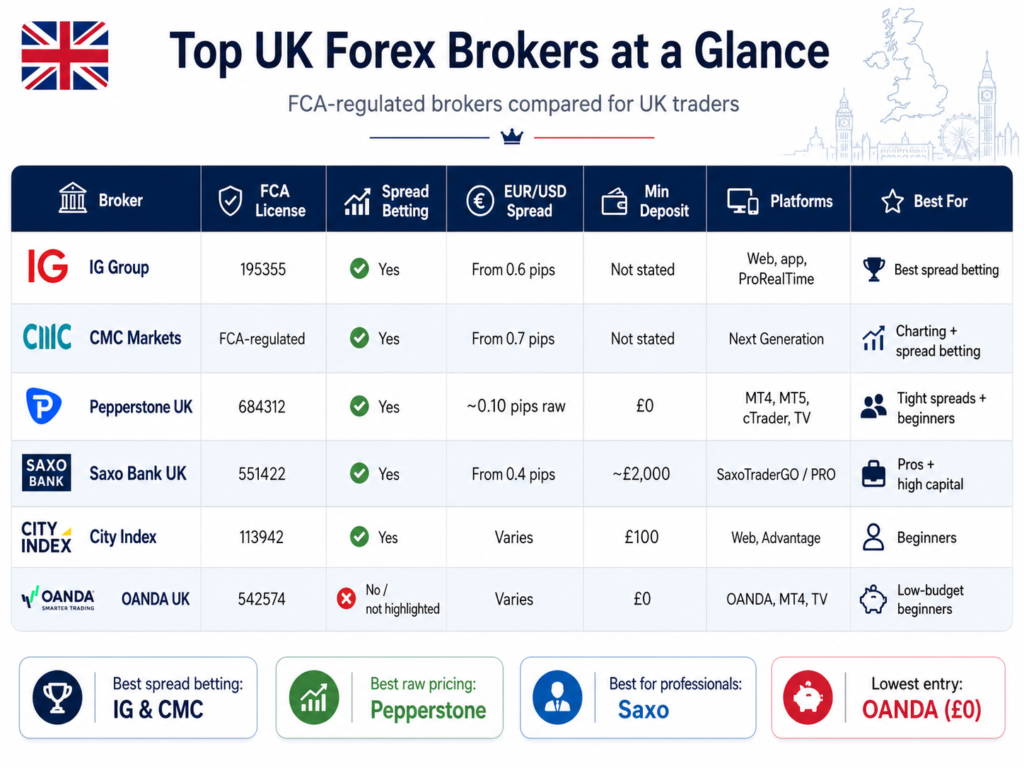
IG Group is the definitive answer for UK spread betting. Founded in 1974, IG is the world’s largest spread betting provider by client assets and the firm that, in many ways, created the modern UK spread betting industry. Their platform — available via web, desktop, and mobile app — is purpose-built for spread betting and continuously developed with UK retail traders as the primary audience.
IG’s spread betting offering covers 17,000+ markets including forex, indices, commodities, shares, and more. EUR/USD spread betting spread typically starts from 0.6 pips in liquid market hours. The platform includes ProRealTime charting integration (available with qualifying trading frequency) — one of the most advanced technical analysis environments available to retail UK traders. IG is regulated by the FCA (FCA No. 195355) and holds additional licenses globally, providing institutional-grade infrastructure.
CMC Markets is IG’s strongest competitor for spread betting platform quality. Founded in 1989 in London, CMC developed its proprietary Next Generation platform specifically for the UK retail market. The platform is consistently recognised for its charting capabilities, customisable layout, and innovative features like the Pattern Recognition Scanner. CMC offers spread betting on 12,000+ instruments. EUR/USD spread betting starts from 0.7 pips.
For UK traders whose primary goal is tax-efficient forex exposure through spread betting, IG and CMC are the two platforms that have invested most heavily in the spread betting experience. Both are listed on the London Stock Exchange — a transparency signal equivalent to XTB’s Warsaw listing.
Which is the best UK forex broker for tight spreads and ECN execution?
Pepperstone UK (FCA No. 684312) delivers the tightest raw spreads among FCA-regulated brokers actively serving the UK market. Their Razor account offers average EUR/USD spreads of approximately 0.10 pips with a £5–£7 round-trip commission per lot. The Active Trader program provides volume-based rebates for high-frequency traders.
Pepperstone supports MT4, MT5, cTrader, and TradingView — broader platform selection than any comparable UK-focused ECN broker. Both spread betting and CFD accounts are available under the UK FCA entity, allowing UK traders to access Pepperstone’s raw spread pricing within a tax-efficient spread betting structure.
The 7-jurisdiction regulatory profile (FCA, ASIC, BaFin, CySEC, DFSA, CMA, SCB) provides the strongest multi-regulatory coverage of any broker on this list — meaningful for traders who also operate internationally.
Saxo Bank UK (FCA No. 551422) serves the upper end of the UK market — professional traders and high-net-worth individuals who want institutional pricing and the broadest instrument range available at a retail broker. EUR/USD spreads start from 0.4 pips on Classic accounts, tightening further for higher-tier accounts. Saxo offers access to 71,000+ instruments including forex, stocks, bonds, options, and futures — the most comprehensive range of any broker on this list.
Minimum deposit is higher than retail-focused brokers (typically £2,000 for UK retail accounts), which positions Saxo for traders who have capital to deploy and want institutional infrastructure at a retail entry point.
Which is the best forex broker for beginners in the UK?
Pepperstone UK is the strongest recommendation for beginners for the same reasons it’s strong for active traders — with the additional factor that it carries the largest safety margin through regulatory coverage.
For a UK beginner, the critical requirements are: FCA authorisation (essential), demo account (unlimited), low minimum deposit (£0 recommended, £200 practical), clear educational materials, and live chat support. Pepperstone meets all five. The 24/5 live chat with sub-5-minute average response time is particularly valuable for new traders encountering platform or account questions outside business hours.
City Index (FCA No. 113942, a subsidiary of StoneX Group) is the other strong beginner recommendation for UK traders. City Index has a 40+ year operating history in the UK market (founded 1983) and offers both spread betting and CFD accounts. Their educational content is structured specifically for beginners entering UK financial markets, and the Advantage platform is intuitive without sacrificing the features that traders need as they develop.
City Index’s minimum deposit starts at £100, accessible for beginners who want to start with real money but manage risk at a lower capital level. The broker’s StoneX Group parent provides institutional financial stability behind the retail interface.
OANDA UK (FCA No. 542574) is worth specific mention for beginners because it is the only major FCA-regulated broker with no minimum deposit requirement at all. A UK beginner can open a live account, deposit £10, and start trading real positions with full FCA protection. This eliminates the financial barrier to moving from demo to live trading — an important psychological step for new traders.
Which UK forex trading platform suits active and professional traders?
IG Group extends its leadership beyond spread betting with their L2 Dealer platform for professional and active clients — providing direct market access (DMA) to underlying exchange order books for share CFDs, which is unique among retail UK brokers.
For active forex traders specifically, IG’s web platform supports one-click trading, advanced order management, and real-time premium news via Reuters. The ProRealTime integration (free for traders placing 4+ trades per month) provides institutional-grade charting.
Saxo Bank serves professional-level traders comprehensively. Their SaxoTraderPRO platform is built for multi-asset active management, with Level 2 pricing, advanced order types, and portfolio analytics. For UK traders with professional client status (allowing leverage above the 1:30 FCA retail cap), Saxo’s infrastructure handles the complexity that sophisticated strategies require.
What is spread betting and why do UK traders have a tax advantage?
Spread betting is a financial derivative product where you bet a fixed amount per point of movement in a market’s price. If EUR/USD moves 50 pips in your favour and you’re betting £10 per pip, you make £500. If it moves against you, you lose £500.
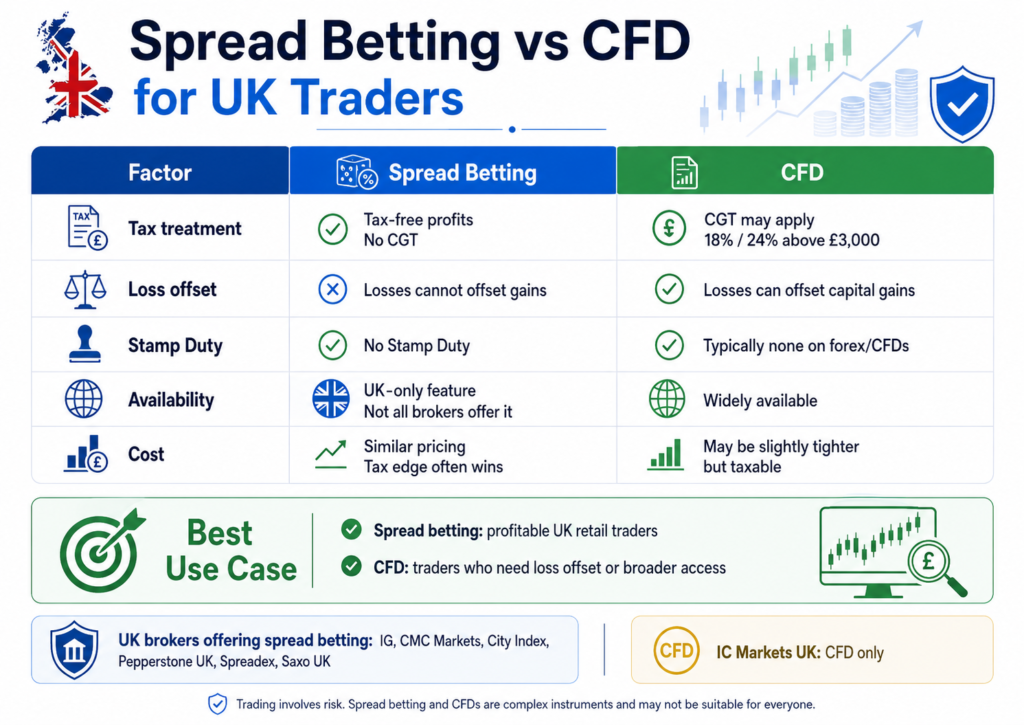
The mechanics are nearly identical to a CFD trade. The critical difference is legal classification: in the UK, spread betting is legally classified as gambling — and gambling winnings are not subject to Capital Gains Tax or Stamp Duty. This is a historical legal quirk that has never been closed by HMRC, and it creates a significant structural advantage for profitable UK traders.
In 2026, the UK CGT annual exempt amount is £3,000. Any forex trading profits above this threshold (via CFDs) are subject to CGT at 18% (basic rate) or 24% (higher rate) depending on your income band. A trader making £20,000 in forex profits via CFDs faces a potential CGT bill of £2,520–£4,080 on profits above the exempt amount.
The same £20,000 in spread betting profits: £0 in CGT.
When is spread betting better than CFD trading for UK traders?
Spread betting is better than CFD for most profitable UK retail forex traders — with these specific conditions:
Spread betting is preferable when:
- Your annual forex profits are likely to exceed £3,000 (the current CGT annual exempt amount)
- You trade forex, indices, or commodities rather than individual UK shares (where Stamp Duty savings are also relevant)
- You don’t need to carry losses forward against non-trading income (CFD losses can be offset against capital gains; spread betting losses cannot)
- You trade from a personal account rather than a limited company
CFD is preferable when:
- You generate losses that you want to offset against other capital gains (spread betting losses have no tax offset value)
- You trade through a limited company structure where corporation tax applies regardless
- You need access to instruments not available on spread betting accounts (some brokers offer broader instrument coverage on CFD vs spread betting)
- You trade internationally and need instruments in non-GBP markets where the spread betting tax advantage is irrelevant
The decision framework: If you’re a consistently profitable UK trader with annual gains above £3,000, calculate your CGT exposure and compare it directly to the cost difference between spread betting and CFD pricing at your chosen broker. For most traders, the tax saving significantly exceeds any spread difference.
Which top UK forex brokers offer spread betting accounts?
The following FCA-regulated brokers offer spread betting accounts for UK retail clients:
- IG Group — market leader, 17,000+ markets available for spread betting
- CMC Markets — 12,000+ markets, strong proprietary platform
- City Index — 12,000+ markets, part of StoneX Group
- Pepperstone UK — spread betting available alongside CFD and cTrader
- Spreadex — UK-only spread betting broker, sports and financial markets combined
- Saxo Bank UK — spread betting on forex and indices for eligible clients
Important clarification: Not all brokers that operate in the UK offer spread betting. IC Markets UK entity, for example, does not offer spread betting — only CFDs and forex. Always verify spread betting availability specifically with the UK entity of any international broker before assuming it’s available.
How does FCA regulation actually protect UK forex traders?
Does FSCS really protect your money at a forex broker?
The FSCS is frequently cited in broker marketing as a safety feature. What it actually covers is narrower than most traders assume — and understanding the distinction prevents a painful surprise.
What FSCS covers:
The FSCS provides up to £85,000 per eligible person per FCA-authorised firm in the event that the firm becomes insolvent and cannot return client funds. If your broker goes bankrupt and cannot access your segregated funds to return them, FSCS compensates you up to that limit.
What FSCS does NOT cover:
- Trading losses — if you lose money trading, FSCS is irrelevant
- Funds lost to fraud by the broker (this falls under a different mechanism)
- Funds above the £85,000 limit
- Funds held at firms that are FCA “Registered” rather than “Authorised”
- Funds at offshore entities of UK brokers (e.g., your account must be held under the UK FCA entity specifically)
Why segregated funds matter more than FSCS for most traders:
All FCA-authorised retail brokers must hold your funds in segregated accounts at Tier-1 UK banks, separate from the firm’s own money. In practice, if a major regulated broker fails, the segregated client funds are returned first — before the FSCS mechanism is even needed. FSCS is the last-resort backstop if segregation fails. For most traders with accounts under £85,000, the combination of fund segregation + FSCS provides effectively complete protection against broker insolvency risk.
What is the FCA leverage limit and can you legally get more?
The FCA caps retail client leverage on forex as follows:
- Major currency pairs (EUR/USD, GBP/USD, etc.): 1:30
- Minor and exotic pairs: 1:20
- Gold: 1:20
- Indices: 1:20
- Individual equities: 1:5
- Crypto (where available): 1:2
These are hard limits for retail clients under FCA jurisdiction. They exist to protect retail traders from the amplified losses that high leverage creates — a policy response to documented retail trader loss rates.
Can you legally access higher leverage as a UK trader?
Yes — through professional client reclassification. FCA allows retail clients to apply for professional client status if they meet two of three qualifying criteria:
- You have carried out trades of significant size on the relevant market at an average frequency of 10 per quarter over the previous four quarters
- The size of your financial instrument portfolio exceeds £500,000
- You work or have worked in the financial sector in a professional position requiring knowledge of derivatives or relevant financial instruments
Professional clients can access leverage up to the broker’s maximum offering (typically 1:200–1:500 at UK entities). The tradeoff: you lose retail client protections including negative balance protection and the FSCS safety net as it applies to certain product categories. This is a legitimate path — but it requires genuinely meeting the criteria and explicitly acknowledging the reduced protections.
Using offshore brokers for higher leverage is a different matter entirely — see the dedicated section below.
How do the best UK forex brokers compare side by side?
| Broker | FCA No. | Spread Betting | EUR/USD (typical) | Min Deposit | Platforms | FSCS | Best For |
|---|---|---|---|---|---|---|---|
| IG Group | 195355 | ✅ 17,000+ mkts | 0.6 pip (SB) | £0 | Proprietary, ProRT | ✅ | Spread betting, active traders |
| CMC Markets | 173730 | ✅ 12,000+ mkts | 0.7 pip (SB) | £0 | Next Generation | ✅ | Platform quality, spread betting |
| Pepperstone UK | 684312 | ✅ | 0.10 pip (Razor+comm) | £0 | MT4, MT5, cTrader, TradingView | ✅ | Low cost ECN, multi-platform |
| City Index | 113942 | ✅ 12,000+ mkts | Competitive | £100 | Advantage web + MT4 | ✅ | Beginners, UK-focused |
| OANDA UK | 542574 | ❌ CFD only | ~0.9 pip | £0 | MT4, OANDA native | ✅ | No-minimum entry, US pairs |
| Saxo Bank UK | 551422 | ✅ (eligible clients) | From 0.4 pip | £2,000 | SaxoTrader GO/PRO | ✅ | Professional traders |
| Spreadex | 116015 | ✅ Sports + financial | Competitive | £0 | Proprietary | ✅ | Spread betting only |
What are the best forex trading platforms available to UK traders?
UK traders have access to the broadest platform ecosystem in the world — a consequence of the UK being the world’s largest forex trading centre by volume.
MetaTrader 4 and MT5: Still the most widely used platforms globally. Available through Pepperstone UK, City Index, OANDA UK, and others. Best for EA traders, algo strategies, and traders with existing MQL4/5 indicator libraries.
IG’s Proprietary Platform + ProRealTime: Best-in-class for spread betting and active discretionary trading. ProRealTime integration provides institutional-grade charting including automated pattern recognition and real-time scanning. Available to IG clients meeting a minimum trading frequency (or by subscription).
CMC Next Generation: Award-winning proprietary platform with superior charting and customisation. Best for UK traders who want a modern interface built specifically for spread betting and CFD trading.
cTrader (via Pepperstone UK): Best for scalpers and algorithmic traders who want Level II market depth, cAlgo automation, and a modern execution interface. Not as widely available in the UK as MT4, but significantly more capable for sophisticated strategies.
TradingView (via Pepperstone UK): Best for analysis-first traders who spend significant time on charts. Full trade execution available directly from TradingView charts at Pepperstone UK spread betting and CFD accounts.
SaxoTraderPRO: Best for professional and multi-asset traders who need options, futures, and bond access alongside forex — all from a single platform with professional-grade order management.
Should UK traders use an offshore broker for higher leverage?
The appeal is understandable. An offshore broker offers 1:500 leverage. The FCA caps you at 1:30. The leverage difference feels like an opportunity.
Here is the honest assessment: for most UK retail traders, using an offshore broker for higher leverage is a financially and legally disadvantageous decision.
Why offshore broker leverage is often a trap:
- No FSCS protection. If the offshore broker fails — and offshore brokers have a meaningfully higher historical failure rate than FCA-regulated firms — you have no UK compensation scheme to fall back on. Recovery of funds from offshore insolvencies is expensive, slow, and often unsuccessful.
- No FCA negative balance protection. Outside FCA jurisdiction, you can lose more than your deposit. With 1:500 leverage, a 0.2% adverse move wipes out your entire deposit. A 0.3% move puts you in negative balance that the broker can legally pursue.
- Tax implications are unchanged. Using an offshore broker does not affect your UK tax obligations. You still owe CGT on profits. But you’ve lost the access to spread betting (which is only available from FCA-regulated UK brokers) that would have eliminated the CGT entirely.
- The leverage math rarely works in practice. Studies consistently show that higher leverage increases loss rates among retail traders, not profits. FCA’s leverage cap exists because the empirical evidence supports it.
The legitimate alternative: Apply for professional client status with an FCA-regulated broker if you genuinely qualify. You access higher leverage under a transparent legal framework, maintain some regulatory protections, and keep access to UK spread betting tax advantages.
How do you open a forex trading account in the UK?
Opening an account at any FCA-regulated forex broker follows a standardised process under UK anti-money-laundering (AML) and Know Your Customer (KYC) requirements:
Step 1: Choose your account type
Decide between spread betting (tax-free, UK-only) and CFD (subject to CGT). Most UK brokers let you hold both under one login. Start with spread betting if you anticipate consistent profits above £3,000/year.
Step 2: Complete the online application
Provide: full name, UK address, date of birth, National Insurance number (for tax reporting), employment status, annual income, and trading experience. This takes 10–20 minutes online.
Step 3: Verify your identity
UK brokers require proof of identity (passport or driving licence) and proof of address (bank statement or utility bill within 3 months). Most FCA brokers use automated ID verification services — approval in minutes to a few hours for most applicants.
Step 4: Complete the appropriateness assessment
FCA rules require brokers to assess whether CFD/spread betting products are appropriate for you. Answer questions about your trading experience and understanding of leverage honestly. If you fail, most brokers still allow you to proceed with a warning — you’re not banned.
Step 5: Fund your account and start with a demo
Deposit via bank transfer, debit card, or e-wallet. Before trading real money, open a demo account alongside and practice on the platform. Most FCA brokers provide unlimited demo access.
The UK forex market is one of the most sophisticated in the world — and UK traders have access to tools (spread betting, FSCS, FCA protections) that traders in other countries simply cannot access. The good forex brokers for UK traders aren’t just any globally-regulated broker. They’re specifically FCA-authorised, spread-betting-capable firms that understand the regulatory and tax environment their UK clients operate in.
Use that advantage. Trade with an FCA broker. Consider spread betting if your profits warrant it. And never let the promise of higher leverage at an offshore firm outweigh the protections you have at home.
→ Read our full Pepperstone review to understand the UK’s best ECN broker for tight spread trading.
→ Compare the best regulated forex brokers globally — including options for traders outside the UK.
Frequently Asked Questions About Good Forex Brokers UK
Is forex trading legal in the UK?
Yes — forex trading is fully legal in the UK for retail clients through FCA-regulated brokers. UK traders can trade via CFDs or spread betting. Both products require FCA-authorised brokers. Forex trading profits via CFD accounts are subject to Capital Gains Tax; spread betting profits are tax-free. The FCA imposes leverage limits (1:30 for major forex pairs) and requires negative balance protection for all retail clients.
What is the difference between a currency broker and a forex broker?
These are different products for different purposes. A currency broker (like Wise, OFX, or Currencies Direct) facilitates the physical exchange of currencies — typically for international money transfers, property purchases, or business payments. A forex trading broker (like IG, Pepperstone, or CMC Markets) provides leveraged trading on currency price movements via CFDs or spread betting, without physical delivery of currency. The two serve completely different needs.
Do I pay tax on forex trading profits in the UK?
It depends on how you trade. CFD trading profits are subject to Capital Gains Tax above the annual CGT exempt amount (£3,000 in 2026), at 18% (basic rate) or 24% (higher rate). Spread betting profits are exempt from CGT and Stamp Duty in the UK. If you trade forex as a full-time professional activity, HMRC may classify gains as income tax rather than CGT. Always consult a UK tax adviser for your specific situation.
What is the minimum deposit to start forex trading in the UK?
Several top FCA-regulated brokers have no minimum deposit — including IG Group, CMC Markets, OANDA UK, and Pepperstone UK. In practice, a starting balance of £200–£500 is recommended for meaningful position sizing within the FCA’s 1:30 leverage limit. A £100 account with 1:30 leverage has limited trading capacity for standard lot sizes. City Index accepts accounts from £100; Saxo Bank UK typically requires £2,000 for retail accounts.
How do I verify if a forex broker is FCA authorised?
Visit the FCA Register at register.fca.org.uk and search the broker’s name or their FCA firm reference number. Check that the status shows “Authorised” (not just “Registered”) and that the authorised activities include “Dealing in investments as agent” or equivalent CFD/spread betting permissions. Cross-reference the firm reference number shown on the broker’s website with the Register entry. Any discrepancy is a warning sign. This verification takes under two minutes and should be done before depositing with any broker.
Methodology: This guide is based on FCA Register data (verified June 2026), independent broker testing from ForexBrokers.com, DayTrading.com, and CompareForexBrokers.com, FSCS official documentation, HMRC guidance on spread betting and CFD taxation, and community feedback from UK trading forums. All fees, regulatory details, and conditions subject to change — verify directly with each broker and consult a qualified UK tax adviser before trading. This content does not constitute financial or tax advice. Retail CFD and spread betting products involve significant risk of loss.