
Pepperstone Broker Review 2026: Fees, Spreads, Safety & Platforms
Every broker review you’ll read online tells you the same thing: competitive spreads, fast execution, top-tier regulation, excellent support. By the time you’ve read three of them, the words blur together. None of them tell you what you actually need to know before depositing money.
I’ve traded forex since 2021 using supply and demand methodology — holding positions across multiple timeframes, placing dozens of trades per month, and paying close attention to the difference between what a broker advertises and what actually happens when you’re live in the market.
This Pepperstone forex broker review covers the things that matter from that perspective. Not just the headline numbers — the actual trading costs, the platform selection logic, the support experience, and the honest answer to questions most reviews dodge, including whether Pepperstone has a cent account (it doesn’t) and whether it’s worth the switch if you’re currently on a high-spread broker.
Here’s what I found.
What exactly is Pepperstone and who is it built for?
Pepperstone is an Australian-founded online forex and CFD broker established in 2010 in Melbourne. It was built with a specific philosophy: eliminate the dealing desk, give retail traders direct access to interbank liquidity, and keep costs as low as possible.
Over the past 15 years, that model has attracted more than 830,000 clients across 170+ countries. The firm now processes approximately US$350 billion in monthly trading volume — a number that reflects not retail hobby traders but a large base of active, professional-leaning participants.
Pepperstone is classified as a No Dealing Desk (NDD) broker, using a hybrid ECN/STP execution model. This means your orders are routed directly to liquidity providers — banks, prime brokers, and electronic communication networks — without a human dealer sitting between you and the market. The practical result: faster execution, no re-quotes, and no conflict of interest between you and the broker on trade direction.
The broker suits:
- Scalpers and high-frequency traders who need raw spreads and fast fills
- EA and algorithmic traders who need low-latency execution and platform stability
- Intermediate to advanced swing traders who want broad instrument access with tight costs
- Beginners who want a well-regulated, low-fee environment without a minimum deposit barrier
It does not suit US-based traders (Pepperstone is not licensed in the US) or traders looking for a cent account (Pepperstone doesn’t offer one — more on this in the account types section).
Is Pepperstone a regulated and trustworthy forex broker?
Pepperstone’s regulatory profile is one of the strongest in the retail brokerage industry. This is not a marketing claim — it’s a verifiable structural advantage that directly affects the safety of your capital.
Which regulatory bodies oversee Pepperstone globally?
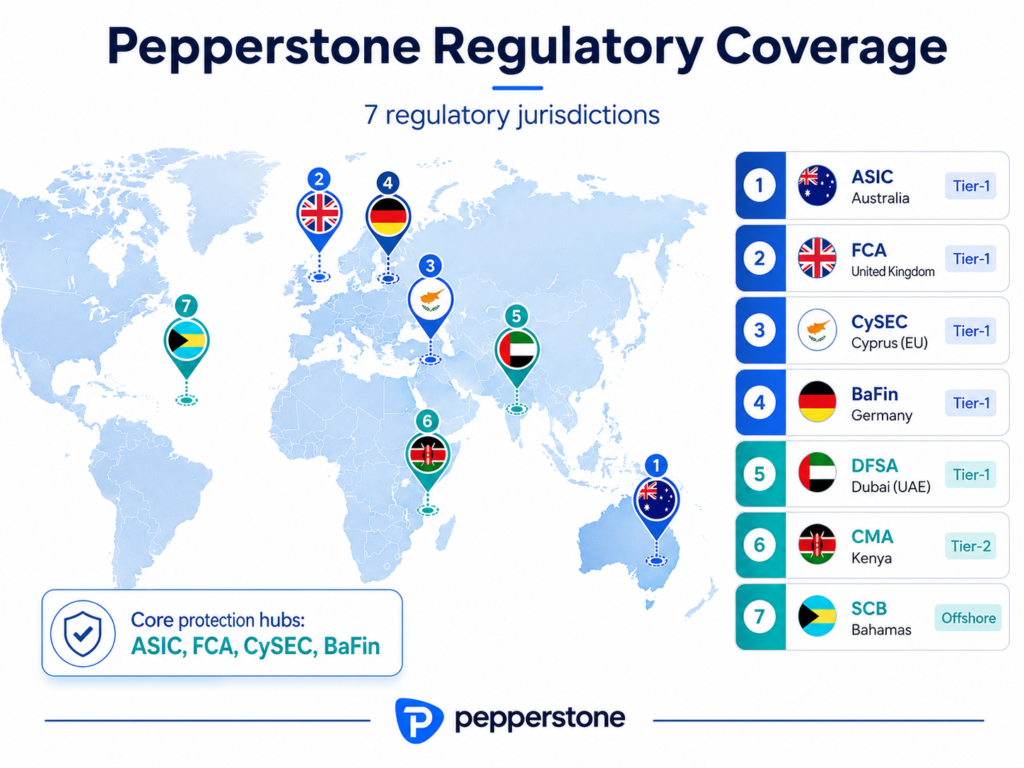
Pepperstone operates under seven separate regulatory licenses across major jurisdictions:
| Regulatory Body | Jurisdiction | Type |
|---|---|---|
| ASIC | Australia | Tier-1 |
| FCA | United Kingdom | Tier-1 |
| CySEC | Cyprus (EU) | Tier-1 |
| BaFin | Germany | Tier-1 |
| DFSA | Dubai (UAE) | Tier-1 |
| CMA | Kenya | Tier-2 |
| SCB | Bahamas | Offshore |
The four Tier-1 licenses — ASIC, FCA, CySEC, and BaFin — are the most meaningful from a client protection standpoint. These regulators enforce strict capital adequacy requirements, audit broker operations regularly, and provide client fund compensation schemes in some jurisdictions (up to £85,000 under the UK FSCS for FCA-regulated accounts).
Your account will fall under the jurisdiction of the Pepperstone entity that serves your country. Traders in the UK are serviced by Pepperstone Limited (FCA). Traders in Australia by Pepperstone Group Limited (ASIC). Traders in Europe by Pepperstone EU Ltd (CySEC). This matters because each entity operates under different leverage limits, protection levels, and client money rules.
How does Pepperstone protect client funds?
Client funds are held in segregated accounts at Tier-1 banks, separate from Pepperstone’s operating capital. This means if Pepperstone were to become insolvent, your deposited funds could not be used to pay company creditors.
Additional protections include:
- Negative balance protection — you cannot lose more than your deposited funds
- No re-quotes on market execution accounts
- No restrictions on stop loss placement — unlike some dealing desk brokers
Pepperstone has maintained a clean regulatory record since its founding in 2010. There are no documented major regulatory actions, fines, or client fund disputes in its history — a meaningful data point when comparing it to brokers with less transparent track records.
What account types does Pepperstone offer for CFD trading?
Pepperstone offers two primary CFD and forex account types. Choosing the right one is the single most impactful decision you’ll make as a Pepperstone client — it directly determines your per-trade cost structure.
What are the real trading costs on the Standard account?
The Standard account is a commission-free, spread-inclusive account. Pepperstone does not charge a separate commission per trade — all its costs are embedded in the spread.
The average spread on EUR/USD sits at approximately 1.00 pip on the Standard account. For context, that’s $10 per standard lot (100,000 units) round-trip. For traders who place 10 trades per month at one lot each, that’s $100 in spread costs.
The Standard account is well-suited for:
- Beginning traders who want simple cost transparency (one number, no calculation)
- Swing traders who hold positions for days or weeks and trade infrequently
- Traders who use market analysis tools on TradingView or MT5 without needing extreme precision on entry cost
It is not ideal for scalpers, high-frequency traders, or anyone trading large volumes where the 1 pip spread compounds significantly across hundreds of monthly trades.
Is the Pepperstone Razor account worth it for active traders?
The Razor account uses a raw spread + commission structure. You access the near-real interbank spread — as low as 0.0 pips on EUR/USD, averaging approximately 0.10 pips — and pay a separate commission per lot.
Commission structure on the Razor account:
| Platform | Commission (round-trip) |
|---|---|
| MT4/MT5 | $6–$7 per lot |
| cTrader | $6 USD per lot (fixed) |
| TradingView | $7 USD per lot |
For EUR/USD at 0.10 pip average spread + $7 round-trip commission on MT5, the effective cost per lot is approximately 0.80 pips — significantly cheaper than the Standard account’s 1.00 pip at any meaningful volume.
For scalpers, the math is stark. A scalper placing 50 standard lot trades per month saves roughly $10 per lot compared to the Standard account — that’s $500 per month in reduced trading costs at the same volume. At that scale, the Razor account is not just better — it’s the only rational choice.
Pepperstone’s Active Trader program adds another layer for high-volume traders. It operates on a tiered rebate system:
- Tier 1 (under 200 lots/month): $1 rebate + 10% spread discount → effective EUR/USD cost ~0.62 pips
- Tier 2 (200–1,500 lots/month): $2 rebate + 20% discount → further reduction
This is the most competitive cost structure Pepperstone offers. It rivals prime brokerage pricing and is genuinely valuable for professional traders who maintain consistent monthly volume.
Does Pepperstone offer a cent account for beginners?
No. Pepperstone does not offer a cent account.
This is a common question — particularly from new traders who’ve heard that cent accounts allow trading micro-positions with very small deposits — and it deserves a direct answer rather than being buried or ignored.
A cent account denominated in cents rather than dollars would allow a $100 deposit to be treated as 10,000 cents, enabling position sizes of 0.001 lots. Pepperstone’s minimum trade size is 0.01 lots (micro lots) on standard accounts, which is already quite small — but it is not the same as a cent account.
If you’re specifically looking for a cent account to practice risk management with very small positions, you’ll need to look at brokers like RoboForex or XM, which explicitly offer cent account denominations. Pepperstone’s equivalent for beginners is its demo account (up to 5 demo accounts for unregistered users, up to 10 for live account holders) and the low practical minimum deposit that allows meaningful trading from a small capital base.
Which trading platforms does Pepperstone support?
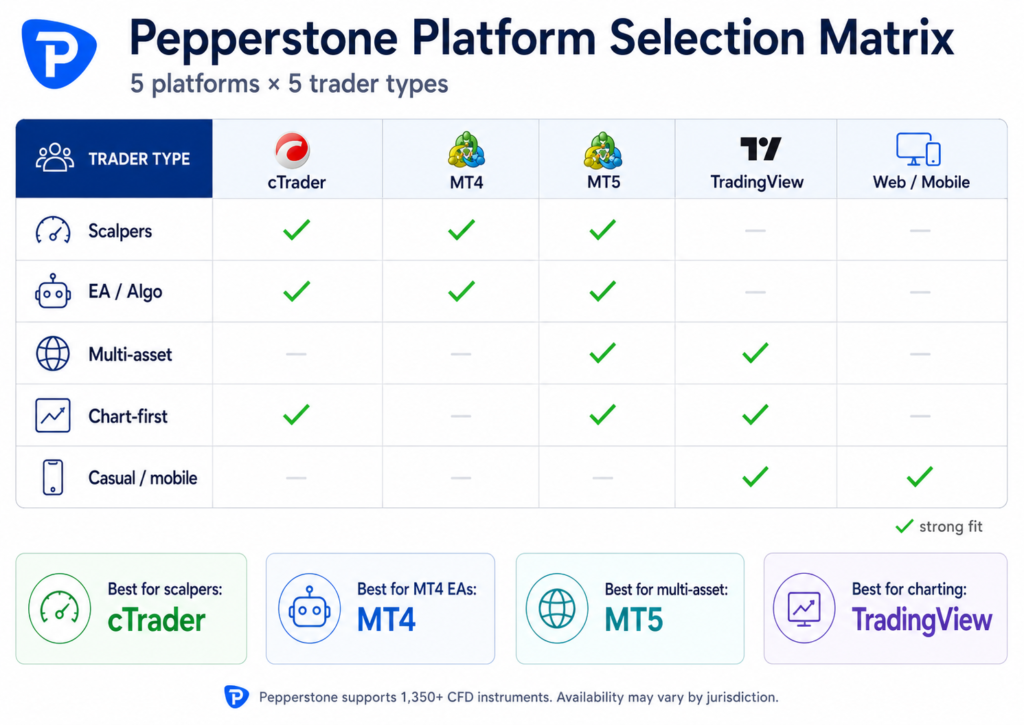
Pepperstone supports five trading environments: MT4, MT5, cTrader, TradingView, and its own native Pepperstone platform (web and mobile). This is the broadest platform offering of any major ECN-style forex broker.
Each platform serves different trader types. Understanding which one fits your approach saves significant setup time.
Which Pepperstone platform suits scalpers and EA traders best?
cTrader is the optimal platform for scalpers. Here’s why:
cTrader provides Level II market depth — you see the full order book, not just the best bid/ask. For scalpers trading around order blocks and liquidity levels, this visibility is a genuine execution edge. cTrader also offers cAlgo — a built-in automated trading environment using C# — for traders who want to deploy or build algorithmic strategies without relying on MetaTrader’s MQL language.
Execution on cTrader at Pepperstone benefits from ultra-low latency connectivity to Pepperstone’s pricing engine. The firm provides VPS hosting for traders who need 24-hour, uninterrupted automated strategy execution.
MT4 remains the standard for EA traders who have existing strategies built in MQL4. Pepperstone’s MT4 environment includes Smart Trader Tools — a suite of expert advisor add-ons including Trade Terminal, Correlation Matrix, and Mini Terminal — that significantly extend MT4’s native functionality. If your EA library is built in MQL4, Pepperstone’s MT4 integration is reliable and well-maintained.
MT5 is the better choice for traders who want multi-asset coverage (shares CFDs, ETFs, bonds alongside forex) and more advanced charting with additional timeframes.
A practical note on cTrader: the desktop version is Windows-only for the downloaded application. Mac users must use the web-based version. MT4 and MT5 desktop are compatible with both Windows and Mac.
Is TradingView on Pepperstone actually better than MT5?
For analysis-first traders, yes — and this is an underrated advantage that most Pepperstone reviews don’t give enough attention.
TradingView’s charting environment is superior to MT5 for several reasons: better drawing tools, cleaner multi-timeframe layout, access to TradingView’s community scripts and published indicators, and a significantly more intuitive interface for traders who aren’t deep in MQL development.
Pepperstone’s TradingView integration allows you to execute live trades directly from TradingView charts — placing, modifying, and closing orders without switching to a separate platform. The underlying execution uses Pepperstone’s Razor account pricing (commission of $7 round-trip per lot), so you’re not paying a premium for the better interface.
For supply and demand traders, price action traders, and anyone who spends significant time marking up charts, the TradingView route on Pepperstone is compelling. The limitation: TradingView’s scripting (Pine Script) doesn’t support the same depth of automated strategy backtesting as MT5’s Strategy Tester. If backtesting complex algorithms is central to your workflow, MT5 remains the more capable environment.
What instruments can you trade as CFDs on Pepperstone?
Pepperstone offers access to 1,350+ instruments across six asset classes, all traded as CFDs:
- Forex: 90+ currency pairs including majors, minors, and exotic pairs
- Indices: Global equity indices (S&P 500, NASDAQ, DAX, FTSE, Nikkei, and more)
- Shares: 1,000+ single-stock CFDs across US, UK, European, and Australian markets
- Commodities: Gold, silver, oil (WTI and Brent), natural gas, agricultural commodities
- ETFs: Selected exchange-traded fund CFDs
- Cryptocurrencies: BTC, ETH, and a range of altcoin CFDs (availability varies by jurisdiction)
For forex and indices traders, the instrument range is comprehensive. For equity-focused traders who want deep single-stock coverage, Pepperstone’s 1,000+ share CFDs offer meaningful breadth — though traders who want to own actual shares (not CFDs) should note that Pepperstone is a CFD-only broker and does not offer stock ownership.
Leverage varies by jurisdiction and instrument type. Under ASIC and FCA regulations, retail clients access maximum leverage of 30:1 on major forex pairs, 20:1 on minor forex pairs and gold, 10:1 on commodities, and 2:1 on cryptocurrencies. Professional client classification allows higher leverage where regulatory frameworks permit.
How does Pepperstone live chat and customer support perform?
Pepperstone’s support operates 24/5 — Monday through Friday, closing over the weekend alongside most forex markets.
Support channels:
- Live chat (primary — fastest response)
- Email (support@pepperstone.com)
- Phone (regional numbers for AU, UK, and other major markets)
Live chat performance: Average response time under 5 minutes. Multilingual support covers key regions including Asia-Pacific, Europe, and the Middle East. For Vietnamese-speaking traders, Pepperstone’s website offers a Vietnamese language interface (pepperstone.com has a Tiếng Việt option), and regional support teams can handle queries in Vietnamese via the support channels.
The quality of Pepperstone live chat is consistently praised in trader community feedback. Responses are handled by knowledgeable agents rather than scripted chatbots — follow-up on complex platform or account issues is typically resolved within one business day.
What to use live chat for:
- Platform login issues
- Account verification queries
- Funding and withdrawal status updates
- Technical questions about specific platforms
What requires email or phone:
- Formal complaints
- KYC document submissions (handled via the Secure Client Area)
- Complex account restructuring
One genuine limitation: weekend support is unavailable. For traders who hold positions over the weekend and encounter a technical issue Saturday or Sunday, there is no live support channel. Pepperstone’s knowledge base (Help Center) covers most common issues, but real-time assistance waits until Monday.
What are the deposit and withdrawal options at Pepperstone?
Pepperstone has one of the lowest-friction funding structures in the industry.
Minimum deposit: $0 technically, with a recommended minimum of $200 for global clients and $500 for EU clients (to ensure you have sufficient margin for practical trading).
Deposit methods:
- Credit/debit card (Visa, Mastercard) — instant
- Bank wire transfer — 1–3 business days
- PayPal — instant (available in select regions)
- Skrill — instant
- Neteller — instant
- UnionPay — available in Asian markets
- USDT (cryptocurrency) — available in select regions
Deposit fees: None from Pepperstone. Third-party provider fees may apply at the payment processor level.
Withdrawal fees:
- Most methods: $0
- International bank wire transfer: $20 (charged by Pepperstone)
- Skrill/Neteller: $1 processing fee
Withdrawal processing: Forms submitted before 07:00 AEST are processed same day. Forms submitted after 21:00 GMT are processed the next business day. After processing, funds typically arrive within 1–3 working days depending on method.
Inactivity fee: None. Pepperstone does not penalize dormant accounts — a meaningful advantage over brokers that charge $10–$25/month on inactive accounts.
An important practical note: funds can only be withdrawn to accounts in the same name as the trading account. Third-party withdrawals are not permitted — standard industry practice for anti-money-laundering compliance.
What are the real pros and cons of using Pepperstone as your broker?
Genuine advantages:
- 7 Tier-1 regulatory licenses — among the strongest multi-jurisdiction regulatory profiles in retail brokerage
- Raw spreads from 0.0 pips on Razor account with competitive commission structure
- 5 platform options including TradingView integration — broadest choice of any comparable ECN broker
- No minimum deposit, no inactivity fee, no withdrawal fee on most methods
- Active Trader rebate program — meaningful cost reduction for volume traders
- 24/5 live chat under 5 minutes — consistent, reliable, multilingual support
- Strong execution with no re-quotes and No Dealing Desk model
Real limitations:
- No US clients — regulatory structure excludes US-based traders
- No cent account — traders specifically wanting cent-denominated micro accounts must look elsewhere
- Standard account spread (1.0 pip EUR/USD) is not competitive — you need the Razor account to access Pepperstone’s real value
- cTrader desktop is Windows-only — Mac users limited to web version
- No proprietary research or signal tools — Pepperstone is an execution broker, not an advisory service
- International bank wire withdrawal incurs $20 fee — minor but worth noting for traders using wire as primary withdrawal method
How does Pepperstone compare to IC Markets for forex trading?
This is the comparison most serious traders want to see because IC Markets is Pepperstone’s closest direct competitor in the ECN raw spread space.
| Feature | Pepperstone | IC Markets |
|---|---|---|
| Founded | 2010 | 2007 |
| Regulation | ASIC, FCA, CySEC, BaFin, DFSA, CMA, SCB | ASIC, CySEC, SCB |
| Instruments | 1,350+ | 2,250+ |
| EUR/USD spread (Razor/Raw) | ~0.10 pips avg | ~0.0 pips avg |
| Commission (MT4/MT5) | $6–$7 round-trip | $7 round-trip |
| Platforms | MT4, MT5, cTrader, TradingView, Native | MT4, MT5, cTrader |
| TradingView integration | ✅ Yes | ❌ No |
| Minimum deposit | $0 | $200 |
| Inactivity fee | None | None |
| US clients | ❌ No | ❌ No |
| Cent account | ❌ No | ❌ No |
The honest comparison:
IC Markets offers a broader instrument range and marginally tighter average spreads on EUR/USD. If pure spread minimization is your only criterion and you trade exclusively via MT4/MT5/cTrader, IC Markets has a slight edge in raw pricing.
Pepperstone counters with superior regulatory depth (FCA and BaFin regulation — IC Markets has neither), TradingView integration, and a more developed Active Trader rebate program for volume traders. For traders who value multi-jurisdictional Tier-1 oversight or who want TradingView as a primary trading interface, Pepperstone is the stronger choice.
Both brokers are excellent. The decision comes down to your regulatory preference, your platform choice, and whether TradingView integration matters to your workflow.
→ Read the full IC Markets vs Pepperstone comparison here.
Who should and should not open a Pepperstone account?
Open a Pepperstone account if:
- You trade forex and CFDs actively (scalping, day trading, or regular swing trading)
- You want the strongest multi-jurisdiction regulatory protection available at a retail broker
- You use or want to use MT4, MT5, cTrader, or TradingView
- You trade EAs or automated strategies
- You’re based outside the US and want a globally accessible, low-cost execution environment
- Volume is high enough to benefit from the Razor account and Active Trader program
Do not open a Pepperstone account if:
- You are based in the United States — Pepperstone cannot legally service you
- You specifically need a cent account for ultra-micro position trading
- You want a broker that also offers stock ownership (not CFDs) for a buy-and-hold portfolio
- You want dedicated educational content and mentorship — Pepperstone is an execution broker, not a trading school
- You need 24/7 support including weekends — Pepperstone’s 24/5 support schedule closes on weekends
Pepperstone’s strongest appeal is for cost-conscious, execution-focused traders who know what they’re doing and want infrastructure that doesn’t get in their way. If that describes your situation, the case for Pepperstone is strong.
→ Open a Pepperstone account — start with a free demo or go straight to live.
→ Compare all regulated forex brokers in our comprehensive broker review hub.
Frequently Asked Questions About Pepperstone Broker
Does Pepperstone accept US traders?
No. Pepperstone does not hold a license from US regulators (CFTC/NFA) and cannot service US-based clients. US traders should look at OANDA, FOREX.com, tastyfx, or Interactive Brokers — all of which are licensed for US retail forex and CFD trading.
What is the minimum deposit to start trading on Pepperstone?
The technical minimum deposit is $0. Pepperstone recommends a starting balance of $200 for most clients and $500 for EU clients to ensure adequate margin for practical trading. E-wallet and card deposits are processed instantly; bank wires take 1–3 business days.
Does Pepperstone charge swap fees on overnight positions?
Yes. Swap rates (also called rollover fees) apply to positions held past the daily rollover time (typically 5pm New York). Rates vary by instrument and direction (long vs short). Pepperstone does offer swap-free (Islamic) accounts for traders from regions where interest-based fees are prohibited — available on request.
Can I use Expert Advisors and automated trading on Pepperstone?
Yes. Pepperstone fully supports Expert Advisors on MT4 and MT5, cAlgo bots on cTrader, and custom API-connected automated strategies. The broker provides VPS hosting to ensure 24-hour uninterrupted EA execution. Standard automated strategy restrictions apply (no latency arbitrage, no tick scalping exploiting data feed irregularities). Standard trend-following, mean-reversion, and rules-based EAs are fully supported.
How fast does Pepperstone process withdrawals?
Withdrawal requests submitted before 07:00 AEST are typically processed the same business day. Those submitted after 21:00 GMT are processed the following business day. Post-processing, funds arrive within 1–3 working days depending on method. Card and e-wallet withdrawals are typically faster than bank wire, which can take up to 3 working days internationally.
Methodology: This Pepperstone broker review is based on published data from Pepperstone’s official website, regulatory filings from FCA, ASIC, and CySEC, independent testing data from ForexBrokers.com (8+ years of live testing), DailyForex, and Commodity.com, plus direct assessment of platform conditions as of June 2026. All fees and conditions are subject to change — verify with Pepperstone directly before opening an account. This review does not constitute financial advice.