
XTB Broker Review 2026: Is XTB Still Worth Using?
Here’s a situation that plays out thousands of times a day. A trader opens an XTB account, deposits €1,000 to buy US stocks, makes their first trade — and quietly pays a 0.5% currency conversion fee on the way in and another 0.5% on the way out. They never noticed it. It wasn’t in the headline. It wasn’t in the comparison table they found online.
That’s not a reason to avoid XTB. It’s a reason to understand it properly before you start.
XTB is one of the strongest brokers available to European and international traders. Its xStation 5 platform won Best in Class at ForexBrokers.com 2026. Its real stock offering covers 6,000+ equities across 16 exchanges. It’s publicly listed on the Warsaw Stock Exchange and regulated by FCA, KNF, CySEC, and more. But in 2025, it also quietly eliminated MT4/MT5 access for new clients and shut down its API for automated trading — a decision that made XTB an excellent choice for some traders and the wrong choice for others.
This XTB broker review tells you which category you’re in.
What is XTB and what kind of broker is it?
Founded in 2004, XTB is a global online broker headquartered in Warsaw, Poland. The business model was initially designed for CFD trading, but over time the company expanded its offerings to include real stocks and ETFs.
Today, XTB operates as a hybrid broker — part CFD platform, part real-asset investing platform. XTB is one of the largest stock exchange-listed FX and CFD brokers in the world, known for its exceptional xStation 5 platform, and continues to innovate in 2026 with new crypto and options offerings.
The scale of the operation is significant. XTB is listed on the Warsaw Stock Exchange and has a strong presence across Europe with offices in 13 different countries, including France, Germany, Italy, Turkey, and the Czech Republic. The broker has 550,000 monthly Google searches and ranks as the 7th most popular forex broker among 65 brokers researched, with 9,098,000 monthly website visits as of February 2026 — the 6th most visited broker globally.
What this means practically: XTB is large enough to be a serious institutional counterparty, publicly accountable through its Warsaw Stock Exchange listing, and operationally mature enough to handle millions of client interactions without significant service disruption.
The broker’s positioning has shifted in recent years. XTB used to serve two audiences clearly: active CFD/forex traders (via Pro accounts with raw spreads) and stock investors. In 2025, XTB consolidated its pricing structure by phasing out the Pro Account with raw spreads, focusing on a standard, no-commission spread model catering primarily to beginners. This was a deliberate strategic choice — and it has significant implications for how different traders should evaluate XTB today.
Is XTB safe and regulated for online trading?
Which regulatory bodies license XTB globally?
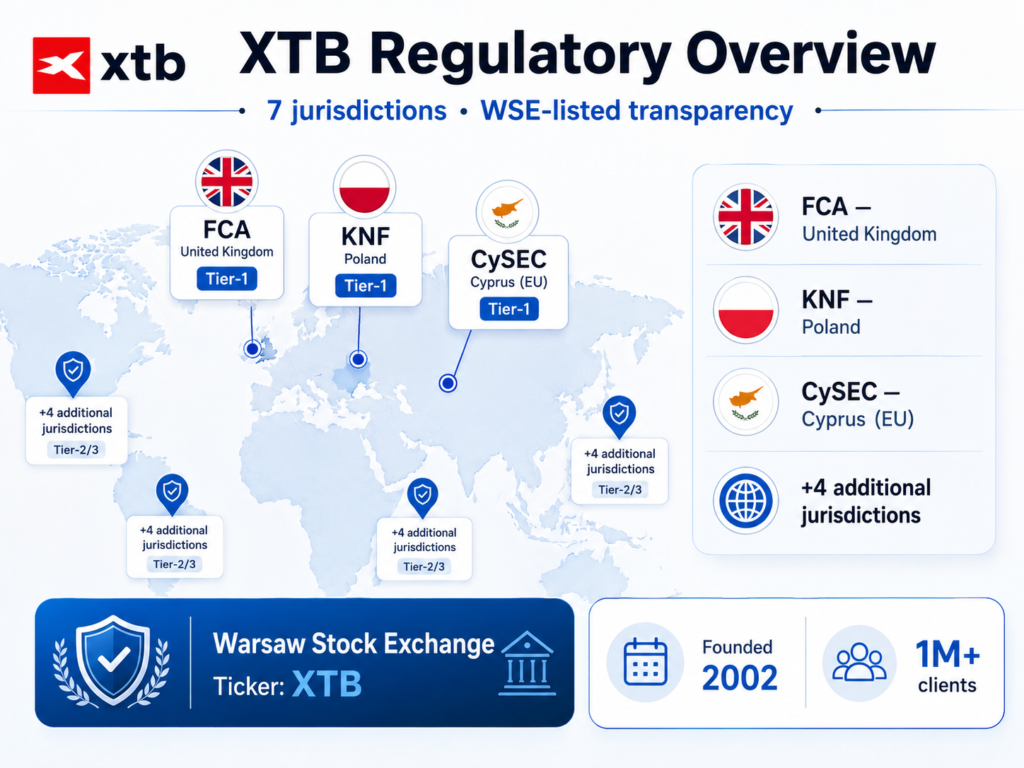
XTB is regulated by multiple top-tier agencies including FCA (UK), KNF (Poland), and CySEC (Cyprus). The full regulatory picture
| Regulatory Body | Jurisdiction | Category |
|---|---|---|
| FCA | United Kingdom | Tier-1 |
| KNF | Poland | Tier-1 |
| CySEC | Cyprus (EU) | Tier-1 |
| + 4 additional | Various | Tier-2/3 |
The FCA and CySEC licenses provide meaningful client fund protection. Client funds are held in segregated accounts with investor protection up to €20,000 (ICF under CySEC) or £85,000 (FSCS under FCA). The KNF license in Poland adds an additional Tier-1 layer that few brokers outside Central Europe can match.
The broker received one regulatory issue in 2018 where they received a significant fine for irregularities — this is worth noting for transparency. It was resolved, and XTB has maintained a clean record in the years since. For a broker with 24+ years of operating history and over 1 million clients, one historical regulatory matter is a manageable data point, not a disqualifying one.
What does XTB’s Warsaw Stock Exchange listing mean for traders?
With over two decades of operating history since 2002 and public listing on the Warsaw Stock Exchange, XTB offers an exceptional level of transparency and security that few competitors can match.
The Warsaw Stock Exchange listing means XTB must file quarterly financial reports, disclose material changes to its business, and maintain corporate governance standards equivalent to any publicly listed company. Its revenue, client numbers, and capital position are public record — you can verify them.
This is a meaningful structural advantage over privately held brokers who disclose nothing about their financial health. When you’re trusting a broker with your capital, knowing that the firm’s balance sheet is subject to external audit and public reporting is a significant trust signal.
Combined with its FCA and KNF oversight, XTB’s public company status makes it one of the most structurally transparent brokers available to retail traders globally.
What are XTB’s real trading costs — all fees explained?
What spreads and commissions does XTB charge on forex and CFDs?
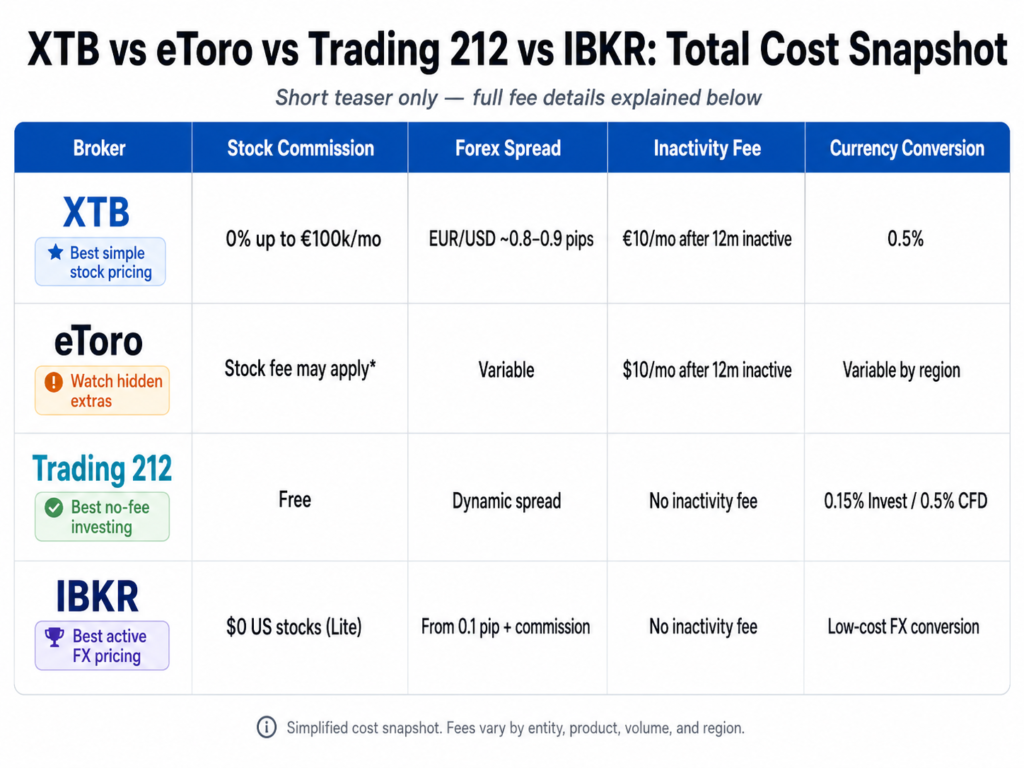
In 2025, XTB streamlined its pricing options, now providing a singular, no-commission spread structure. Previously, they catered to diverse trading needs with a Pro Account featuring raw spreads. However, this option has been phased out.
The current Standard account uses spread-only pricing — no commission charged separately. All costs are embedded in the spread.
Key spreads on the Standard account:
- EUR/USD: ~0.8–0.9 pips average
- S&P 500: ~0.5 pts (vs industry average 0.79)
- DAX 40: ~1.1 pts (vs industry average 1.65)
- Gold (XAU/USD): Higher than industry average (per FX Empire live testing)
These spreads are competitive, sitting slightly tighter than eToro but wider than a raw-spread ECN broker like IC Markets. For position traders and stock investors, XTB’s spread profile is more than adequate. For scalpers and high-frequency forex traders, the spread-only model is less competitive than ECN alternatives.
For eligible professional clients, XTB still offers a Pro account structure with tighter spreads and commission-based pricing ($3.50 per lot per side on forex, indices, and commodities). But retail clients — the majority — are on the Standard spread-only model.
What are the hidden fees on XTB that most reviews mention but don’t emphasize enough?
Inactivity fee: €10 per month after 12 months of no trading activity, if you haven’t deposited in the last 90 days. It’s easily avoidable — just buy a single fractional share once a year. Unlike eToro’s 12-month clock that starts from account opening regardless, XTB’s condition is slightly more forgiving — triggered by inactivity without a recent deposit.
Withdrawal fee for small amounts: Withdrawals are quick but small withdrawals may incur a fee. Specifically: free for withdrawals above €100 (or $100/£100); approximately €10 fee for amounts below that threshold. Most traders won’t trigger this regularly, but it’s worth knowing.
Currency conversion fee — the most underreported cost:
XTB charges a 0.5% markup on currency conversion. If your account is in EUR and you buy US stocks, you pay this fee on the way in and the way out.
For a practical example: an EU trader with a EUR-denominated account who buys $10,000 of US stocks pays approximately €45–50 in conversion fees at entry, and another €45–50 when they sell. That’s roughly €90–100 in conversion costs on a single round-trip — invisible in the headline “0% commission” marketing. The pro tip: if you trade mostly US stocks, open a USD sub-account to avoid paying this fee on every trade.
Is XTB’s 0% commission on real stocks genuinely free?
XTB offers 0% commission on real stocks and ETFs for monthly turnover up to €100,000 (EU clients). Above that threshold, a 0.2% commission applies.
For the vast majority of retail investors who trade less than €100,000 per month, the 0% commission is real. But “free” needs qualification:
- The 0% commission applies to trade execution — not to currency conversion costs if your account currency doesn’t match the stock currency.
- The 0% commission applies to real stock purchases under relevant entities. Stock and ETF trading is not available under the XTB Ltd (Cyprus) entity — meaning clients under certain jurisdictional arrangements may only access stock CFDs, not real ownership.
- Below the monthly €100K cap, you pay no commission. This is genuinely competitive — it matches Trading212 and is better than most traditional brokers for European retail investors at moderate volumes.
How good is xStation 5 and is it better than MetaTrader?
What does xStation 5 offer that MT4 and MT5 don’t?
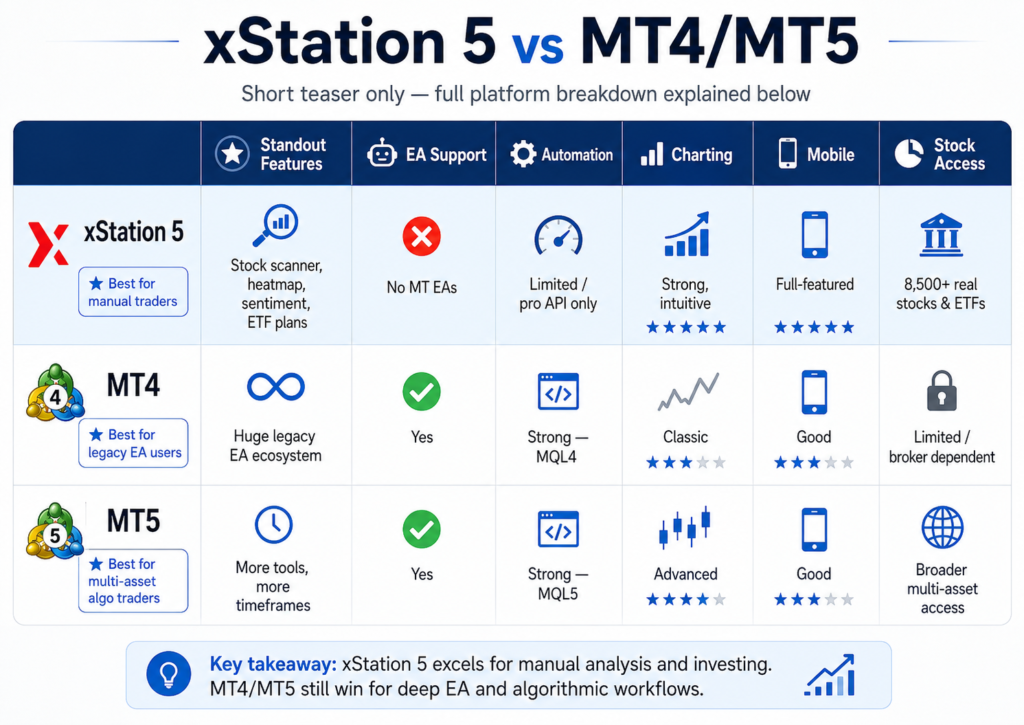
The proprietary xStation 5 platform impressed with its powerful charts and intuitive design. xStation 5 wins Best in Class at ForexBrokers.com 2026 across Overall, Ease of Use, and Beginners categories. This is a meaningful third-party validation — ForexBrokers.com tests platforms independently across 65+ brokers.
Key xStation 5 features that MT4/MT5 lack:
- Stock screener: XTB’s proprietary ‘Stocks scanner’ — available from the ‘Market analysis’ tab — features multiple filtering options to sift through 8,500+ real stocks and ETFs based on country, industry, market cap, dividend yield, BETA, ROE, and more. Both basic filters for first-time investors and advanced options for seasoned portfolio managers. No MT4/MT5 equivalent exists.
- Heatmap tool: The Heatmap tool helps you understand the current strength of one currency against others — visual market overview that MT4’s aging interface doesn’t provide natively.
- Market sentiment indicators: Real-time sentiment data integrated into the platform, not a third-party add-on.
- Investment Plans tab: Automated ETF investing directly within the trading platform — a feature MT4/MT5 were never designed to offer.
- xStation Mobile parity: XTB offers xStation 5 (Web version) and xStation Mobile, both featuring strong research tools, high customization, and accessible interface. The mobile app has full functionality — not a stripped-down version.
Where MT4/MT5 still excel: the depth of the algorithmic ecosystem. Two decades of MQL indicators, templates, and community tools built for MT4/MT5 do not exist for xStation. For traders who are deeply embedded in that ecosystem, the switch requires rebuilding their entire workflow.
Can you run Expert Advisors or automated strategies on XTB?
XTB does not support MT4 or MT5 for new clients, and its API was discontinued in 2025.
This is the most important limitation in the entire XTB review — and the one most often glossed over.
If your trading strategy relies on:
- Expert Advisors (EAs) running on MT4/MT5
- Third-party algorithmic trading via API
- Backtesting within MT5’s Strategy Tester
- Custom MQL indicators or scripts
…then XTB is not compatible with your trading setup. Period. For EA and algorithmic trading, the review recommends alternatives like Pepperstone, Eightcap, or XM Group — all of which maintain full MT4/MT5 support.
xStation 5 does support automation through its own xStation API for professional clients, but this is a more limited and less documented ecosystem than the MetaTrader environment. For discretionary traders, buy-and-hold investors, and manual technical traders, this limitation is irrelevant. For algo traders, it’s a dealbreaker.
What can you trade on XTB — stocks, forex, CFDs, crypto?
XTB has earned a reputation for its extensive lineup of over 11,300 trading and investing products, including currency pairs, commodities, real shares and share CFDs, ETFs, ETF CFDs, and more.
The full breakdown:
Forex: 70+ major, minor, and exotic currency pairs. Competitive EUR/USD and index spreads; gold and oil spreads slightly above industry average.
Real stocks: 6,000+ real stocks across 16 global exchanges, with commission-free trading up to €100,000 monthly volume. Fractional shares available with a minimum investment of just €10. Real stock ownership — not CFDs — is available for clients under qualifying entities (primarily EU and UK).
Real ETFs: 1,400+ ETFs available for real investment. 0% commission applies within the monthly threshold.
Indices: 25+ CFD indices including S&P 500, NASDAQ, DAX 40, FTSE 100, Nikkei. Competitive spreads on major indices.
Commodities: Oil (WTI, Brent), gold, silver, agricultural commodities — all as CFDs.
Crypto: 50+ cryptocurrencies. XTB continues to expand its crypto offering. Note: The UK’s FCA banned the sale of crypto-derivatives to UK retail consumers as of January 6, 2021 — UK clients cannot trade crypto CFDs.
What is NOT available: Options (except for CySEC entity clients), futures, bonds, mutual funds as standard products.
What are XTB Investment Plans and who should use them?
This is the most underexplored feature in XTB’s offering — and one that genuinely differentiates XTB from pure trading brokers.
From the ‘Investment Plans’ tab on xStation 5, you can find a selection of real ETFs and assess which ones suit you best for automated investing.
Investment Plans work as follows: you select one or more ETFs from XTB’s real ETF library, set a recurring investment amount and frequency (monthly, weekly, etc.), and XTB automatically executes the purchases on your chosen schedule. The platform handles portfolio rebalancing as contributions accumulate. 0% commission applies on these investments within the monthly €100,000 turnover threshold.
This makes XTB a viable platform for passive investors who want to build a long-term ETF portfolio using automatic contributions — a use case typically associated with robo-advisors or dedicated investment apps like Vanguard or Nutmeg.
Who should use Investment Plans:
- Long-term investors who want to dollar-cost average into ETF portfolios
- Traders who want to separate their active trading activity from their passive portfolio — both accessible from one platform
- Beginners who want automated, low-cost market exposure without managing individual stock picks
Who won’t benefit:
- Traders focused purely on short-term CFD or forex activity — Investment Plans are a separate feature that doesn’t interact with the trading account’s leverage or CFD structure
- Investors who need access to specific ETFs not in XTB’s library — the selection is substantial but not exhaustive
The combination of active CFD trading and passive ETF Investment Plans within a single regulated platform is unusual in the industry and genuinely valuable for traders who want both capabilities without maintaining two separate accounts.
What account types does XTB offer for different trading needs?
XTB offers two primary account types for retail clients:
Standard Account:
- Minimum deposit: $0 (no practical minimum, though $250 is recommended)
- Spread-only pricing: from 0.8 pips on EUR/USD
- Commission: 0% on stocks/ETFs (up to €100K/month); 0% on forex/indices/commodities (cost in spread)
- Leverage: Up to 1:30 for EU/UK retail (regulated cap); up to 1:500 for international clients
- Negative balance protection: Included
- 0.01 minimum lot size
- Platform: xStation 5 (web, desktop, mobile)
Pro Account (professional clients only):
- Tighter spreads than Standard
- Commission: $3.50 per lot per side on forex, indices, commodities, crypto; from 0.08% on stock/ETF CFDs
- Requires professional client qualification (significant trading history, portfolio, or financial industry employment)
Demo Account:
Traders can also open a demo account, where they can trade risk-free for four weeks with £100k in virtual funds. The demo includes full xStation 5 functionality — useful for testing the platform before committing real capital.
Swap-Free / Islamic Account:
Available for clients from regions where interest-based fees are prohibited. Applies to the standard account structure with overnight swap fees removed.
How does XTB handle deposits, withdrawals, and customer support?
Deposits:
XTB offers fully digital, fast account opening — approximately 15–30 minutes to register, with approval usually in less than a day — and multiple deposit methods including bank transfer, cards, and PayPal. Deposits are processed quickly with no fee charged by XTB for deposits. Currency conversion applies if depositing in a different currency than your account denomination.
Withdrawals:
Processing is fast — same or next business day for most methods. The key fee condition: free for withdrawals above €100 (or equivalent); approximately €10 charge for amounts below this threshold. For most traders making periodic withdrawals, this is a non-issue. For small account holders making frequent micro-withdrawals, it’s worth structuring withdrawal timing to stay above the threshold.
Customer support:
Available 24/5 via multiple channels — live chat, phone, email — in multiple languages, providing efficient and accessible assistance. XTB’s education section supports 22 languages — one of the most multilingual educational environments in the broker industry, which matters significantly for non-English speaking traders across Europe and emerging markets.
Response quality is consistently rated highly across independent review sites. Live chat is the fastest channel for account and platform queries. Complex issues (KYC, account escalations) are routed to regional teams with language-matched support.
How does XTB compare to eToro for European stock investors?
This comparison is worth its own section because these two brokers compete directly for the same European retail investor audience — particularly those drawn to 0% commission stock trading.
| Feature | XTB | eToro |
|---|---|---|
| Real stocks available | 6,000+ across 16 exchanges | ~900 (primarily US listed) |
| Real ETFs available | 1,400+ | ~250 |
| Stock commission | 0% up to €100K/month | 0% (US stocks only) |
| EUR/USD spread | ~0.9 pips | ~1.0 pip |
| Copy trading | ❌ Not available | ✅ CopyTrader |
| Investment Plans (auto) | ✅ Yes | ❌ Not available |
| Inactivity fee | €10/month (after 12 months) | $10/month (after 12 months) |
| Withdrawal fee | Free above €100 | $25 flat (every withdrawal) |
| Currency conversion | 0.5% markup | Varies (~0.5%–1.5%) |
| Platform | xStation 5 | eToro social platform |
| MT4/MT5 | ❌ No | ❌ No |
| EA/Algo trading | ❌ Not supported | ❌ Not supported |
XTB offers 6,000 stocks from 16 exchanges (vs eToro’s ~900), 1,400 ETFs (vs eToro’s ~250), and has no withdrawal fee or inactivity fee structure that matches eToro’s more punishing $25 flat fee.
The verdict on this comparison: For European investors focused on building a real stock and ETF portfolio, XTB offers meaningfully broader asset access at lower ongoing withdrawal costs. For investors who want social features, CopyTrader, or crypto-focused investing, eToro’s unique capabilities justify its limitations.
Neither broker suits active forex day traders or algo traders — both platforms removed or never offered the infrastructure required for that use case.
Who should choose XTB — and who should look elsewhere?
Choose XTB if:
- You are a European stock and ETF investor who wants 0% commission on real asset purchases and broad exchange coverage
- You want a modern, award-winning platform (xStation 5) that works equally well on web and mobile
- You want to combine active CFD/forex trading and passive ETF Investment Plans in a single account
- You’re a beginner who needs structured education in your language and an intuitive interface
- You want a publicly listed, multi-regulated broker with maximum financial transparency
- You trade European indices and want competitive DAX/S&P 500 spread pricing
Do not choose XTB if:
- You need MetaTrader 4 or MT5 — XTB does not support these for new clients. Consider Pepperstone, Eightcap, or XM Group.
- You need Expert Advisor (EA) automated trading — XTB’s API was discontinued in 2025.
- You are a scalper or high-frequency forex trader — the 0.8–0.9 pip EUR/USD spread is not competitive against raw-spread ECN brokers.
- You are based in the United States — XTB does not accept US clients.
- You need options or futures trading as a core part of your strategy (not available for most retail accounts).
- You primarily trade gold and crude oil — FX Empire testing found these spreads above industry average on XTB.
The honest assessment: XTB made a deliberate choice in 2025 to optimize for stock investors and discretionary traders, at the cost of algorithmic traders and raw-spread seekers. That choice produced the industry’s best-rated platform for its target audience. Knowing whether you’re in that audience or not is the entire decision.
→ Compare XTB to the best regulated forex brokers for your trading style.
→ See the IC Markets review for the best ECN alternative if raw spreads and EA support are your priority.
Frequently Asked Questions About XTB Broker
Does XTB accept traders from Vietnam and Southeast Asia?
XTB serves clients internationally through its offshore entity structure. Traders from Vietnam and Southeast Asia may be able to open accounts under XTB’s international entity (registered in Belize). Product availability — particularly real stocks vs CFDs — varies by the entity serving your region. Check xtb.com directly for your country’s access level before applying. All standard disclaimer and risk warnings apply; leverage caps and product restrictions differ from EU/UK regulated entities.
Can US traders open an account with XTB?
No. US clients are not accepted — XTB does not hold a US regulatory license (CFTC/NFA). US traders should consider OANDA, FOREX.com, tastyfx, or Interactive Brokers, all of which are licensed for US retail clients.
What is the minimum deposit to start trading on XTB?
XTB has no minimum deposit requirement — you can open an account and start trading with any amount. In practice, a starting balance of $250–$500 is recommended to allow sufficient margin for meaningful position sizing. Fractional shares are available with a minimum investment of just €10, which allows very small starting balances to still access stock market exposure.
How long does it take to withdraw money from XTB?
XTB processes withdrawal requests typically on the same or next business day. After processing, funds arrive within 1–3 business days for card and e-wallet withdrawals; bank transfers may take up to 3–5 business days. Withdrawals above €100 are fee-free; smaller withdrawals incur approximately €10. There is no flat withdrawal fee equivalent to eToro’s $25 per withdrawal — a meaningful cost advantage for traders who withdraw frequently.
Does XTB offer a demo account for practice trading?
Yes — XTB offers a demo account where traders can practice risk-free with £100k in virtual funds for four weeks. The demo uses real market prices and includes full xStation 5 functionality — including the stock screener, Investment Plans interface, and charting tools. This is useful both for beginners learning the platform and for experienced traders testing strategies before going live. After the demo period expires, you can request an extension or open a live account.
Methodology: This XTB broker review is based on publicly available data from XTB’s official website (xtb.com), regulatory filings from FCA (license 522157), KNF (Poland), and CySEC (license 169/12), independent live testing data from FX Empire (45 live trades tested), ForexBrokers.com Best in Class 2026 platform assessment, CompareForexBrokers.com spread tracking data (updated May 2026), and Warsaw Stock Exchange filings. All fees and conditions subject to change — verify directly with XTB before opening an account. Trading CFDs involves significant risk of loss. This review does not constitute financial or investment advice.