IG Forex Broker Review 2026: Is IG Still Worth Using?
You’ve seen the name everywhere — on the London Stock Exchange ticker, in financial news, maybe even on a billboard. IG isn’t some offshore broker you stumbled onto through a Telegram ad. It’s been around since 1974, longer than most trading platforms have existed at all. But here’s where it gets confusing fast: search for it and you’ll find “IG Markets,” “IG Index,” “IG Group,” and “IG Trading and Investments” all referenced as if they might be different companies entirely. They’re not — but almost nothing online actually explains that clearly.
This review fixes that gap and answers the question that actually matters: is this IG forex broker, with its decades of history and stock-exchange listing, actually worth the fees it charges compared to leaner, cheaper competitors? We’ll walk through exactly how IG’s corporate structure works, what you’re really paying for, whether US traders have any path in at all, and who this broker genuinely fits — without the marketing gloss.
Is IG a Safe and Trustworthy Forex Broker?
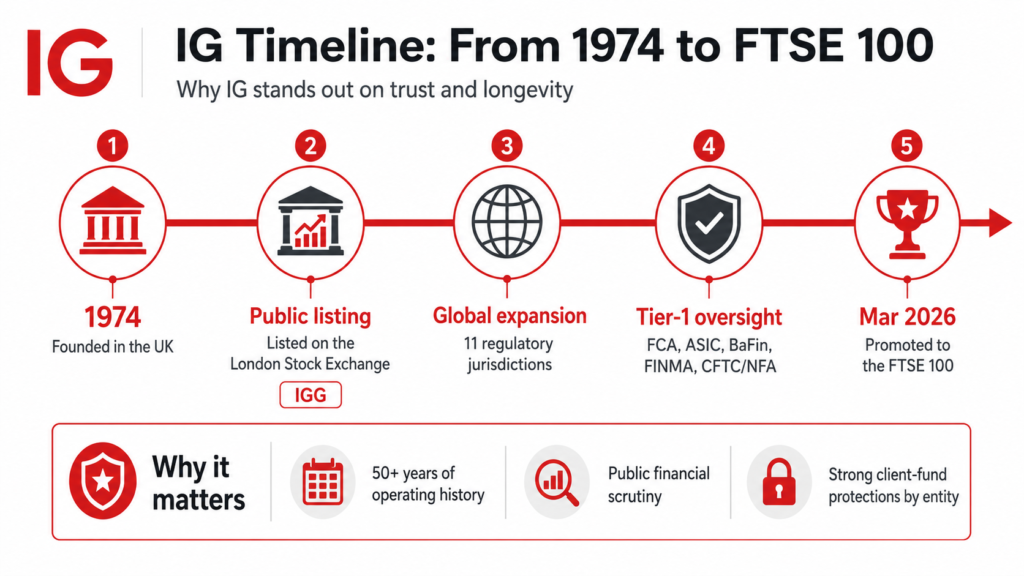
Let’s start where most traders actually start worrying: can you trust this broker with real money? IG was founded in 1974, making it one of the longest continuously operating forex and CFD providers in the world — older than the vast majority of brokers you’ll find on any comparison list. It’s publicly traded on the London Stock Exchange under the ticker IGG, and as of March 2026, it was promoted into the FTSE 100, putting it under a level of public financial scrutiny that privately held offshore brokers simply don’t face. Public companies file audited financials, face shareholder accountability, and can’t quietly disappear the way some unregulated operations have.
That history translates into real regulatory weight. IG holds licenses across 11 jurisdictions, including the FCA in the UK, ASIC in Australia, BaFin in Germany, FINMA in Switzerland, and the CFTC/NFA in the United States — a combination very few brokers in this industry can match. If you’re weighing trust above all else, IG’s combination of decades of operating history, public listing, and tier-1 regulatory coverage puts it in a different category from younger, privately held competitors.
How Many Regulators Oversee IG, and What Do They Protect?
Each regulator IG holds a license under enforces specific, concrete protections rather than just adding a logo to a footer. Under the FCA, client funds are held in segregated trust accounts at major banks like Barclays and Lloyds under strict CASS (Client Assets Sourcebook) rules, meaning your deposited capital is legally ring-fenced from IG’s own corporate assets. UK retail clients are also covered by the Financial Services Compensation Scheme up to £85,000 if the firm were ever to fail, and negative balance protection is a legal requirement, meaning your account can never go below zero. Other jurisdictions — ASIC in Australia, FINMA in Switzerland, MAS in Singapore — enforce broadly similar segregation and conduct standards, adapted to local law. The practical takeaway: which specific entity regulates your account changes the exact compensation scheme available to you, so it’s worth confirming which one applies to your country before depositing.
Why Does IG’s Stock Market Listing Matter for Your Trust?
A privately held broker can restructure, change ownership, or wind down with comparatively little public visibility. A FTSE-listed company can’t. IG Group Holdings plc must publish audited annual results, disclose material business changes to shareholders, and operate under far more public accountability than almost any of its competitors. This doesn’t make IG immune to operational problems — no broker is — but it does mean the kind of opacity that fuels “is this broker even real” anxiety around smaller, newer firms is structurally much harder to hide at IG’s scale and listing status.
Are IG Markets, IG Index, and IG Group the Same Company?
Yes — and this confusion is common enough that it shows up as its own separate search query. Here’s the actual structure, explained plainly.
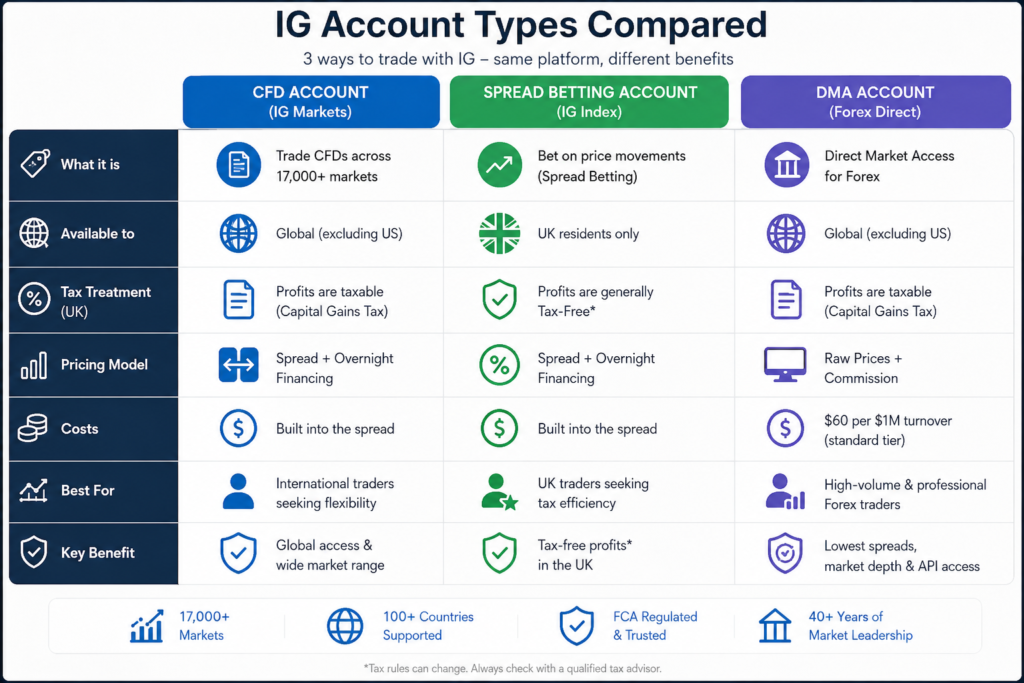
“IG” is the trading brand used across several legally separate entities that together make up IG Group Holdings plc. IG Markets Ltd is the entity that provides CFD trading. IG Index Ltd is the entity that provides spread betting, available only to UK clients, where profits are typically tax-free. IG Trading and Investments Ltd handles share dealing and the IG Smart Portfolio managed accounts. All three are authorized and regulated by the FCA under separate registration numbers, but they all sit under the same parent brand, the same platform, and the same underlying pricing — you’re not choosing between different companies when you pick a product, just between different regulated entities of the same group.
What’s the Difference Between IG Markets and IG Index?
The pricing is essentially the same between the two — what differs is the product wrapper and the tax treatment. IG Index offers spread betting, a UK-specific product where you’re technically betting on price movement rather than owning a derivative contract, and profits are generally exempt from UK capital gains tax. IG Markets offers CFD trading, available more broadly outside the UK as well, where profits are taxable but the contract structure is more globally standardized and recognizable to international traders. If you’re a UK resident deciding between the two, the tax treatment is usually the deciding factor, not the trading experience itself, since the underlying spreads and execution are functionally identical.
Where Did the Name “IG” Actually Come From?
The company started in 1974 as Investors Gold Index, built around a simple but novel idea at the time: letting individual investors speculate on the price of gold as an index, rather than needing to buy and store the physical metal. That name shortened to IG Index, and as the product range expanded well beyond gold into the full range of CFDs and global markets it offers today, the company rebranded again to the simpler “IG” you see now, with IG Group as the listed parent. The gold-trading origin is also why, decades later, IG still treats commodities and indices as a structurally important part of its product range rather than an afterthought bolted onto a forex-first business.
What Products and Markets Can You Trade on IG?
IG’s defining characteristic compared to forex-focused competitors is sheer breadth. Across its various entities, IG offers access to over 17,000 markets — spanning forex, indices, shares, commodities, bonds, options, futures, ETFs, and underlying crypto investing (though not crypto CFDs for UK retail clients, due to FCA restrictions). This range significantly exceeds competitors like CMC Markets (around 11,000+ markets) and most pure forex/CFD brokers, which typically concentrate on a few thousand instruments at most. For traders who want to consolidate forex trading, share investing, and CFD speculation under a single account rather than juggling multiple brokers, this breadth is IG’s clearest practical advantage.
What Is IG’s Direct Market Access (DMA) Account?
For more advanced traders, IG offers a Forex Direct DMA account, which functions similarly to an ECN account at other brokers — you get direct access to underlying market pricing rather than a marked-up spread, with commission charged separately. IG’s tiered DMA commission structure charges $60 per $1 million in monthly turnover at standard volumes, which is on the higher side compared to dedicated ECN brokers like Pepperstone or IC Markets, but the tiered model means costs decrease as your monthly volume grows. The L2 Dealer platform supporting DMA access also gives experienced traders order book depth and FIX API connectivity rarely offered outside specialist institutional brokers.
What Are IG’s Forex Fees, Spreads, and Commissions?
This is where most independent reviews land on a consistent verdict: IG’s pricing is solid but not the cheapest in the industry, and that’s a deliberate trade-off tied to everything else IG offers.
Forex and index CFD costs are built directly into the spread rather than charged as a separate commission on the standard account — EUR/USD spreads typically run around 0.6 to 0.9 pips, and S&P 500 index CFD spreads around 0.4 points. There’s no separate “Raw” or “ECN” account tier the way forex-focused brokers offer; IG’s standard spread-inclusive pricing is the default model across the board, with the DMA option available for traders who specifically want to unbundle spread from commission.
How Does IG’s Pricing Compare to ECN-Focused Brokers?
Compared to IC Markets or Pepperstone’s Raw accounts, which can quote EUR/USD spreads near 0.0 to 0.6 pips plus a small per-lot commission, IG’s all-in spread-based pricing on its standard account tends to land somewhat higher on a like-for-like cost basis. What you’re trading that premium for is the absence of a separate commission line to track, access to IG’s full multi-asset product range under one account, and the regulatory and corporate transparency covered earlier. If your priority is the absolute lowest possible per-trade cost and you’re trading forex exclusively, a dedicated ECN broker will likely beat IG on price. If you value consolidating multiple asset classes and want the deepest regulatory coverage available, IG’s premium becomes easier to justify.
What Non-Trading Fees Should You Watch For?
IG charges no deposit or withdrawal fees in most cases, and processing is typically fast — debit card withdrawals often complete within two business days. The fee that catches traders off guard is the inactivity charge: $12 to $18 per month, but only after two full years without a trade, which is a notably more forgiving window than the 90-day inactivity triggers common at many other brokers. A 0.5% currency conversion fee applies if you trade an instrument denominated in a currency different from your account’s base currency — a detail worth checking if you trade a mix of USD, EUR, and GBP-denominated markets from a single account.
| Account Type | Pricing Model | Typical EUR/USD Cost | Best For |
|---|---|---|---|
| Standard CFD (IG Markets) | Spread-inclusive | ~0.6–0.9 pips | Most retail traders, simplicity |
| Spread Betting (IG Index, UK only) | Spread-inclusive, tax-free profits | ~0.6–0.9 pips | UK residents prioritizing tax treatment |
| Forex Direct (DMA) | Raw spread + tiered commission | Varies, $60/$1M turnover | High-volume, advanced traders |
What Trading Platforms Does IG Offer?
IG supports one of the widest platform lineups in the industry: its own proprietary web and mobile platform, MetaTrader 4, a TradingView integration, the L2 Dealer DMA terminal, and ProRealTime for advanced charting. The proprietary IG platform is generally considered the most polished and feature-complete option, with one-click trading, customizable alerts, and integrated research tools like Autochartist signals and sentiment data. Notably, full native MetaTrader 5 support is not part of IG’s core offering the way it is at many forex-focused brokers, which may matter if you’re specifically committed to running MT5-based Expert Advisors — IG’s algorithmic trading support leans more toward its API and L2 Dealer infrastructure instead.
Can US Traders Use IG?
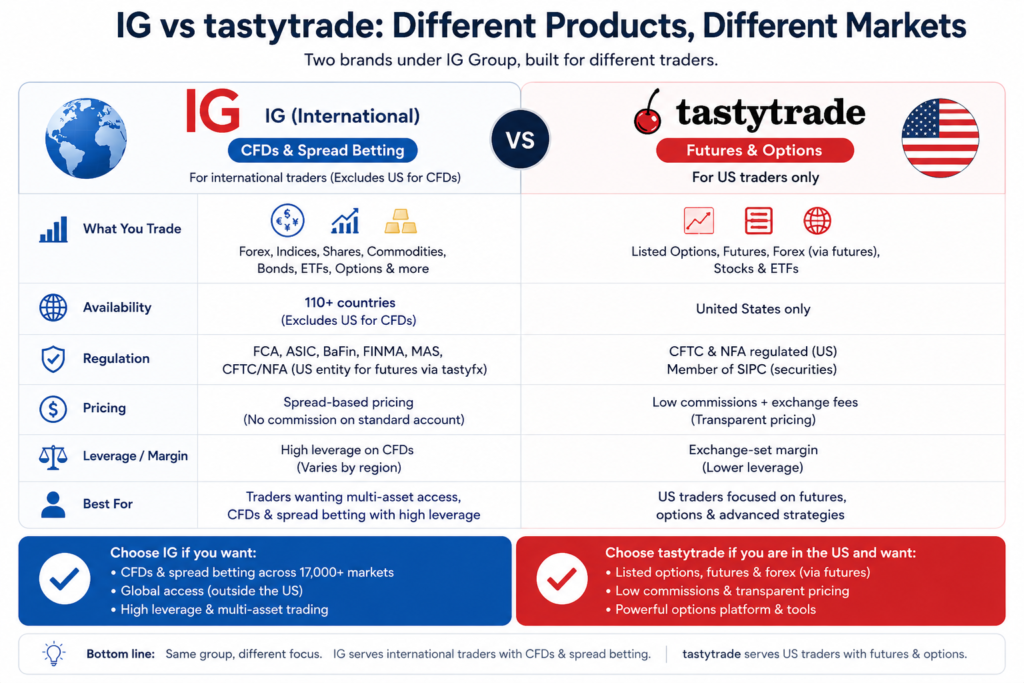
This is a question that trips up a lot of readers, because IG genuinely does have a US presence — just not in the form most people expect. CFD trading is banned outright for retail clients in the United States under federal law, so IG’s core forex/CFD product simply isn’t available there. Instead, IG operates in the US through its subsidiary, tastytrade (and its forex-specific arm, tastyfx), offering listed derivatives — futures and equity options — rather than CFDs.
What Can US Clients Trade Through tastytrade Instead?
Through tastytrade, US clients get access to listed options, futures, and forex trading structured to comply with CFTC and NFA requirements, which differ meaningfully from the CFD-based product UK and international clients use. The platform experience, fee structure, and available instruments are distinct enough that a US trader researching “IG” should understand they’ll end up on a different product entirely, under a different brand name, rather than simply signing up for a US version of the same CFD account. If you’re in the US and specifically want IG’s reputation and regulatory backing, tastytrade is the legitimate path — just go in expecting a derivatives-focused platform, not a forex CFD account.
Is IG Good for Beginners, or Only Active Traders?
The honest answer splits depending on what “good for beginners” means to you.
Is the Higher Cost of IG Worth It for Beginners?
If you’re brand new to trading, IG’s education library — despite some reviews noting it has stagnated in recent depth compared to its peak — still includes interactive courses, demo accounts, and resources like the Trade of the Week newsletter that genuinely help orient a first-time trader. The intuitive web platform reduces the learning curve compared to MetaTrader’s more technical interface. The trade-off is cost: a beginner trading small positions infrequently will likely pay a noticeably higher effective spread than they would at a stripped-down ECN broker. For a beginner who values hand-holding, platform polish, and regulatory comfort over shaving fractions of a pip off each trade, that premium is often a reasonable price for reduced anxiety while learning.
Is IG Worth It for Active or DMA Traders?
For active traders, the calculation shifts. IG’s Forex Direct DMA account and tiered commission structure mean costs improve meaningfully as volume scales up, and the L2 Dealer platform’s order book depth and FIX API access support strategies that simply aren’t possible on a standard retail account anywhere. Combined with weekend trading on major indices and extended hours on US equities, IG offers genuine flexibility for traders who want to react to news outside standard market hours — a feature most pure forex ECN brokers don’t prioritize. High-frequency scalpers chasing the absolute lowest commission will likely still find dedicated ECN brokers cheaper, but traders who value the combination of DMA-grade execution with IG’s regulatory backing get something genuinely difficult to replicate elsewhere.
What Are the Real Pros and Cons of Trading With IG?
Pros:
- Over 50 years of continuous operating history and a FTSE 100 listing, offering a level of public transparency few competitors can match.
- 11 regulatory licenses across major jurisdictions, including the FCA, ASIC, and CFTC/NFA.
- Exceptionally broad product range — 17,000+ markets across forex, CFDs, shares, options, futures, and more under one account.
- No deposit or withdrawal fees in most cases, and a notably forgiving two-year inactivity window.
- Tax-free spread betting available to UK residents through IG Index.
Cons:
- No standalone Raw/ECN account tier — all-in spread pricing tends to run higher than dedicated forex-focused brokers.
- No native copy trading functionality, a gap competitors like eToro and Vantage fill directly.
- DMA commission rates are comparatively high unless your monthly volume is substantial.
- CFD trading is unavailable to US clients, who must use the differently structured tastytrade platform instead.
- Customer support response times have been flagged repeatedly in independent reviews as slower than some competitors.
Is IG Forex Broker Worth It in 2026? Final Verdict
IG isn’t trying to be the cheapest forex broker on the market, and pretending otherwise would misrepresent what it actually offers. What it delivers instead is a rare combination: over five decades of continuous operation, a public listing that forces a level of financial transparency most brokers never face, regulatory coverage across more jurisdictions than almost any competitor, and a product range broad enough to replace several specialized brokers with one account.
If your priority is squeezing the lowest possible cost out of every forex trade, a dedicated ECN broker will likely beat IG on price, full stop. But if you’re weighing the premium against what you’re actually getting — institutional-grade regulatory backing, a platform mature enough to serve both first-time traders and DMA-level professionals, and a corporate structure transparent enough to survive public market scrutiny — that premium starts looking less like a cost and more like the price of genuinely reduced risk. For traders who’ve been burned by opaque, fast-moving offshore brokers before, that trade-off is often exactly what they’re looking for.
Want to weigh IG against a lower-cost ECN alternative before deciding? Check our IC Markets review for a direct cost comparison, or see our guide to choosing a forex broker as a beginner if you’re still narrowing down your first account.
Frequently Asked Questions About IG
Is IG Markets Regulated by the FCA?
Yes. IG Markets Ltd is authorized and regulated by the UK’s Financial Conduct Authority, along with separate FCA authorization for IG Index Ltd (spread betting) and IG Trading and Investments Ltd (share dealing) — all three are part of the same IG Group brand.
Does IG Charge Inactivity Fees?
Yes, but only after an unusually long grace period. IG charges $12 to $18 per month in inactivity fees, and only after two full years without a trade — considerably more lenient than the 90-day windows common at many other brokers.
Can You Do Copy Trading on IG?
No, IG does not offer native copy trading functionality. If copy trading is a priority for you, dedicated social-trading brokers like eToro or Vantage are better suited, since this remains one of IG’s clearer feature gaps.
Is Spread Betting on IG Tax-Free?
For UK residents, yes — spread betting profits through IG Index are generally exempt from UK capital gains tax, unlike CFD trading profits through IG Markets, which are typically taxable. Tax treatment can change, so confirm current rules with a tax professional.
What Is the Minimum Deposit for IG?
It varies by region and account type, with some markets requiring as little as £1 for retail accounts, while certain regions cite a $250 minimum. Always check the specific minimum listed for your country and chosen account type before depositing.
Risk Disclosure: Spread bets and CFDs are complex instruments and come with a high risk of losing money rapidly due to leverage. The majority of retail investor accounts lose money when trading these products with this provider. This article is for informational purposes only and does not constitute financial advice. Always verify a broker’s current regulatory status and product availability in your country before depositing funds.
Methodology: This review is based on publicly available regulatory filings, independently published fee and spread data current as of 2026, and aggregated trader feedback from Trustpilot and independent broker-comparison platforms cited throughout.