
FP Markets Review 2026: Is This Forex Broker Still Worth Using?
You’ve opened your account agreement or a regulatory disclosure page, and a name you didn’t expect shows up: First Prudential Markets. You signed up for FP Markets. Did you accidentally open an account with a different company? Did something change without you noticing? This exact moment of confusion is common enough that it shows up as its own search query — and almost no broker review actually stops to explain it clearly before diving into spreads and platforms.
This FP Markets review starts by clearing that up, then goes further: we’ll confirm exactly how this broker is regulated across its various entities, address the CySEC fine and workforce reduction that surfaced in news coverage in early-to-mid 2026 without burying it in fine print, break down what you’ll actually pay to trade, and tell you honestly who this broker fits best. No marketing gloss — just what the regulatory filings, fee schedules, and independent testing data actually show.
Are First Prudential Markets and FP Markets the Same Company?
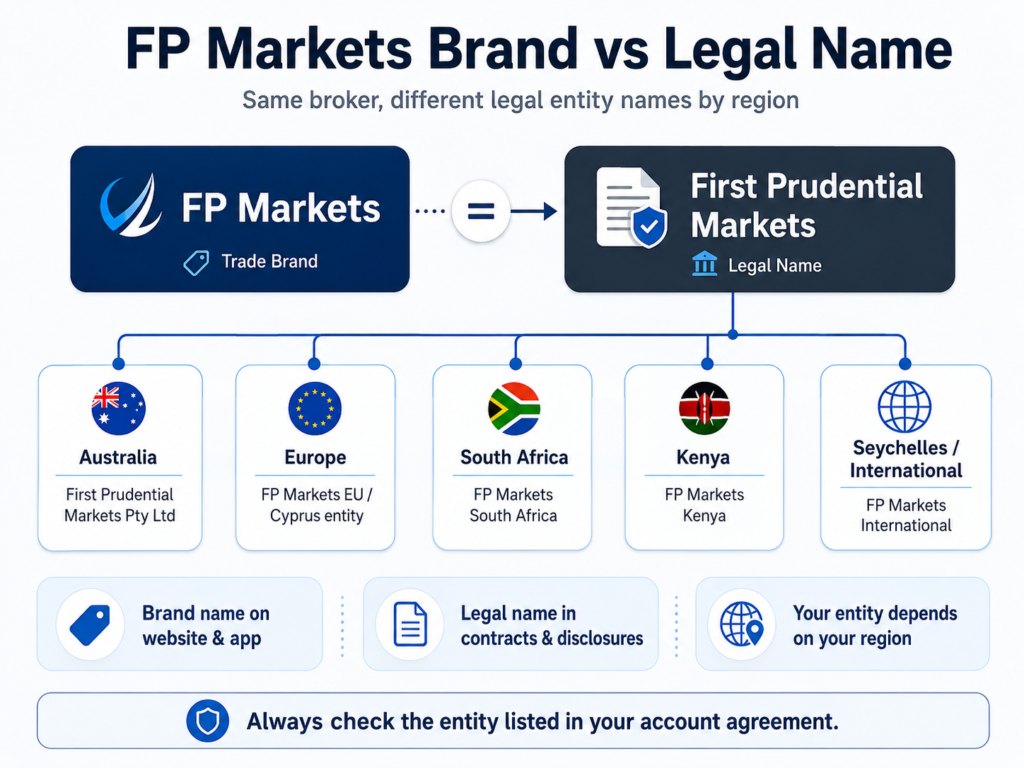
Yes — completely. There’s no separate entity, no rebrand-in-progress, no reason for concern. First Prudential Markets is the legal name of the company; FP Markets is simply its trade name, the brand you see on the website, the app, and the marketing. This is no different in principle from how many companies operate under a shorter public-facing name than their full legal registration — what makes it worth explaining clearly here is that FP Markets’ regulatory disclosures, terms and conditions, and account agreements consistently use the full legal name “First Prudential Markets,” which is exactly where most people first encounter it and start wondering if something’s off.
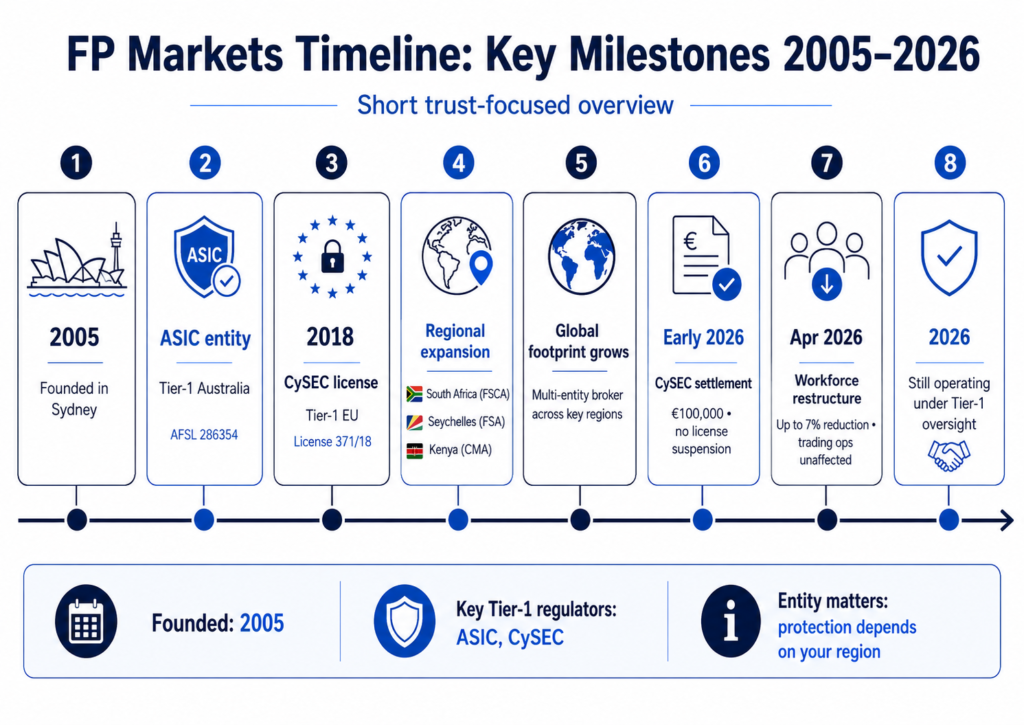
The company was founded in 2005 in Sydney, Australia, by Matt Murphie, who also sits on the board of the Australian FX and CFD Association — a detail that signals genuine, long-standing industry involvement rather than a name picked off a shelf. Today, the FP Markets Group of Companies operates from Sydney with additional entities across Cyprus, South Africa, Kenya, Seychelles, and several other jurisdictions, employing more than 250 people globally under Craig Allison’s leadership as CEO.
Why Does FP Markets Use a Different Trade Name?
There’s no unusual or concerning reason behind this. Many regulated financial services firms operate under a trade name that’s shorter, more memorable, or more marketable than the formal legal entity name used in registration documents and regulatory filings — this is standard practice across the industry, not specific to FP Markets. “First Prudential Markets” reads like a traditional, formal financial institution name, while “FP Markets” functions as the cleaner, more brandable identity used in day-to-day client communication. If you see “First Prudential Markets Pty Ltd” or “First Prudential Markets Ltd” on a regulatory document, a withdrawal confirmation, or a terms-of-service page, you’re looking at the same company you signed up with under the FP Markets name — just referenced by its registered legal identity for that specific jurisdiction.
Is FP Markets Safe and Properly Regulated?
With the naming question settled, the more substantive trust question is whether this broker is genuinely well-regulated — and the answer is yes, across a meaningfully wide spread of jurisdictions, though with varying tiers of oversight depending on which entity governs your account.
FP Markets holds licenses through First Prudential Markets Pty Ltd under ASIC in Australia (AFSL 286354), First Prudential Markets Ltd under CySEC in Cyprus (License No. 371/18), FP Markets (Pty) Ltd under the FSCA in South Africa, First Prudential Markets Limited under the FSA in Seychelles, and FP Markets Ltd under the CMA in Kenya. Both ASIC and CySEC rank as Tier-1 regulators, giving the broker genuine regulatory weight in its two primary markets, while the remaining entities provide lighter-touch oversight for clients in other regions.
Which Entity Will Regulate Your Specific Account?
Your country of residence generally determines which entity onboards you, and this matters because the protections differ meaningfully between them. Australian residents are served by the ASIC-regulated entity, EU and EEA clients by the CySEC-regulated entity, South African clients by the FSCA entity, and clients across much of the rest of the world — including most of Asia, the Middle East, and Latin America — typically fall under one of the offshore entities (Seychelles or similar), which carry lighter regulatory requirements and correspondingly less formal recourse if a dispute arises. If you’re outside Australia, the EU, or South Africa, it’s worth directly confirming with FP Markets which specific entity will hold your account before depositing, since the marketing site doesn’t always make this distinction obvious upfront.
What Protections Does Each Regulator Actually Provide?
Under ASIC, client funds must be held in segregated accounts, separate from FP Markets’ own operating capital, with strict capital adequacy rules governing the Australian entity. Under CySEC, EEA clients additionally benefit from the Investor Compensation Fund, which protects eligible clients up to €20,000 if the firm were to become insolvent — a real, if modest, safety net not available to clients under the lighter-touch offshore entities. The FSCA and CMA entities enforce regional standards that, while less stringent than ASIC or CySEC, still require basic client fund segregation. The practical takeaway: the broker as a whole has a strong regulatory profile, but the specific protection you receive is a direct function of which entity legally holds your account.
Should You Be Concerned About FP Markets’ Recent CySEC Fine and Layoffs?
Two pieces of news worth addressing directly, since burying them helps no one. In early 2026, FP Markets settled a €100,000 fine with CySEC related to potential CFD compliance breaches. Separately, the company reduced its global workforce by up to 7% in April 2026 as part of an organizational restructuring.
Neither of these, on its own or combined, signals a broker in financial distress. A €100,000 settlement is a modest figure relative to the scale of FP Markets’ reported daily trading volume, exceeding $1 billion, and CySEC settlements of this kind are a fairly routine part of regulatory oversight across the CFD industry — the relevant detail is that it was settled with continued, ongoing regulatory standing under both ASIC and CySEC, not a license suspension or revocation. The workforce reduction was framed by the company as part of a broader organizational review, with trading operations specifically reported as unaffected, and the company has stated continued investment in technology and market expansion alongside the changes. Treat both as worth knowing about — genuine transparency requires that — but neither rises to the level of a red flag that should override the broker’s two decades of continuous operating history and Tier-1 regulatory standing.
What Are FP Markets’ Fees, Spreads, and Commissions?
FP Markets runs two primary account types for forex and CFD trading, and the cost structure between them differs enough to matter depending on how often you trade.
| Account Type | Spread (EUR/USD) | Commission | Best For |
|---|---|---|---|
| Standard | ~1.0–1.1 pips | None | Casual traders, beginners |
| Raw | From 0.0 pips (avg. ~0.1–0.14 pips) | $3 per side ($6 round-turn) | Active traders, scalpers, algo trading |
Independent execution testing has placed FP Markets’ average EUR/USD spread on the Raw account around 0.10 to 0.14 pips during peak London/New York trading hours, putting it on competitive footing with IC Markets and Pepperstone, and in some independent audits, $1 cheaper per round-turn lot than either of those two competitors at $6 versus $7. Index CFDs are priced into the spread directly — the S&P 500, for example, has been cited around 0.4 points — while stock CFD trading carries a separate commission structure of $0.02 per share with a $15 minimum.
How Does the Raw Account Compare to the Standard Account?
The Standard account suits traders who prefer not to track a separate commission line and trade smaller or less frequent positions, accepting a wider spread in exchange for pricing simplicity. The Raw account is built for active and algorithmic traders, where the tighter spread plus fixed commission combination becomes more cost-effective the more frequently you trade — the same trade-off seen across most ECN-style brokers, but here priced slightly more aggressively on the commission side than some direct competitors.
What Are FP Markets’ Withdrawal and Non-Trading Fees?
FP Markets does not charge an inactivity fee under standard trading accounts, a genuine advantage over brokers that penalize dormant accounts. Withdrawals via bank transfer or credit card are typically free. The clearer weak point, confirmed across multiple independent reviews, is the cost of international bank wire withdrawals specifically, which run noticeably higher than domestic transfers or e-wallet options — if you’re withdrawing internationally, checking the current fee schedule before requesting a wire transfer avoids an unwelcome surprise. Separately, traders using the Iress platform face a monthly fee of AUD 55 unless they generate at least AUD 200 in monthly commissions or maintain a AUD 50,000 balance — a cost specific to that platform, not the broker’s standard MT4/MT5/cTrader offering.
What Trading Platforms Does FP Markets Offer?
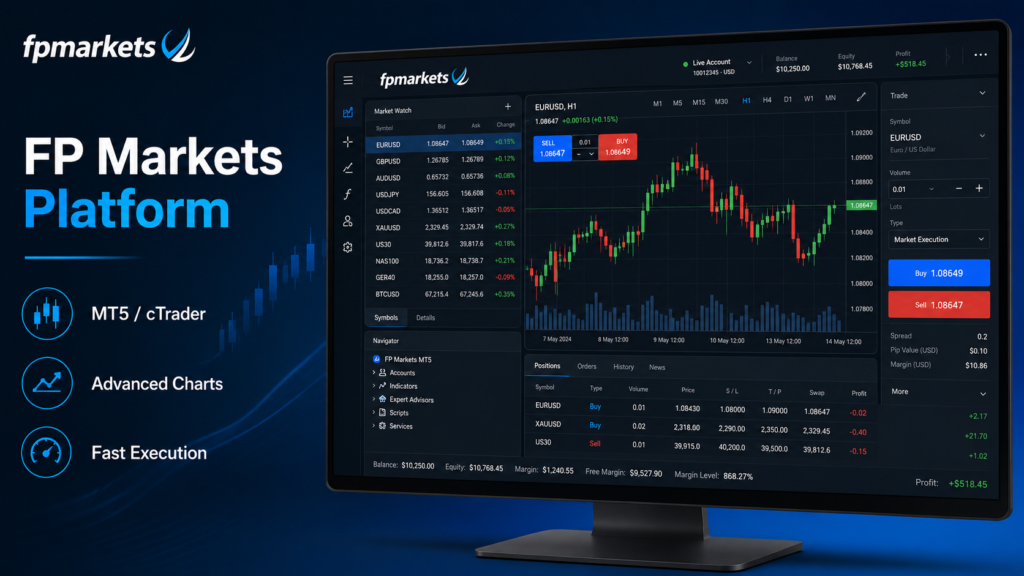
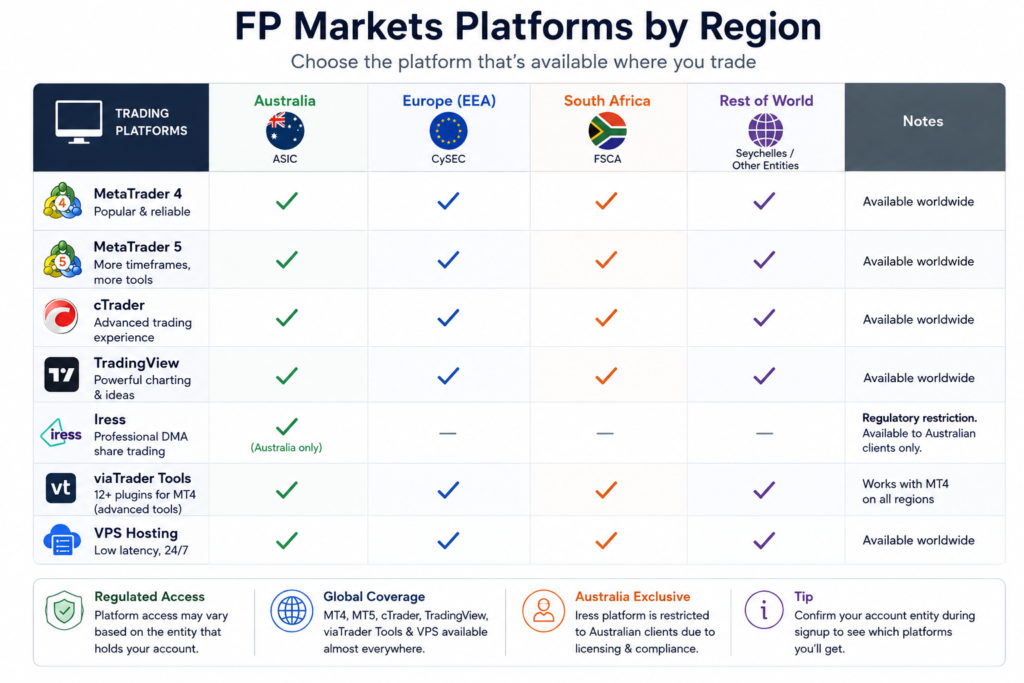
FP Markets supports MetaTrader 4, MetaTrader 5, cTrader, TradingView, and the Iress platform, alongside its own VPS hosting and a 12-plugin MT4 toolkit branded viaTrader Tools that adds features like correlation analysis and advanced order management. This is one of the broader platform lineups among ECN-focused brokers, giving traders genuine choice between MetaTrader’s algorithmic-trading strength, cTrader’s more modern interface, and TradingView’s charting depth.
Why Is the Iress Platform Only Available in Australia?
Iress is a specialized platform built primarily around direct market access (DMA) share trading, and FP Markets restricts its availability specifically to Australian clients. This is a regulatory and licensing reality rather than an oversight — Iress access for direct share dealing ties into Australian market infrastructure and compliance requirements that don’t extend cleanly to FP Markets’ other regulated entities. If you’re outside Australia and specifically interested in Iress-style DMA share trading, FP Markets’ standard MT4/MT5/cTrader offering won’t replicate that experience, and it’s worth setting that expectation before assuming the full platform suite advertised applies equally everywhere.
Is FP Markets Good for Scalping and Algorithmic Trading?
Independent latency testing has recorded average execution speeds around 28 milliseconds for FP Markets, placing it in the upper tier for high-frequency and algorithmic strategies. Combined with the Raw account’s tight spreads, free VPS hosting options, and an NDD (No Dealing Desk) execution model that removes the broker’s incentive to interfere with profitable strategies, FP Markets is a genuinely strong fit for scalpers and EA traders who prioritize execution speed and cost efficiency over platform simplicity. The 12-plugin MT4 toolkit and Myfxbook integration add further value specifically for this segment, supporting both manual high-frequency strategies and automated systems running continuously.
Is FP Markets Good for Beginners?
The $100 minimum deposit, free demo account, and genuinely useful educational resources make FP Markets accessible to newer traders, and live chat support has been described as responsive and helpful in independent testing. That said, the sheer number of platform choices and account types can feel like more decision-making overhead than a beginner strictly needs compared to simpler, app-first competitors — there’s no single proprietary app that streamlines the experience the way some beginner-focused brokers offer. A new trader who’s comfortable spending a little time choosing between MT4, MT5, and cTrader will do fine here; someone who wants the absolute simplest possible onboarding might find a more streamlined alternative less overwhelming initially.
How Does FP Markets Compare to IC Markets and Pepperstone?
| Factor | FP Markets | IC Markets | Pepperstone |
|---|---|---|---|
| Tier-1 Regulation | ASIC, CySEC | ASIC, CySEC | ASIC, FCA |
| Raw Spread Commission | $3/side ($6 round-turn) | $3.50/side ($7 round-turn) | $3.50/side ($7 round-turn) |
| Avg. EUR/USD Spread (Raw) | ~0.10–0.14 pips | ~0.0–0.1 pips | ~0.0–0.1 pips |
| Platform Variety | MT4, MT5, cTrader, TradingView, Iress (AU only) | MT4, MT5, cTrader, TradingView | MT4, MT5, cTrader, TradingView |
| Standout Feature | Widest instrument range (10,000+) | Deepest liquidity | Smart Trader Tools add-ons |
FP Markets edges out both competitors slightly on round-turn commission cost, and its 10,000+ instrument range — including a notably wide stock CFD selection — exceeds what either IC Markets or Pepperstone typically offers. IC Markets generally holds a marginal edge on raw liquidity depth for the highest-frequency strategies, while Pepperstone’s third-party add-on ecosystem is somewhat more developed. None of the three is definitively “best” — the right choice depends on whether instrument breadth, marginal commission savings, or add-on tooling matters most for your specific strategy.
Is FP Markets Worth It in 2026? Final Verdict
FP Markets earns its place as a credible, well-regulated choice for active traders: two decades of continuous operation under its full legal name, First Prudential Markets, genuine Tier-1 regulatory coverage through ASIC and CySEC, competitive Raw account pricing that undercuts several direct competitors on commission, and one of the widest instrument ranges in its category. The CySEC fine and recent restructuring are worth knowing about, but neither indicates a broker in distress — both were handled within normal regulatory and corporate channels, with trading operations unaffected.
Where FP Markets asks a little more of you is navigating its multi-entity structure and understanding exactly which regulatory protections apply to your specific account, along with the international withdrawal fee that’s worth checking before you wire funds out. For active traders, scalpers, and algo traders who value tight Raw spreads, fast execution, and platform variety, FP Markets holds up well against the top names in the category — just go in knowing which “FP Markets” entity, legally, is actually holding your money.
Want to see exactly how FP Markets stacks up against the alternatives before you commit? Check our IC markets review for a direct cost comparison, or see our Lowest spread forex brokers reivew before you open your account.
Frequently Asked Questions About FP Markets
Is FP Markets Available in the US?
No. FP Markets is regulated by ASIC and does not hold NFA/CFTC approval, and it is not configured to accept clients from the United States. US-based traders will need to look at NFA-regulated alternatives instead.
Does FP Markets Charge an Inactivity Fee?
No, FP Markets does not charge an inactivity fee on standard trading accounts. The one exception is the Iress platform specifically, which carries a monthly fee unless you meet a minimum commission or balance threshold.
Does FP Markets Offer Copy Trading?
Yes. FP Markets launched its own social and copy trading features, alongside support for MAM/PAMM account structures and third-party tools like Myfxbook, giving traders multiple ways to follow or replicate other strategies.
Is FP Markets Good for Islamic Accounts?
Yes, FP Markets offers swap-free Islamic accounts that comply with Sharia principles, charging no interest on positions held overnight, available across its supported MetaTrader platforms.
How Long Has FP Markets Been in Business?
FP Markets, legally First Prudential Markets, was founded in 2005 in Sydney, Australia, making it one of the more established brokers in the industry with two full decades of continuous operation as of 2026.
Risk Disclosure: CFDs are complex instruments and come with a high risk of losing money rapidly due to leverage. The majority of retail investor accounts lose money when trading CFDs with this provider. This article is for informational purposes only and does not constitute financial advice. Always verify a broker’s current regulatory status and the specific entity applicable to your country before depositing funds.
Methodology: This review is based on publicly available regulatory filings, independently published fee and spread data current as of 2026, verified company history and recent corporate news, and aggregated testing data from independent broker-comparison platforms cited throughout.